

On this page
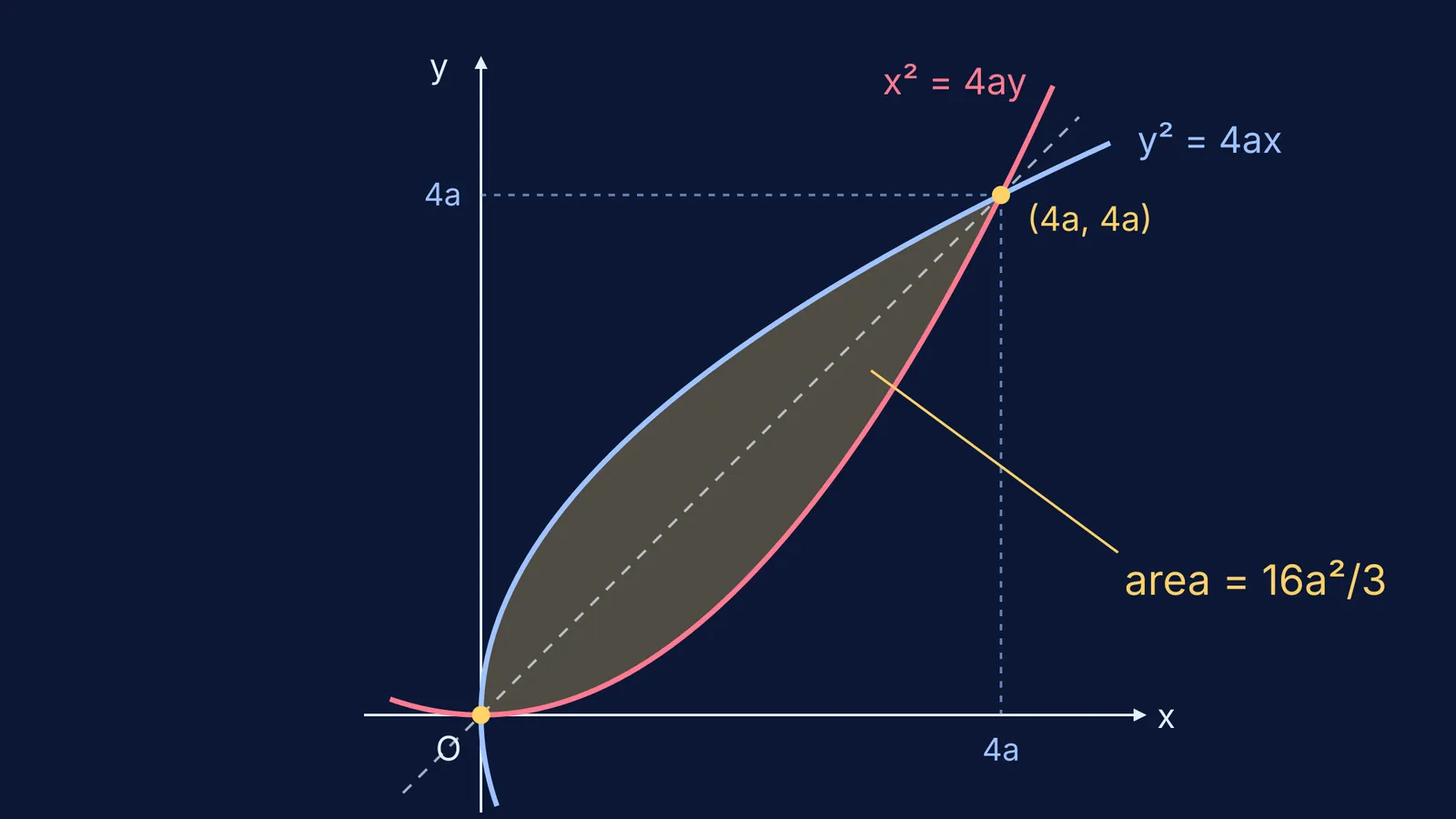
Take two parabolas, y² = 4ax opening to the right and x² = 4ay opening upwards, with a > 0. They cross twice and trap a leaf-shaped region between them. Its area, 16a²/3, is a classic area-between-curves exercise for Class 12 and JEE preparation.
Where do y² = 4ax and x² = 4ay intersect?
From x² = 4ay, write y = x²/(4a). Put this into y² = 4ax:
x⁴/(16a²) = 4ax
x⁴ = 64a³x
x(x³ − 64a³) = 0, so x = 0 or x = 4a
Then y = 0 or y = (4a)²/(4a) = 4a. The two points are (0, 0) and (4a, 4a).
Swapping x and y turns y² = 4ax into x² = 4ay, so each curve is the mirror image of the other in the line y = x. Both intersection points sit on that line. For a refresher, see how to identify the direction a parabola opens.
How do you set up the integral for the area?
The NCERT Class 12 chapter on application of integrals builds area from thin vertical strips: a strip of height y and width dx has area dA = y dx, and the total area is the integral of y dx across the region. The chapter works with one curve at a time; between two curves, the strip's height is the top curve minus the bottom curve.
Which curve is on top? Test a point between 0 and 4a, say x = a. On y² = 4ax, y = 2a. On x² = 4ay, y = a/4. So y = 2√a·√x is the upper curve and y = x²/(4a) the lower one.
Area = ∫ from 0 to 4a of [2√a·√x − x²/(4a)] dx
First part: 2√a × (2/3) × (4a)^(3/2) = (4/3)√a × 8a^(3/2) = 32a²/3.
Second part: (4a)³/(12a) = 64a³/(12a) = 16a²/3.
Subtract: 32a²/3 − 16a²/3 = 16a²/3 square units.
Subtract the other way round and you get −16a²/3; why a definite integral can be negative but area can't explains the fix.
Is there a quick symmetry check for 16a²/3?
Yes. Draw the square with corners (0, 0), (4a, 0), (4a, 4a) and (0, 4a). Its area is 16a². The two parabolas cut it into three pieces:
Below x² = 4ay, down to the x-axis: 16a²/3 (this is step 2 above).
Left of y² = 4ax, across to the y-axis: also 16a²/3, because it is the mirror image of the first piece in y = x.
The region between the curves: 16a² − 16a²/3 − 16a²/3 = 16a²/3.
The square splits into three equal thirds.
A second check uses Archimedes. The line y = x cuts the region into two mirror-image halves. Each half is a segment of the parabola y² = 4ax cut off by the chord from (0, 0) to (4a, 4a). Archimedes showed that the area of such a parabolic segment is 4/3 of its inscribed triangle, whose third vertex is the point where the tangent is parallel to the chord. For y² = 4ax the slope is 2a/y, which equals 1 at (a, 2a). The triangle with corners (0, 0), (4a, 4a) and (a, 2a) has area 2a², so each half is (4/3) × 2a² = 8a²/3, and the whole region is 16a²/3. Same answer, with no integral at all.
What changes if the question changes?
Horizontal strips: integrate [2√a·√y − y²/(4a)] dy from 0 to 4a. By symmetry it is the same integral, so again 16a²/3.
Different constants: for y² = 4ax and x² = 4by, the curves meet at x = 4a^(1/3)b^(2/3), and the same steps give 16ab/3. Put b = a and you are back to 16a²/3.
One curve and a line: NCERT Exercise 8.1, question 4 in the same chapter, asks for the area bounded by y² = 4x, the y-axis and y = 3; horizontal strips give 9/4.
How should you practise area-between-curves questions?
Run this checklist on every question:
Sketch both curves roughly and mark where they cross.
Solve for the intersection points; they become your limits.
Test one x-value between the limits to find which curve is on top.
Choose vertical or horizontal strips, whichever gives one integral instead of two.
Check the answer against a simple shape: a bounding square, a triangle, or a symmetry like the one above.
If you keep putting the wrong curve on top, try the Fermi Problem Library, where a step-by-step solver explains the reasoning rather than printing an answer. If the strip idea itself feels shaky, the Fermi Concept Library gives each mathematics concept its own lesson.


