

On this page
An Olympic archer draws, holds and lets go, and a moment later the arrow lands in the small 10-ring at the centre of the target. Three pieces of Class 11 physics make that happen: elastic potential energy, projectile motion and the vibration of a flexible rod.
Recurve archers shoot over a distance of 70 metres at a target face 122 cm across, with a 10-ring just 12.2 cm across, according to World Archery's guide to target archery.
How does a bow store energy?
When you draw a bow, its limbs bend and store your work as elastic potential energy, like a stretched spring. The stored energy equals the area under the graph of draw force against draw distance.
If the force rose in a straight line from zero to a peak force F over a distance d, that area is a triangle, so the stored energy is ½Fd. It is the same sum as the work done stretching a spring between two extensions; a real recurve's curve is not perfectly straight, so treat it as an estimate.
Here is a worked example, from draw to arrow speed:
Suppose the pull rises steadily to 180 N (roughly the weight of an 18 kg bag) over a 0.5 m power stroke.
Stored energy = ½ × 180 × 0.5 = 45 J.
If every joule went into a 20 g (0.020 kg) arrow: ½ × 0.020 × v² = 45, so v = √4500 ≈ 67 m/s.
Real arrows leave slower, because the limbs and string move too. We use a round 60 m/s below.
How far does an arrow drop over 70 m?
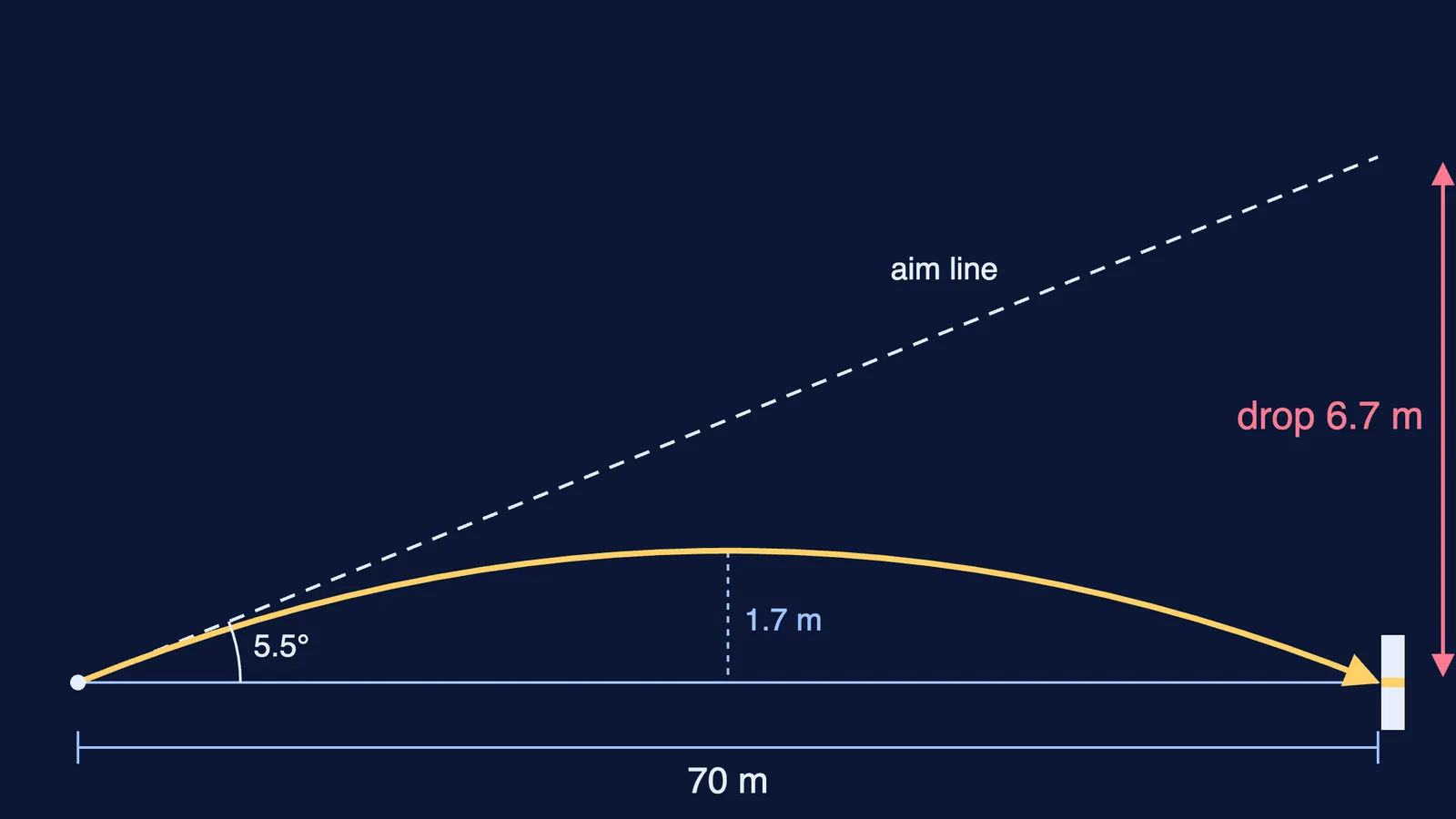
Once the arrow leaves the string, gravity pulls it down the whole way. Ignoring drag, the horizontal speed stays constant while the vertical speed changes at g = 9.81 m/s². Take the 70 m distance from World Archery and our 60 m/s launch speed.
If you pointed the arrow dead level, the flight time would be 70 ÷ 60 ≈ 1.17 s.
The drop in that time is ½ × 9.81 × 1.17² ≈ 6.7 m, more than five target faces stacked up.
So the archer aims upwards. The range formula R = v² sin 2θ ÷ g gives sin 2θ = 9.81 × 70 ÷ 60² ≈ 0.19, so θ ≈ 5.5°. The arrow rises about 1.7 m above the line of sight at the halfway mark, then falls onto the gold. At the target, the line the arrow first pointed along is 6.7 m above the centre: that gap is the drop.
Air drag, the same force behind why tennis balls are fuzzy, slows the arrow, so the real flight is a little longer and the drop a little larger.
What is the archer's paradox?
An arrow rests beside the bow's handle, not through its middle, so at full draw it appears to point slightly to one side of the target. Yet it flies straight to the gold. That puzzle is called the archer's paradox.
The answer is that the arrow bends. An arrow leaving a recurve bow flexes sideways, which lets its rear clear the bow, and the flex comes from the way the string leaves the archer's fingers, according to James Park's 2013 study of arrow behaviour. In simple terms, the string slides sideways off the fingers and nudges the arrow's tail, so the arrow snakes around the handle.
This flex during the power stroke happens too fast to follow by eye, so Park and Oliver Logan used high-speed video to measure its timing and size for sixteen world-class archers (Park and Logan, 2013). They concluded that differences in technique between archers could be a significant source of error when a single archer is used to test the mathematical models.
That is why archers match an arrow's stiffness, called its spine, to their bow.
The Fermi Simulation Lab has interactive simulations for ideas that are easier to see than read.
How do you solve an archery physics problem?
A checklist for any bow-and-arrow question, from school tests to JEE Main practice:
Energy: find the area under the force-draw graph (½Fd for a straight-line graph).
Speed: set ½mv² equal to the energy that reaches the arrow, and say what share you assumed.
Time of flight: t = horizontal distance ÷ (v cos θ).
Drop: ½gt² below the line the arrow first points along.
Angle to hit a level target: sin 2θ = gR ÷ v².
Sanity check: units in joules, metres and seconds, and the square law for drop.
Try one yourself: what speed would a 25 g arrow get from the same 45 J bow if every joule reached it? (Answer: 60 m/s, the speed we used above.)
Not sure where to start? Fermi's AI tutor can work out what you already know and build a plan for the session, so you sit down to a clear next step.


