

On this page
On a giant wheel at a mela, the seat seems to drop away from you at the top and press into you at the bottom. Your mass has not changed, and neither has gravity. What changes is how hard the seat pushes on you, and that push is what you feel as weight.
Why do you feel lighter at the top of a giant wheel?
You never feel gravity directly. You feel the floor, the chair or the seat pushing back on you. In physics that push is the normal force N, and it is what a weighing scale reads. The OpenStax textbook shows this with a bathroom scale in a lift: the scale reads more than your weight while the lift accelerates upward, and zero if the lift is in free fall (OpenStax University Physics, section 6.1). We call that reading your apparent weight.
On a giant wheel you keep changing direction. Any body moving in a circle of radius r at speed v has a centripetal acceleration a = v²/r, pointing towards the centre (OpenStax University Physics, section 6.3). The net force that causes it is the centripetal force, F = mv²/r, from the same section.
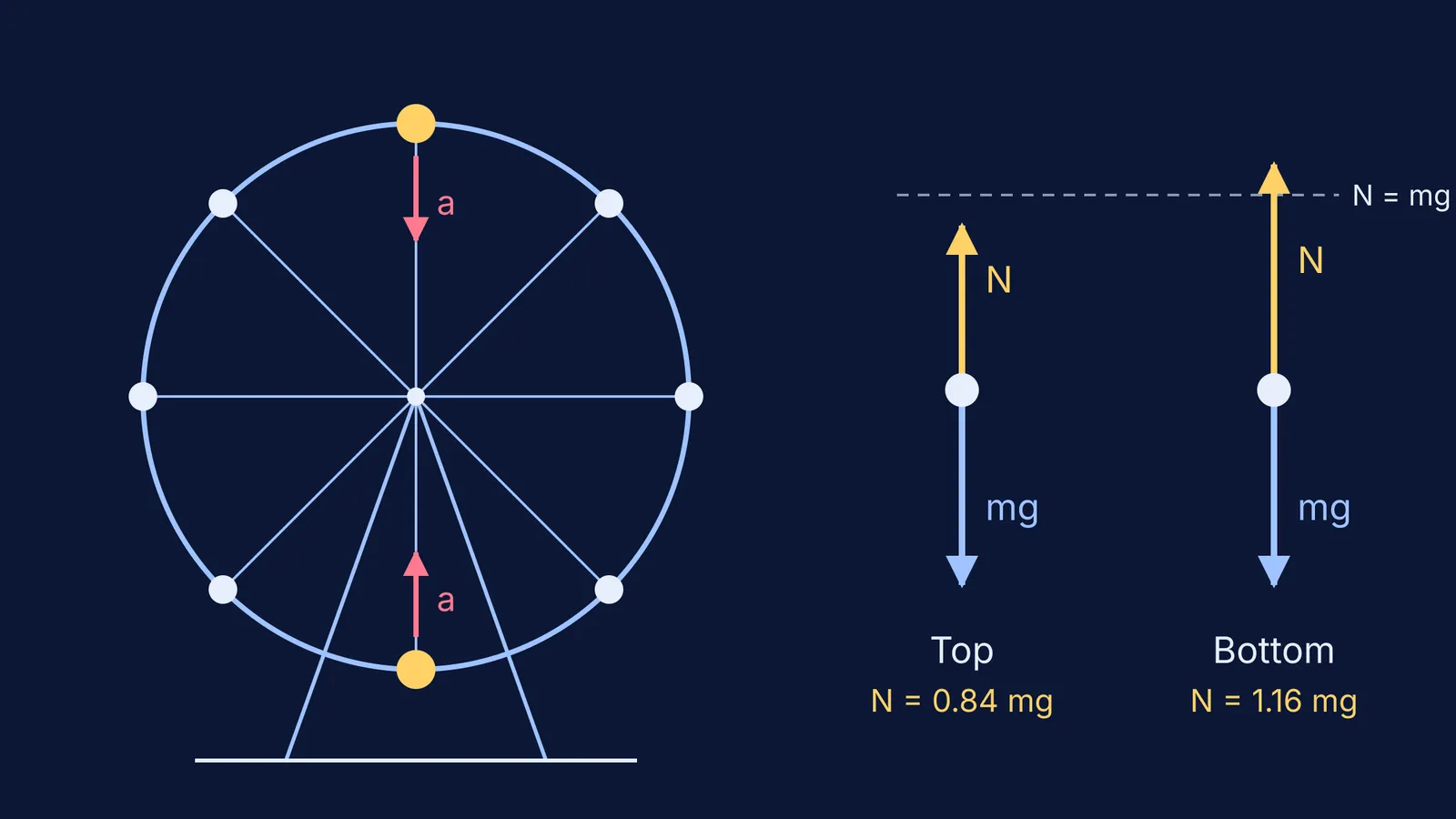
At the top of the wheel, the centre is below you, so the net force must point down. Gravity already pulls down, so the seat does not need to push up as hard as it does when you sit still. Less push means you feel lighter. At the bottom, the centre is above you, so the seat must hold you up and supply the extra upward force too. You feel heavier.
What are the formulas for apparent weight at the top and bottom?
Take the direction towards the centre as positive and apply Newton's second law, net force = mv²/r.
At the top: mg − N = mv²/r, so N = mg − mv²/r.
At the bottom: N − mg = mv²/r, so N = mg + mv²/r.
So the bottom seat pushes 2mv²/r harder than the top seat. And if the wheel turned fast enough that v² = gr, the top-seat force would be zero and you would feel weightless for an instant, just like the falling lift.
Worked example: a 50 kg rider on a 20 m wide giant wheel
Take an imaginary fairground wheel. Radius r = 10 m, one full turn every 16 s, rider mass m = 50 kg, g = 9.8 m/s².
Speed: v = 2πr/T = (2 × 3.14 × 10)/16 ≈ 3.93 m/s.
Centripetal acceleration: v²/r ≈ 15.4/10 ≈ 1.54 m/s².
Centripetal force: mv²/r ≈ 50 × 1.54 ≈ 77 N.
True weight: mg = 50 × 9.8 = 490 N.
Top: N = 490 − 77 ≈ 413 N, about 0.84 mg. A bathroom scale on the seat would read about 42 kg.
Bottom: N = 490 + 77 ≈ 567 N, about 1.16 mg. The scale would read about 58 kg.
Now push it further. For N = 0 at the top you need v = √(gr) = √98 ≈ 9.9 m/s, which means one turn every 2πr/v ≈ 6.3 s. That is a thrill ride, not a giant wheel. Our post on the minimum height for a loop-the-loop builds on the same condition.
If you want to rework this with your own numbers and check each step, the Fermi Problem Library has worked problems with a step-by-step solver that explains the reasoning rather than printing an answer.
Why don't you feel this on the London Eye?
Because v²/r is tiny there. The London Eye is 120 m across and moves at about 26 cm per second, taking about 30 minutes per turn (Wikipedia, London Eye). With r = 60 m, v²/r = (0.26)²/60 ≈ 0.0011 m/s², roughly one ten-thousandth of g. That is far too small to notice. The light feeling needs speed, and it grows with v², so doubling the speed makes it four times stronger.
Which mistakes cost marks in these questions?
Writing N = mg everywhere. On a level seat or floor, the normal force equals mg only when there is no vertical acceleration. Our post on when normal reaction is not equal to mg lists the common cases.
Adding a separate "centripetal force" arrow to the free-body diagram. Only gravity and the seat act on you. mv²/r is their sum, not a third force.
Getting the sign wrong. Always take "towards the centre" as positive, then decide whether N points towards or away from it.
Treating the wheel as new physics. It is the lift again: the scale reads mg plus or minus ma. Our post on how a weighing scale reading changes in an accelerating lift is a good next read.
If the idea of centripetal force itself still feels shaky, the Fermi Concept Library gives each concept in physics its own lesson and shows where it sits in the map.


