

On this page
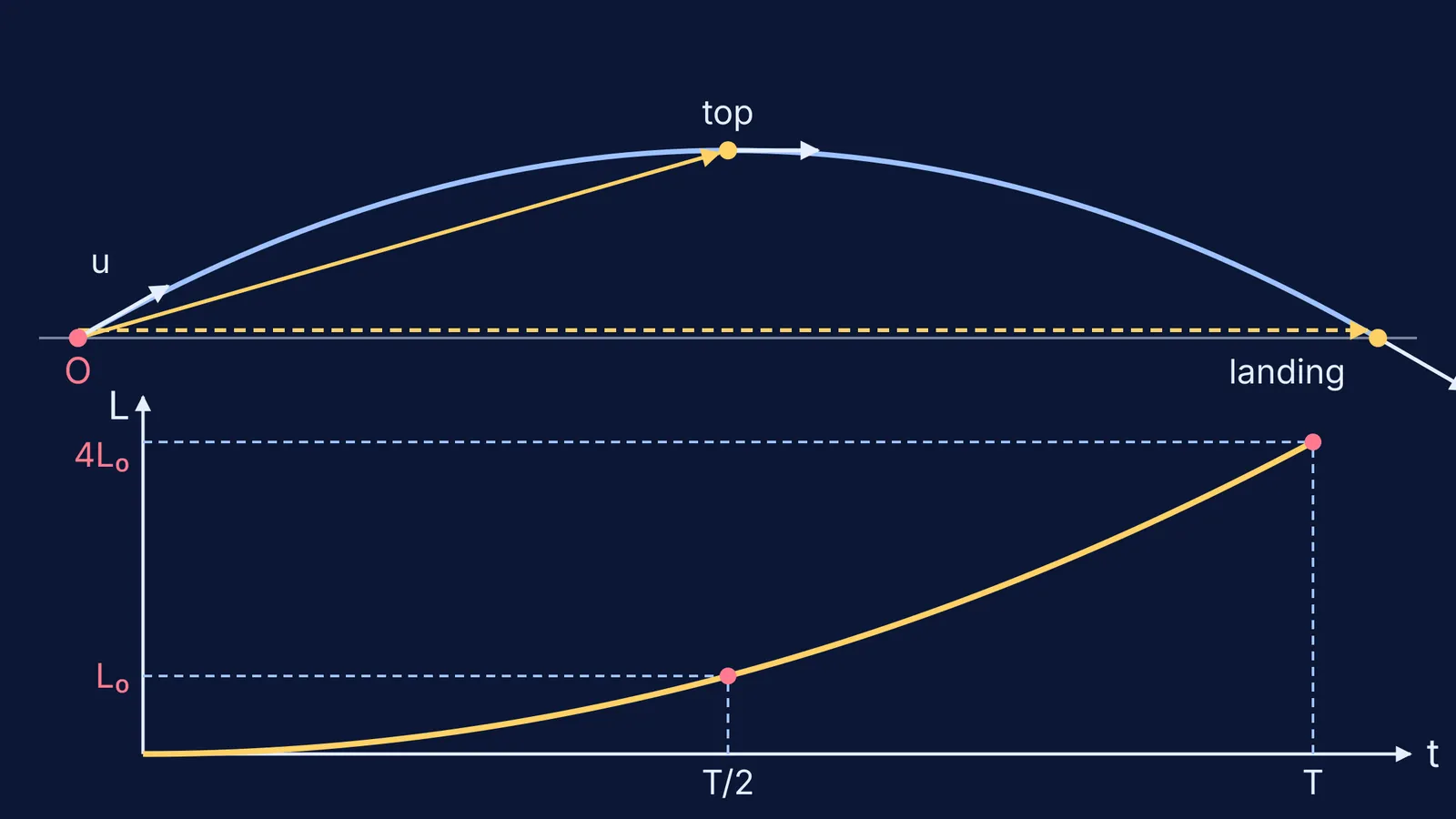
You throw a ball from point O at speed u and angle θ. About O, its angular momentum starts at zero and keeps growing until it lands. Here is the derivation, the values at the top and at landing, and a worked example.
What is the angular momentum of a projectile about the point of projection?
The angular momentum of a particle about a point is L = r × p, where r is the position vector from that point and p = mv is the linear momentum (OpenStax University Physics, section 11.2).
Put the origin at the launch point O, with x horizontal and y upward. With air resistance neglected, the horizontal velocity stays u cos θ and the vertical acceleration is −g (OpenStax University Physics, section 4.3). So at time t:
x = u cos θ · t and y = u sin θ · t − ½gt²
vx = u cos θ and vy = u sin θ − gt
The motion stays in one plane, so only the component perpendicular to that plane survives: Lz = m(x·vy − y·vx). Substitute:
Lz = m[u cos θ · t (u sin θ − gt) − u cos θ (u sin θ · t − ½gt²)]
The u² sin θ cos θ · t terms cancel, leaving Lz = −½ m g u cos θ · t². The magnitude is L = m u cos θ × (gt²/2). The minus sign means that for a ball thrown left to right the vector points into the page, the clockwise sense.
Read it this way: m u cos θ is the unchanging horizontal momentum, and gt²/2 is the height at which the ball's line of motion, extended backwards, crosses the vertical line through O. That height is the lever arm for the horizontal momentum.
Why does the angular momentum keep growing?
The rate of change of angular momentum equals the net torque, dL/dt = τ (OpenStax, section 11.2). The only force is the weight mg, acting straight down. Its lever arm about O is the horizontal distance x = u cos θ · t, so the torque is τ = m g u cos θ · t, and it grows steadily as the ball moves away.
Integrate that torque from 0 to t and you get ½ m g u cos θ · t², the same answer.
What is the angular momentum at the highest point and at landing?
The time of flight on level ground is T = 2u sin θ / g, and the maximum height is H = (u sin θ)² / 2g (OpenStax, section 4.3). The ball reaches the top at t = T/2 = u sin θ / g.
At the top: L = m u³ sin²θ cos θ / 2g. Check: the velocity there is horizontal, u cos θ, and its line is a height H above O, so L = m u cos θ × H. Same result.
At landing: L = 2 m u³ sin²θ cos θ / g. Check: the ball is a distance R = u² sin 2θ / g from O along the ground, and its vertical speed is u sin θ, so L = m R u sin θ. Same result.
Landing gives exactly four times the value at the top. That follows from L ∝ t²: the ball takes twice as long to land as to reach the top, and 2² = 4.
Worked example: a 0.5 kg ball at 20 m/s and 30°
Take m = 0.5 kg, u = 20 m/s, θ = 30° and g = 10 m/s² to keep the arithmetic easy. OpenStax uses 9.8 m/s² (section 4.3).
Components: u cos θ = 17.32 m/s and u sin θ = 10 m/s.
Times: the ball reaches the top at t = 1 s and lands at T = 2 s.
Formula: L = ½ × 0.5 × 10 × 17.32 × t² = 43.3 t² kg m²/s.
At the top: L = 43.3 kg m²/s. Check: H = 5 m, and 0.5 × 17.32 × 5 = 43.3.
At landing: L = 173.2 kg m²/s. Check: R = 34.64 m, and 0.5 × 34.64 × 10 = 173.2.
An extension: for a fixed launch speed, the landing value depends on sin²θ cos θ. Setting its derivative 2 sin θ cos²θ − sin³θ to zero gives tan θ = √2, so landing angular momentum is largest at about 54.7°, not the 45° that maximises range.
If you want more problems like this, the Fermi Problem Library has worked problems with a step-by-step solver that explains the reasoning rather than printing an answer.
Which mistakes cost marks on this question?
Using the launch velocity alone. At t = 0, r = 0, so L = 0.
Assuming L is conserved. Gravity exerts a torque about O.
Using R instead of H at the top. There, the lever arm is the height H.
Dropping the direction: perpendicular to the plane, into the page for a left-to-right throw.
For the linear version of this question, see change in momentum of a projectile during flight. For the wider topic, read five common rotational motion mistakes in JEE and how to choose the point for taking torques.
If L = r × p still feels abstract, the Fermi Concept Library gives each physics concept its own lesson and shows where it fits in the map, so you can revise angular momentum before trying the next problem.


