

On this page
When studying kinematics, one of the most common stumbling blocks is tracking how vector quantities shift during flight. While the speed and velocity of a projectile change continuously, its momentum changes in a very specific, predictable way.
Understanding this pattern is a frequent requirement in JEE Main, NEET-UG, and board exams. Below, we break down why only one component of momentum changes and how to calculate the exact difference for any part of the journey.
Why does only the vertical momentum change?
Momentum (p) is the product of mass (m) and velocity (v). Because velocity is a vector, momentum is also a vector, meaning it has both magnitude and direction. To find the change in momentum (Δp), you must use vector subtraction: Δp = p_f − p_i, where p_f is the final momentum and p_i is the initial momentum.
According to HyperPhysics, the impulse-momentum theorem states that the change in momentum of an object is equal to the impulse (J) applied to it, which is the average net force multiplied by the time interval (J = F_avg × Δt).
For a projectile in free fall (ignoring air resistance), the only force acting on the mass is gravity.
Horizontal direction: There is no horizontal force. Therefore, the horizontal impulse is zero, and the horizontal component of momentum remains constant throughout the flight.
Vertical direction: Gravity pulls downward with a constant force equal to mg. This force provides a continuous downward impulse, which steadily changes the vertical momentum over time.
If you find it hard to picture the separation of horizontal and vertical vectors in your head, Fermi Simulation Lab offers interactive simulations for the ideas that are easier to see than to read.
What is the change in momentum at any given time?
To see how this continuous impulse works in practice, we can express the momentum vector at any arbitrary time t. Suppose a projectile of mass m is launched with an initial velocity u at an angle θ above the horizontal.
The initial momentum is p_i = m(u cos θ) î + m(u sin θ) ĵ.
At a later time t, the horizontal velocity is unchanged (u cos θ), while the vertical velocity has decreased due to gravity (u sin θ − gt).
The new momentum is p(t) = m(u cos θ) î + m(u sin θ − gt) ĵ.
Subtracting p_i from p(t) gives the change in momentum over time t:
Δp = −mgt ĵ.
This simple formula proves that the change in momentum is always directed straight down and grows linearly with time, perfectly matching the impulse provided by gravity (F × t = −mg × t ĵ).
What is the change in momentum to the highest point?
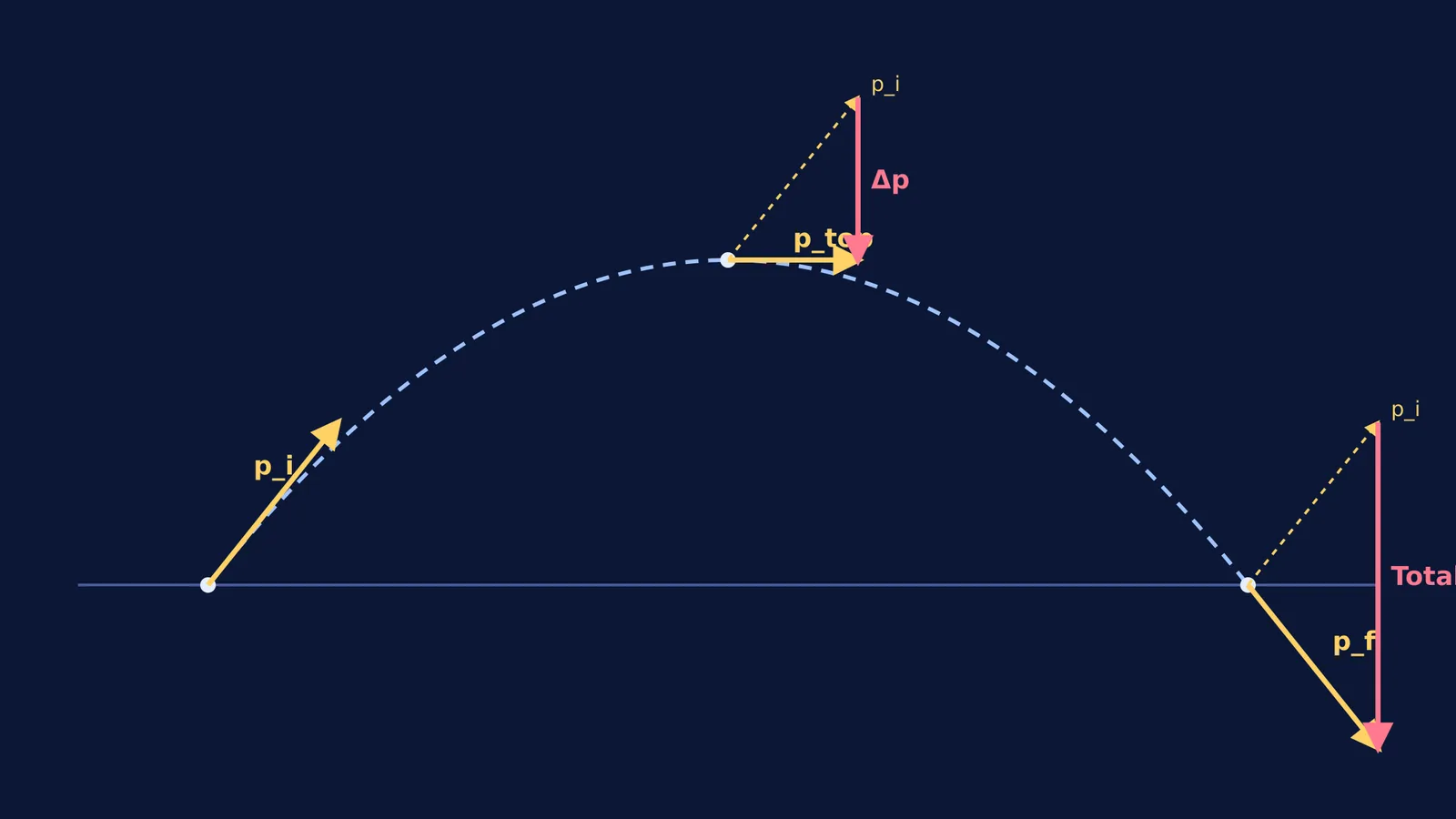
Let's apply this to the first half of the flight. At the highest point, the projectile momentarily stops rising. Its vertical velocity drops to zero, but its horizontal velocity remains unchanged.
Momentum at the peak (p_top):
p_top = m(u cos θ) î + 0 ĵ
Change in momentum (Δp):
Subtract the initial momentum from the peak momentum: Δp = p_top − p_i Δp = [m(u cos θ) − m(u cos θ)] î + [0 − m(u sin θ)] ĵ Δp = −mu sin θ ĵ
The change in momentum from launch to the peak has a magnitude of mu sin θ and is directed vertically downward. The time to reach the maximum height is t = (u sin θ) / g. Plugging this into our general formula from earlier (−mgt ĵ) yields the exact same result: −mg[(u sin θ)/g] ĵ = −mu sin θ ĵ.
How do you calculate the change in momentum for the full flight?
Now, consider the complete trajectory from the launch point to the moment it strikes the ground at the same horizontal level.
Final momentum (p_f):
When the projectile returns to its original height, its horizontal velocity is still u cos θ. Due to symmetry, its vertical velocity has the same magnitude as launch but is now directed downward, so it is −u sin θ. p_f = m(u cos θ) î − m(u sin θ) ĵ
Change in momentum (Δp):
Subtract the initial momentum from the final momentum: Δp = p_f − p_i Δp = [m(u cos θ) − m(u cos θ)] î + [−m(u sin θ) − m(u sin θ)] ĵ Δp = −2mu sin θ ĵ
For the full flight, the horizontal components cancel out completely. The total change in momentum has a magnitude of 2mu sin θ and points strictly downward.
What are the most common mistakes?
When solving momentum problems, avoid these frequent traps:
Forgetting that momentum is a vector: Students often try to subtract the magnitudes of the initial and final velocities. Since the speed at launch and landing is identical, calculating m(u) − m(u) leads to a false answer of zero. You must subtract the vectors, not just the speeds.
Applying gravity to the horizontal axis: Do not subtract the time of flight from the horizontal velocity. The horizontal velocity is entirely independent of the vertical pull of gravity.
Mixing up speed and velocity at the peak: The projectile does not stop at the highest point; it only stops moving vertically. The horizontal momentum m(u cos θ) is still present.
It is easy to accidentally add magnitudes instead of subtracting vectors. If you drop a sign during vector subtraction, the Fermi Problem Library has worked problems with a step-by-step solver that explains the reasoning rather than printing an answer.
Once you are comfortable with how momentum and velocity vectors evolve over time, you can apply these principles to more complex kinematics. For example, knowing the horizontal and vertical velocity components is essential if you need to derive the equation of trajectory of a projectile. Similarly, if you are testing whether two projectiles will collide midair, breaking the motion into independent axes simplifies the relative motion analysis.


