

On this page
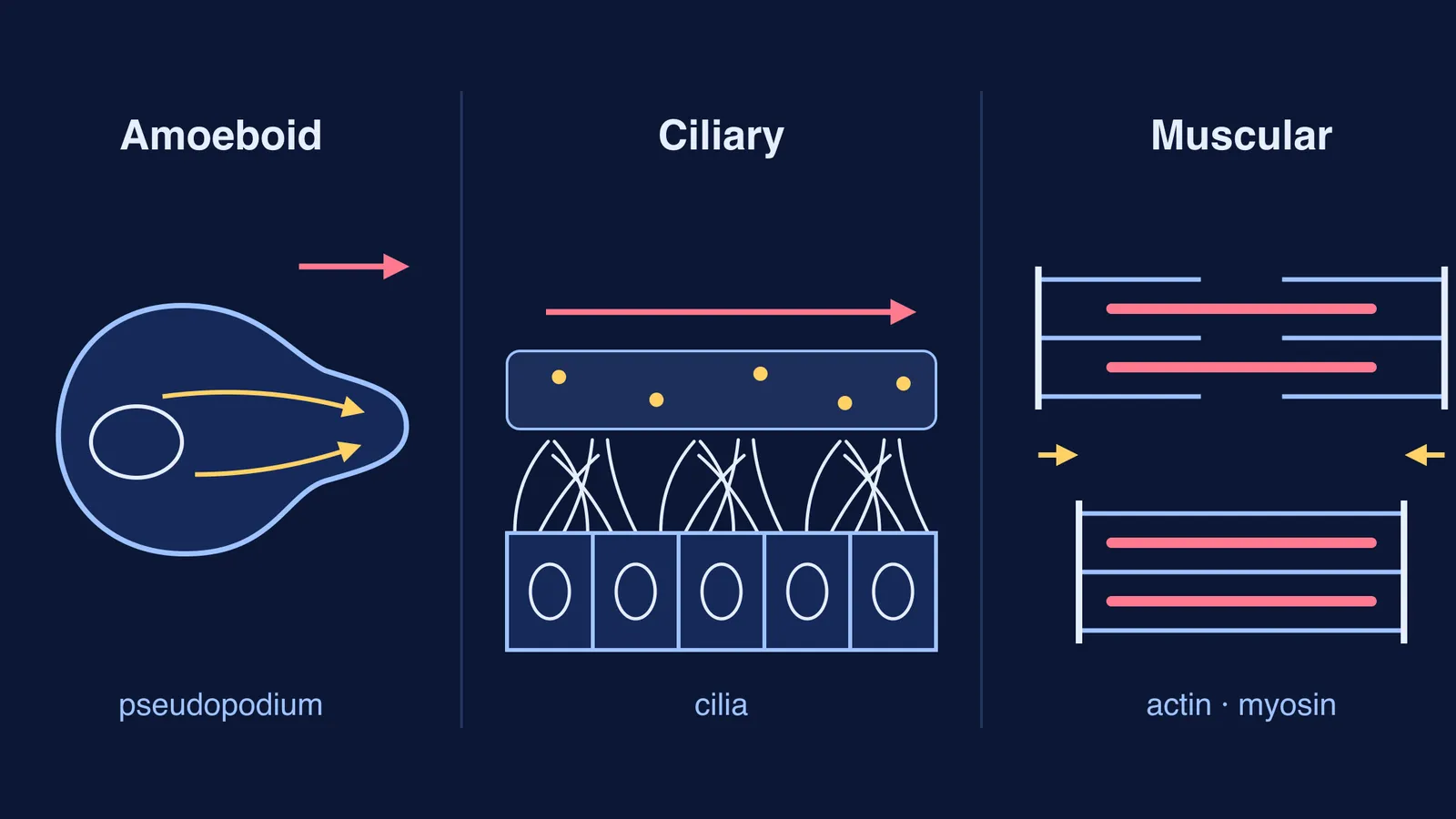
Chapter 17 of NCERT Class 11 Biology, Locomotion and Movement, opens section 17.1 with one line worth learning word for word: cells of the human body exhibit three main types of movements, namely, amoeboid, ciliary and muscular. The definitions are short. The harder part is matching each type to the right human example and the right cell part. This guide does that matching for you, one movement at a time.
Start with the distinction the chapter draws first. Locomotion is voluntary movement that changes place, like walking or swimming. NCERT links the two ideas in one sentence: all locomotions are movements, but all movements are not locomotions. All three types below are movements; only the muscular one moves you across a room.
How does amoeboid movement work in macrophages?
NCERT names macrophages and leucocytes in blood as the specialised human cells that show amoeboid movement. The cell pushes out a temporary bulge called a pseudopodium, formed by the streaming of protoplasm, the same way an Amoeba moves. The textbook adds that cytoskeletal elements like microfilaments are also involved.
So the cell parts to write are: pseudopodia, cytoplasm (protoplasm) streaming, and microfilaments. The NCERT cell chapter defines the cytoskeleton as a network of microtubules, microfilaments and intermediate filaments whose jobs include mechanical support, motility and maintaining cell shape. Motility is the job that matters here.
A macrophage crawls towards a microbe and then engulfs it. That second step is phagocytosis, which is a different syllabus point from movement; this comparison of phagocytosis, pinocytosis and other forms of endocytosis keeps the two apart.
Where does ciliary movement happen in the human body?
NCERT says ciliary movement occurs in most of our internal tubular organs which are lined by ciliated epithelium. It gives two human examples:
Trachea: coordinated beating of cilia removes dust particles and foreign substances inhaled with air.
Female reproductive tract: ciliary movement helps the ova pass along the tract (the fallopian tube, or oviduct).
Research reviews describe the same jobs in more detail. A review in Cold Spring Harbor Perspectives in Biology calls mucociliary clearance the primary innate defense mechanism of the lung, built from a protective mucous layer, an airway surface liquid layer and the cilia themselves. A review in Human Reproduction Update notes that movement of ova and embryos through the fallopian tube comes from muscle contractions, ciliary activity and the flow of tubal secretions working together. For the exam, NCERT's word "facilitated" is the safe one to use.
The cell part here is the cilium. According to the NCERT cell chapter, the core of a cilium, the axoneme, has nine doublets of peripheral microtubules and a central pair, called the 9+2 array, and each cilium grows from a centriole-like basal body. Our explainer on the 9 + 2 axoneme and the basal body walks through the cross-section.
How does muscular movement work?
Movement of limbs, jaws and tongue needs muscular movement, and NCERT notes that about 40-50 per cent of the body weight of a human adult is contributed by muscles. Skeletal (striated, voluntary) muscle does the work of locomotion; visceral and cardiac muscle handle the gut, the reproductive tract and the heart. Our comparison of striated, smooth and cardiac muscle sets the three side by side.
The cell parts are inside the muscle fibre: myofibrils made of thin actin and thick myosin filaments, arranged in sarcomeres between two Z lines, plus the sarcoplasmic reticulum, which stores calcium ions. NCERT's sliding filament theory says contraction happens by the sliding of thin filaments over thick filaments. A signal from a motor neuron triggers the release of calcium ions, myosin heads bind actin using energy from ATP, and the Z lines are pulled inwards. During contraction the I bands shorten while the A bands keep their length.
The sarcomere is the part students find hardest to picture. The Fermi Simulation Lab has interactive simulations for ideas that are easier to see than to read, which suits a mechanism like this one.
A three-line answer you can reuse
For any question on this topic, write the same chain: movement type, human example, cell part.
Amoeboid: macrophages and leucocytes, pseudopodia formed by protoplasm streaming, with microfilaments.
Ciliary: trachea (clears dust) and female reproductive tract (helps move ova), cilia with a 9+2 axoneme and basal body.
Muscular: limbs, jaws, tongue, skeletal muscle fibres with actin and myosin in sarcomeres.
Check yourself before a test with three quick questions:
Can you name a human cell, not Amoeba, for amoeboid movement?
Can you give two ciliary sites and what each one moves?
Can you say which band stays the same length during contraction?
If one answer is shaky, the gap is usually a concept, not a fact. The Fermi Concept Library covers every concept in biology with its own lesson and its place in the map, so you can go back to the cytoskeleton or the sarcomere and see how it connects to this chapter.


