

On this page
Maybe you broke your writing wrist a month before exams. Maybe you play cricket and want a stronger off-side, or you just like the idea of switching hands. You can get much better with your weaker hand. What studies do not show is that practice turns you into someone with two equal hands, or that it makes you smarter.
How common is left-handedness, and what counts as ambidextrous?
A 2020 meta-analysis in Psychological Bulletin puts left-handedness at 10.6% of people, or anywhere from 9.3% to 18.1% depending on how strictly you define it. That spread matters. "Ambidextrous" is not one clear group: many people write with one hand but throw, bat or use scissors with the other. Researchers often call that mixed-handedness, and it is closer to what many people mean by ambidextrous than two equally skilled hands.
The same review argues that cultural factors, such as pressure against using the left hand, change how many left-handers are recorded. If a grandparent ever moved a child's pencil to the "correct" hand, you have seen that pressure up close.
Is handedness decided before birth?
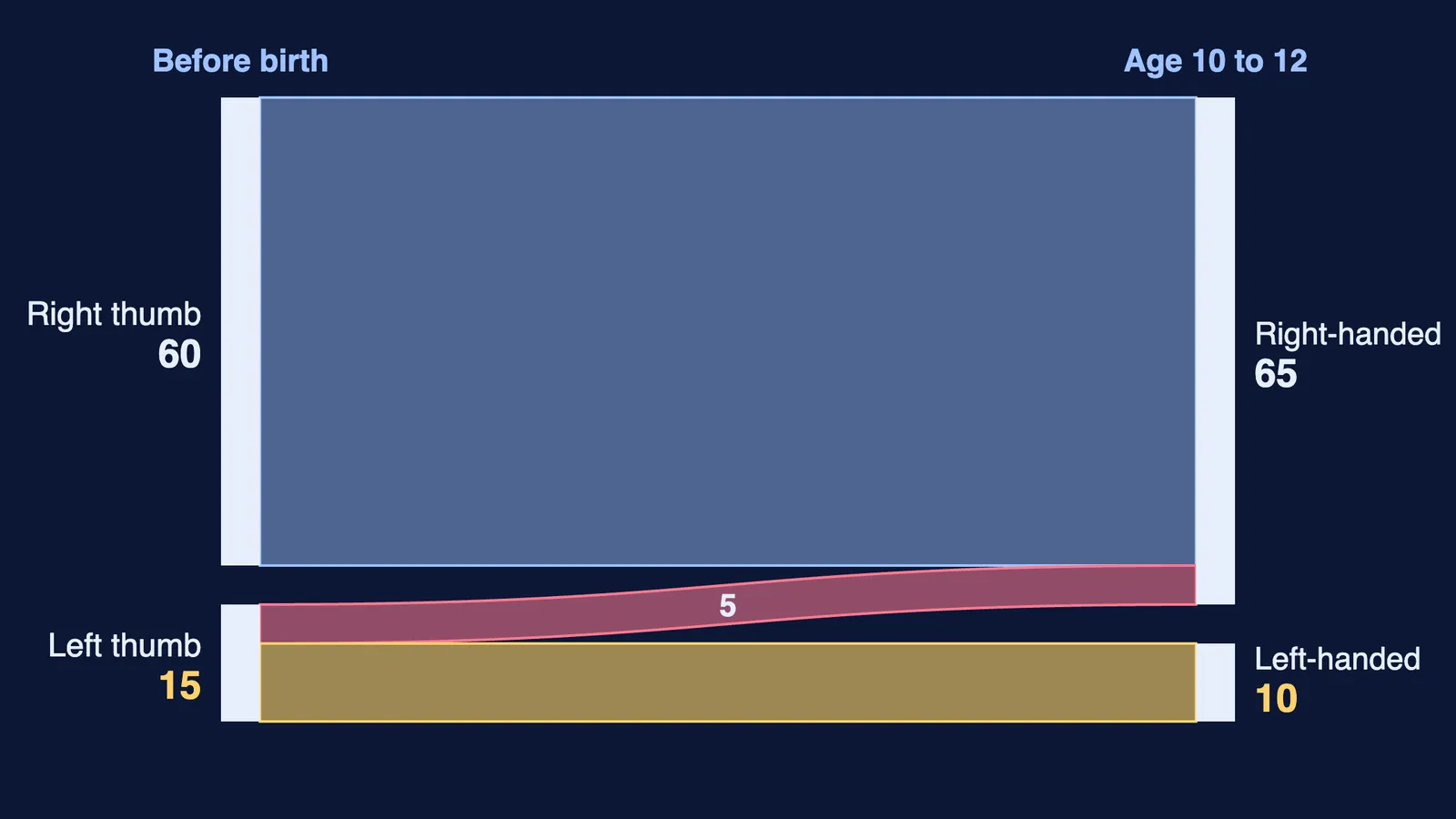
Partly, and earlier than most people think. In a Belfast study, researchers watched 75 fetuses suck their thumbs on ultrasound and checked their handedness at age 10 to 12. All 60 who sucked the right thumb grew up right-handed. Of the 15 who preferred the left thumb, 10 were left-handed and 5 were right-handed.
Genes play a part, but not the whole part. A twin study of 54,270 people in 25,732 Australian and Dutch families found that additive genetic effects explained about a quarter (23.64%) of the differences in handedness. The rest came from environmental influences that each person experiences differently, not from the home that siblings share.
Can you become ambidextrous by practising?
You can become much more skilled with your other hand, and quickly. In a 2016 study, 22 right-handed adults practised a precision drawing task with their left hand for 10 days, under 200 minutes in total. 89% became faster, more accurate and smoother with that hand. Six months later, 71% were still smoother than when they started. Brain scans linked the gains to stronger connections between the hand areas and a network used for skilled hand actions.
Two limits are worth knowing. The smoothness gains were specific to the trained left hand and to a drawing task. And the study measured skill, not which hand people prefer, so it says nothing about switching your dominant hand.
Forcing a switch in childhood leaves traces. Adults who were made to write right-handed as children showed a reversed size pattern in the primary sensorimotor cortex and less grey matter in part of the left putamen, a structure involved in movement, than people who kept their natural hand.
Is being ambidextrous good for your brain or your marks?
The popular claim that using both hands "balances the brain" is not what the evidence shows. An analysis of IQ tests taken by viewers of a television show found that adults who said they write with either hand scored lower than left- or right-handers, especially on arithmetic, memory and reasoning. An earlier British finding pointed the same way, but a German study of younger boys did not repeat it. These are naturally mixed-handed people, not people who trained, and the link is a correlation, not a cause. Either way, there is no case here for training a second hand to raise your marks.
A 10-day plan to train your weaker hand
This borrows the dose from the 2016 left-hand drawing study: short daily sessions for 10 days, under 200 minutes in all. The steps are our suggestions, not the study's programme.
Day 1: write one fixed sentence and draw a circle, a square and a star with your weaker hand. Time it and keep the page.
Days 1 to 10: practise 15 to 20 minutes a day. Trace shapes slowly first, then copy them, then write the same sentence.
Add one everyday task: brushing teeth, stirring, or using a computer mouse with your weaker hand.
Go for smooth before fast. Speed comes after the shapes stop wobbling.
Day 10: repeat the Day 1 page and compare it side by side.
Week 4: test once more to see what stayed.
If you are recovering from an injury, ask your doctor or an occupational therapist before you start, and plan for writing exams with your usual hand once it heals. Our guide on writing faster and neater for board exams is for the exam itself, and the three-week typing speed plan is another step-by-step plan for a hand skill.
Curious about what the putamen and motor cortex actually do? The Fermi Concept Library has a lesson on every concept in biology, each with its place in the map. For how sleep and memory work together, read does sleep help you remember what you studied.


