On this page
Studying animals and ecosystems draws many students to the life sciences. According to the All India Survey on Higher Education (AISHE) 2021-2022 report, over 56 lakh Indian students enrol in a B.Sc. programme each year, with women making up more than 50.8% of the cohort. But what comes after you finish studying chordates and cell biology? A Bachelor of Science in Zoology is a foundational degree that opens up diverse paths—from laboratory research to fieldwork in dense forests.
What are the core career options after a BSc in Zoology?
A zoology degree is highly academic, meaning the most specialised roles often require further study. However, your BSc is the essential first step to three main sectors.
The first is government research and taxonomy. The Zoological Survey of India (ZSI), for example, sets a B.Sc. in Zoology as the minimum requirement for Scientific Assistant positions, which involve field collections and specimen preservation for candidates aged 18 to 30. Higher-level roles, such as Assistant Zoologist, require a master's degree and prior research experience.
The second area is wildlife conservation. Institutions like the Wildlife Institute of India (WII) run ecology projects across the country. They frequently hire project assistants with zoology backgrounds to survey habitats, track animal populations, and support large-scale conservation efforts.
The third is teaching and education. If you want to teach at the school level, you will need a B.Ed. degree alongside your science qualifications. If you are aiming for a university lectureship, you must clear the CSIR-UGC NET after your postgraduation. Deciding whether to pivot immediately to work or continue studying is a common dilemma, much like deciding Should you do an MSc or a job after a BSc?
Do you need an MSc to build a career in zoology?
While you can find entry-level laboratory technician or medical coding roles straight after graduation, a Master of Science (MSc) is almost always needed for long-term career progression in the life sciences.
An MSc in Zoology, Biotechnology, or Environmental Science qualifies you for Junior Research Fellow (JRF) exams and advanced project associate roles. For instance, if you want to understand the mechanisms of adaptation or why the tropics have more biodiversity, researching these questions professionally requires postgraduate training and rigorous funding applications.
When you are preparing for postgraduate entrance exams like CUET-PG or IIT JAM, you need a strong grip on fundamental biology, chemistry and physics. The Fermi Concept Library holds every concept with its own lesson and its place in the map, helping you fill gaps from your undergraduate years.
How can you widen your career options beyond the lab?
Modern biology relies heavily on technology and data. You can significantly improve your employability by adding specific technical skills to your zoology background before you graduate.
Learn data analysis: Ecology and genetics generate huge amounts of data. Learning programming languages like R or Python, or studying bioinformatics, allows you to analyse this data yourself rather than passing it to a computer scientist.
Learn GIS (Geographic Information Systems): Wildlife biologists use GIS software to map habitats and track animal movements. Knowing how to use these mapping tools makes your resume stand out for conservation jobs.
Look off campus: Government jobs are highly competitive, but private environmental consultancies, pharmaceutical companies, and conservation NGOs also hire zoology graduates. You can expand your search by learning how to get a job off campus as a fresher.
If you struggle with the mathematical and statistical models used in modern genetics and ecology, Fermi's AI tutor teaches through the problem—drawing the figure and checking your understanding as it goes.
How do you choose your next step?
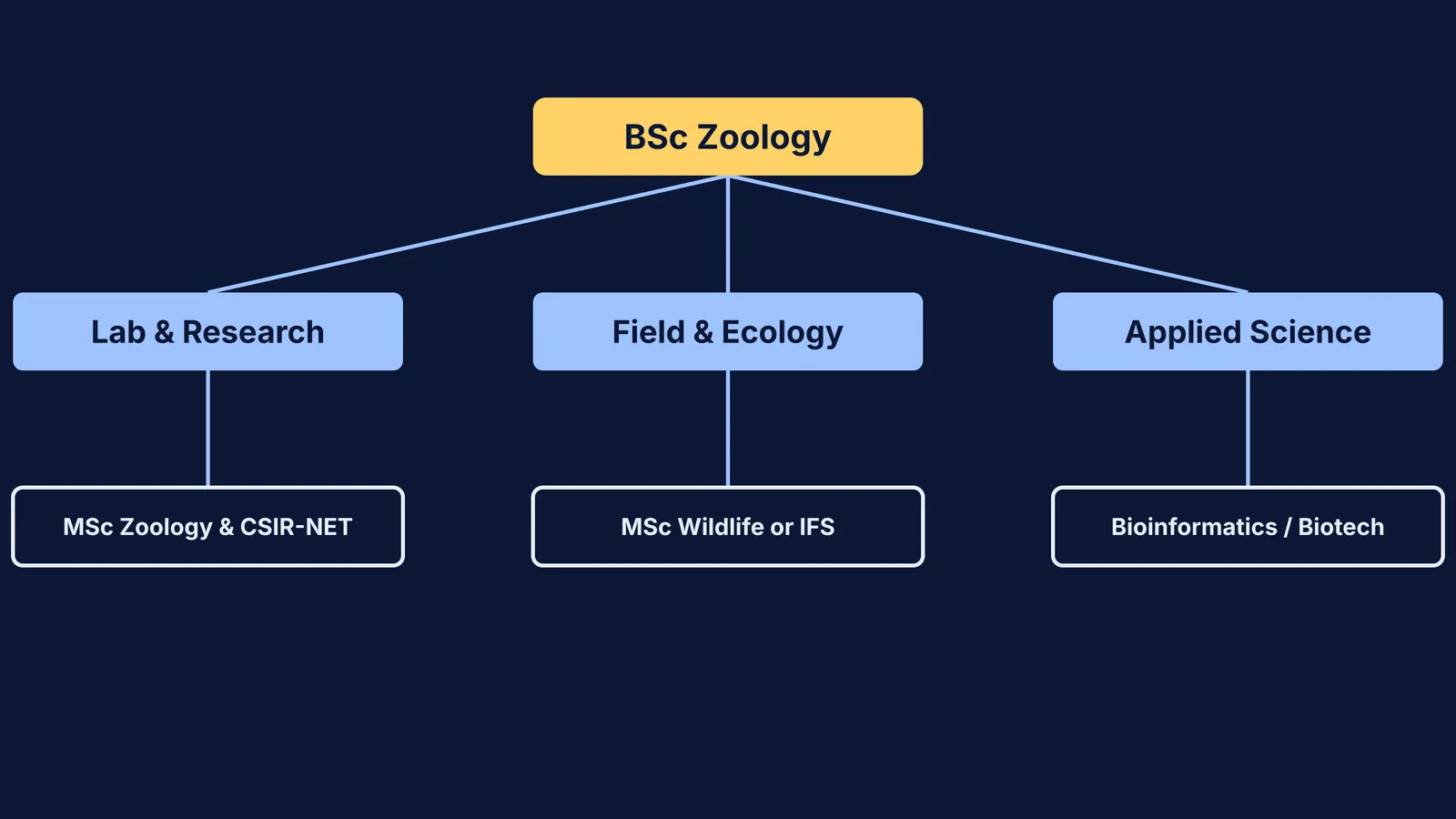
Choosing a path depends on whether you prefer fieldwork, bench work, or computer work. Use this framework to decide on your immediate next step:
The Field Path: If you want to work outdoors in conservation or forestry, look towards an MSc in Wildlife Science or prepare for the Indian Forest Service (IFS) exam.
The Lab Path: If you enjoy microscopy, physiology, and taxonomy, pursue an MSc in Zoology and aim for the CSIR-NET to become a researcher or lecturer.
The Tech Path: If you want higher starting salaries and enjoy working with data, shift towards bioinformatics or biotechnology for your postgraduate studies.
With a clear plan and the right supplementary skills, a zoology degree offers a solid foundation for a lifetime of discovering how the natural world works.