

On this page
Most students read the mark, glance at the red ink and put the paper away. Yet the margin comments, such as "steps missing" or "units?", are the most useful part of the sheet, and they tend to repeat. Here is a short routine for every unit test or half-yearly exam.
Why do teacher comments matter more than the marks?
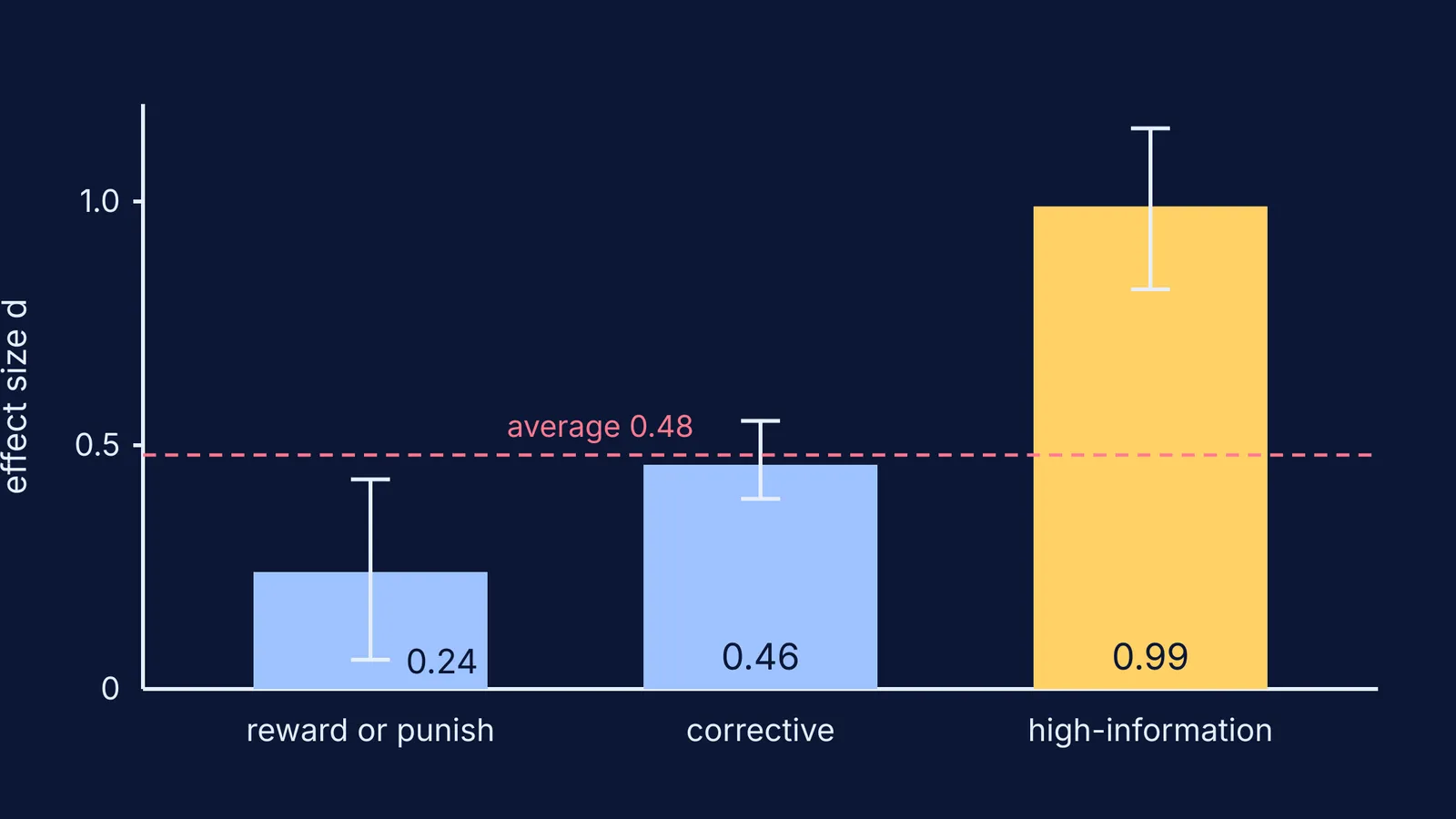
Feedback works, but not all feedback works equally. A 2020 meta-analysis by Benedikt Wisniewski, Klaus Zierer and John Hattie pooled 435 studies with more than 61,000 learners and found a medium average effect of feedback on learning, d = 0.48 (Frontiers in Psychology).
In the same analysis, high-information feedback, which covers the task, how to do it and sometimes how to monitor your own work, had an effect of 0.99, while simple reward or punishment had an effect of 0.24 (Wisniewski, Zierer and Hattie, 2020).
A bare mark is closer to the second kind; a comment such as "you substituted before writing the formula" is closer to the first. An earlier review by John Hattie and Helen Timperley called feedback a powerful influence on learning, "but this impact can be either positive or negative", depending on its type and how it is given (Review of Educational Research, 2007).
Why don't students use the comments they get?
Anders Jonsson's review of research on how students use teacher feedback found that usefulness is a key reason students act on it, and that a lack of strategies for using feedback, or not understanding the academic language it is written in, can get in the way (Active Learning in Higher Education, 2013). That review covered university students, but "be more precise" is just as hard to act on in Class 10 if nobody shows you what precise looks like.
A systematic review of 195 publications by Naomi Winstone and colleagues looked at how learners receive feedback, engage with it and put it into practice (Educational Psychologist, 2017). The routine below is one simple way to take on that part yourself.
How do I turn red-pen comments into action?
Run these three steps within a few days of getting the paper back.
List the repeated remarks. Put your last three or four corrected papers in one subject side by side. Write every comment on one page, in your own words, and tally how often each appears.
Rewrite one answer per remark. For each remark that appears two or more times, pick one answer where it happened and rewrite it in full, fixing exactly that problem. If you cannot tell what the comment means, take that question to your teacher.
Check the next test. Before handing in your next paper, spend two minutes scanning for your top remarks. When it comes back, mark each one: gone, fewer, or still there.
What does this look like on a real answer?
Say your last three physics tests carry these comments:
"Units missing" (four times)
"Write the formula first" (three times)
"Diagram not labelled" (once)
The first two repeat, so each gets a rewrite.
The question: find the speed of a stone dropped from 20 m, taking g = 10 m/s². Your original answer read "v² = 2 × 10 × 20 = 400, v = 20", with "formula?" and "units?" in red beside it.
The rewrite: using v² = u² + 2gh, with u = 0, g = 10 m/s² and h = 20 m, v² = 0 + 2 × 10 × 20 = 400 m²/s², so v = 20 m/s.
The number was right both times; the rewrite is the version a teacher marking step by step can follow. If "units missing" has gone on the next test but "write the formula first" is still there, that remark stays on the list.
Sometimes a remark points to a method you do not understand rather than a slip. The Fermi Problem Library has worked problems with a step-by-step solver that explains the reasoning, so you can compare your method with each step. If the comment says the concept is unclear, the Fermi Concept Library gives every concept in physics, chemistry, biology, mathematics and computing its own lesson.
What if the comments feel harsh or vague?
A vague comment needs one specific question: "In question 4 you wrote 'be precise'. Could you show me one line where I should have been more precise?"
A blunt comment is still information once you set the tone aside; see how to respond when a teacher's feedback feels harsh and how students can learn to take criticism well. With a big pile of old papers, you can also ask AI to find the pattern in your mistakes.
If test results leave you anxious for days at a time, talk to someone you trust, or call Tele MANAS, the government's free 24x7 mental health helpline, on 14416 (Press Information Bureau).
Start with your most recent paper tonight: write down every comment on it, and see which ones you have seen before.


