

On this page
Getting back a test covered in red marks is disheartening. When a teacher points out your mistakes in front of the class or writes a blunt comment on your assignment, it is natural to feel defensive. However, learning how to process that criticism is a skill that directly translates into better grades.
Why does feedback feel so personal?
The way you react to criticism often comes down to how you view your abilities. If you believe that your intelligence is a fixed, static trait, then when a teacher criticises your physics derivation, your brain interprets it as a permanent label.
You are upset that you lost the marks, and you are hurt by the negative feedback. In contrast, students who view their abilities as something they can develop take criticism better (APA, 2015). By treating competence as a result of effort and persistence, they see criticism as just data about what to fix next.
In many schools, feedback is heavily evaluative. Teachers, often managing large class sizes, use a "flick and tick" method—marking an answer wrong without the time to explain the missing steps. When you only receive a cross on your page, it is easy to assume you just do not understand the subject. Why making mistakes helps you learn, and how to use them explores this gap between getting an answer wrong and figuring out why.
How can you separate the work from yourself?
The first step to taking criticism positively is to put distance between your identity and your output. Your essay or your maths solution is something you produced, not who you are.
When a teacher says, "This paragraph is disorganised," they are diagnosing the paragraph, not your character. Try to pause before you react. Remind yourself that the discomfort you feel is the friction of learning, not a signal to give up.
If you find classroom corrections too public or stressful, you might prefer working through problems in private first. Fermi's AI tutor does not judge you when you make an error; it simply notices where you are stuck and decides whether to explain or ask a guiding question. This creates a low-stakes environment where you can practise separating your ego from your mistakes before you face a human examiner.
Which clarifying questions should you ask?
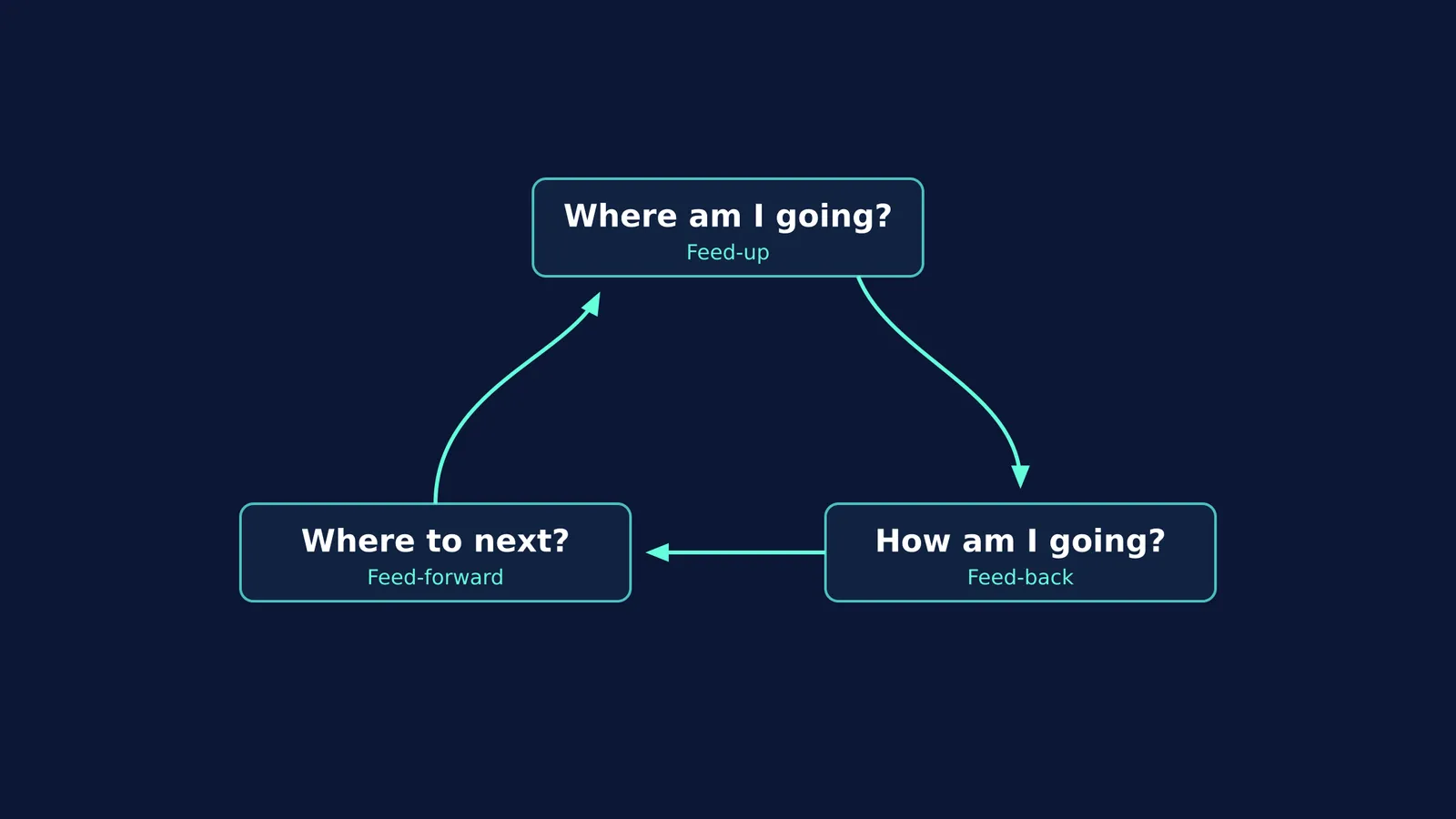
Constructive feedback is highly effective when it is specific. John Hattie and Helen Timperley's 2007 review, *The Power of Feedback*, proposed that the best feedback answers three questions: Where am I going? How am I going? And where to next? A 2020 meta-analysis by Wisniewski, Zierer, and Hattie of over 61,000 participants confirmed that feedback interventions have a moderate average effect size of 0.48 on student achievement (Frontiers in Psychology, 2020), meaning they make a tangible difference to academic performance. Black and Wiliam's 'Inside the Black Box': feedback that helps shows how formative assessment relies on this exact principle.
If your teacher's feedback is vague, you have to extract the actionable points yourself. Use these scripts:
Instead of "I don't get this," ask: "Could you show me where my reasoning broke down in step three?"
Instead of "Is this right?" ask: "I am trying to apply the right-hand rule here. Am I pointing my thumb in the correct direction for the current?"
Instead of "How do I get a better grade?" ask: "What is the one thing I should focus on improving for the next assignment?"
How should you act on one point at a time?
A paper covered in corrections is overwhelming. If you try to fix your handwriting, your calculation speed, and your conceptual gaps all at once, you will exhaust yourself. Immediate or delayed feedback: when should you check your answers? covers how timing your corrections changes how much you retain.
Instead, review the criticism and pick a single, manageable target. If your teacher pointed out that you consistently miss negative signs in integration, make that your only focus for the next study session. If the feedback reveals a fundamental misunderstanding of a topic, you can review that specific idea in the Concept Library before attempting more problems.
Once you have mastered that one point, move on to the next. Over time, you will find that seeking out criticism becomes a habit, because you know exactly how to turn it into progress.


