On this page
If you are applying to US colleges from India, the personal essay is the one part of the application where an admissions reader hears you rather than your marks. You are not alone in finding it hard: India was second only to China among non-US home countries of first-year Common App applicants in 2025-26, according to a Common App presentation for counsellors from May 2026. Many reach for the same few stories. Here is how to find yours.
How do you choose a college essay topic as an Indian student?
Start with the purpose. Yale's admissions office says that if an essay doesn't sound like the person who writes it, it cannot serve very well as a personal statement, and it asks applicants to write about something that matters to them. Johns Hopkins, in its Essays That Worked collection, says the essays it chose share stories from everyday life to reveal character, values and life; its examples include baking, clearing out a closet and trees.
So a good topic passes three tests:
Small: you can describe one scene in detail (a place, a time, what people said).
True to you: nobody else in your class could write the same essay.
It changed something: you think or act differently now, and you can say how.
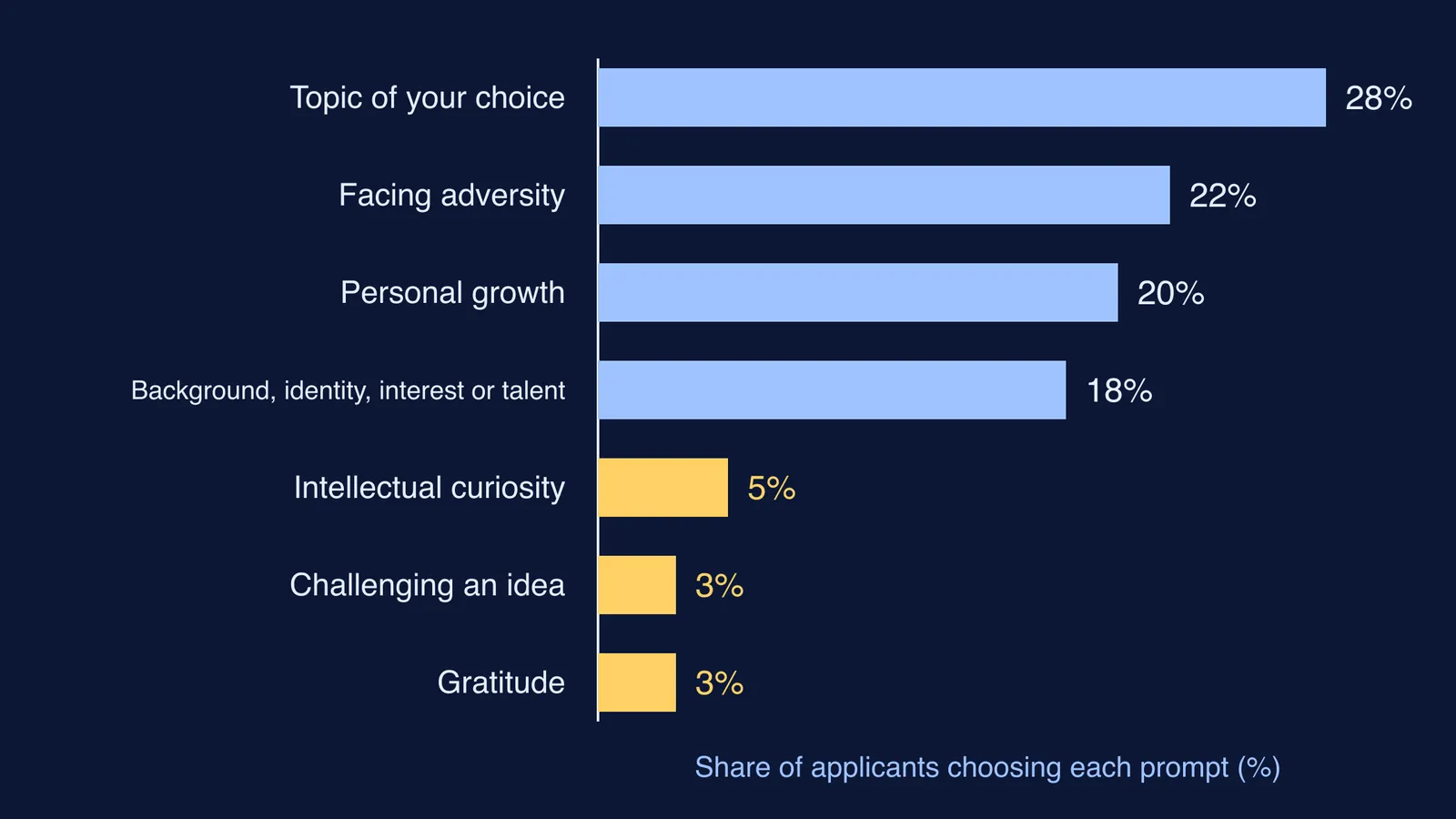
The prompt matters less than you think. The Common App's 2026-27 essay prompts remain the same as last year's seven, and one of them is simply a topic of your choice. In that Common App presentation, 28% of applicants chose that open prompt, 22% wrote about facing adversity and 20% about personal growth, while only 5% chose intellectual curiosity and 3% each chose challenging an idea or gratitude.
Which college essay topics are overused by Indian applicants?
These topics are not banned, just crowded; readers have seen the obvious version many times:
The JEE or NEET grind: long coaching days, a mock test that went badly, the pressure to choose engineering or medicine.
The grandparent who taught me values: warm, but often about the grandparent, not you.
The service trip: a day teaching at a village school, ending with "I realised how privileged I am".
The big win: an olympiad medal or a hackathon prize, retold as a list of achievements.
Diwali or a family wedding as a picture of Indian culture, written for an imagined foreign reader.
You can still use any of these if you narrow it to a moment only you lived and keep the focus on what changed in you.
Expensive experiences are not an advantage either. A 2021 study in Science Advances of 60,000 undergraduate applications found that essay content and style were more strongly related to household income than SAT scores were. The study did not look at summer programmes, but a story built on a costly experience can say more about a family's budget than about you.
What does showing growth look like in a college essay?
Growth means a real before and after, with the turning point shown in a scene. A worked example:
Crowded version: "Preparing for JEE taught me discipline and perseverance."
Narrowed version: Every evening in Class 11 you rode the bus home from coaching with a classmate who was failing physics. You started explaining problems to him on the back seat and found you had to understand torque properly before you could explain it.
Before: you studied to get answers right.
Turning point: the evening he asked "but why?" and you could not answer.
After: you now test whether you can explain an idea before you call it learned, and you want to study something where you can teach.
The second version still involves coaching, but nobody else could have written it.
A 30-minute topic finder you can do this weekend
Spend 10 minutes listing 15 small moments: arguments, mistakes, habits, jobs at home, things you fix or make, questions you keep asking.
Next to each one, write one sentence: "Before, I…; now I…". Cross out any you cannot finish.
Run the three tests (small, true, changed something) on the rest and keep two or three.
Tell each story aloud to a parent or friend for two minutes. Choose the one they ask questions about.
Write the scene first and the reflection second. Explain what changed; don't just announce it.
Parents can help most in step 4. Ask "what happened next?" and "how are you different now?", and leave the writing to your child. If you are tempted to let an AI draft it for you, read our guide on using AI honestly for college application essays first.
If your story turns on an idea from science, such as the torque example above, get the idea right before you write about it. The Fermi Concept Library covers every concept in physics, chemistry, biology, mathematics and computing, each with its own lesson.
Once you have a topic, see how the essay fits the rest of your application in our Common App guide for Indian students, then move on to the college-specific question with our guide to writing a "why this college" essay.