On this page
If you are in Class 12 and want a UK degree from September 2027, the date that matters most is 13 January 2027. Whatever your board, the application itself goes through UCAS.
How do you apply to UK universities through UCAS from India?
You make one online application and send it to up to five courses; the fee for the 2027 cycle is £34.50, according to UCAS. Four parts take time: your choices, a personal statement, predicted grades and a teacher's reference.
If you apply through your school, it has a teacher write the reference and sends the application. If you apply independently, UCAS emails your referee instructions, as the UCAS reference guide explains. Either way, you cannot submit until the reference is added.
When is the UCAS deadline for 2027 entry?
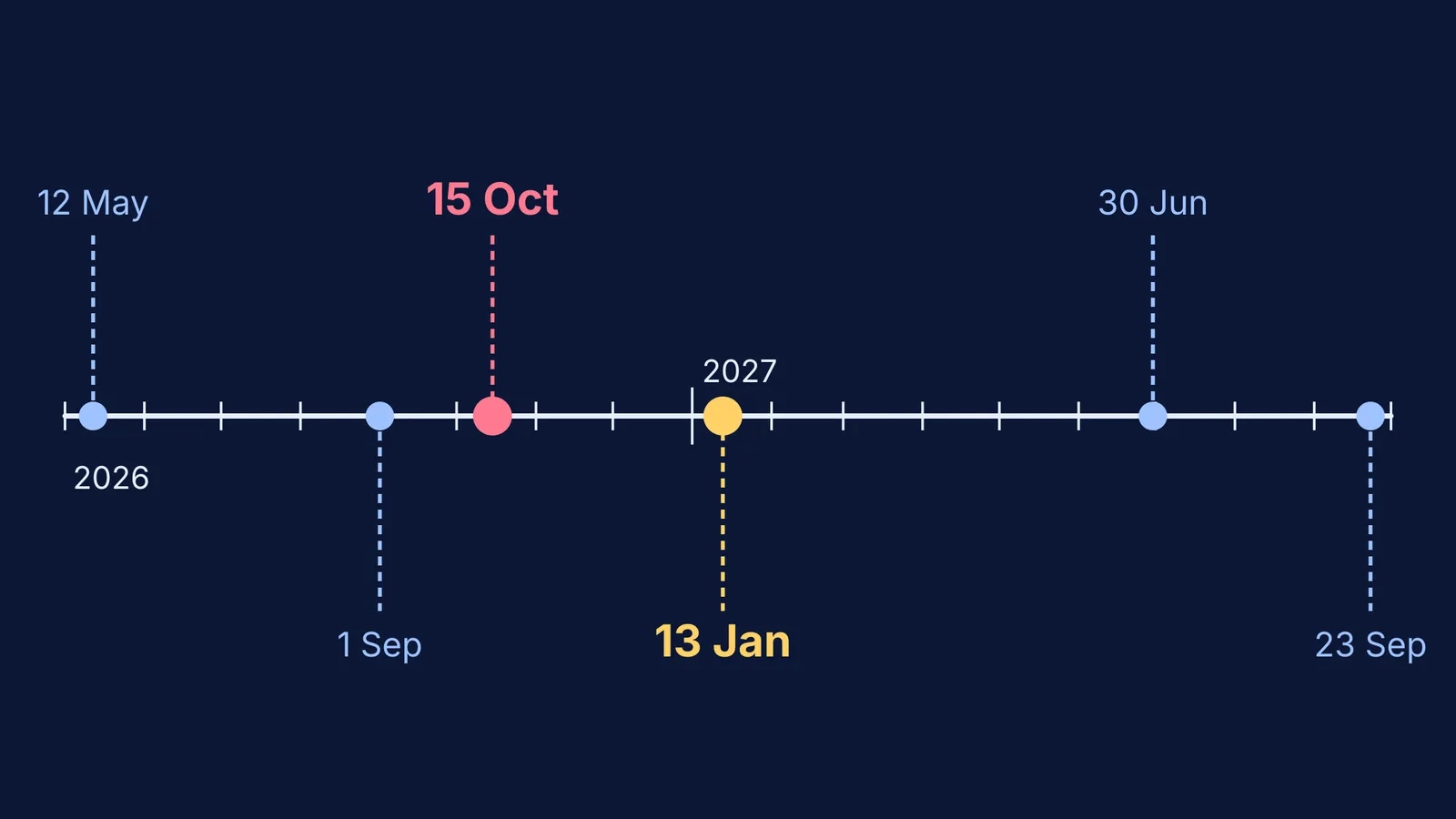
These are the official dates on the UCAS deadlines page; the deadlines fall at 18:00 UK time:
1 September 2026: completed applications can be submitted.
15 October 2026: Oxford, Cambridge and most medicine, dentistry and veterinary courses.
13 January 2027: the equal consideration date for most undergraduate courses (11:30 pm in India).
30 June 2027: the last date for applications to be sent on to universities.
Many universities accept international applications later, UCAS notes, but 13 January is the date for equal consideration. Your school may set an earlier internal deadline; treat that as your real one.
How should you choose your five UCAS courses?
UCAS lets you add up to five choices, and they can be the same or different courses at the same or different universities (UCAS: filling in your application). Two rules limit your list: you can apply to at most four courses in any one of medicine, dentistry or veterinary science, and usually to only one course at either Oxford or Cambridge.
All five read the same personal statement, so choose one subject, not five. Then spread risk using each course's entry requirements for Indian boards:
One or two reach courses, where the usual offer is at or above your predicted marks.
Two match courses, where your prediction meets the offer comfortably.
One safer course, where you clear the offer easily and would still be happy to go.
A worked example: take Ananya, an imagined CBSE science student who wants physics. She could list one reach course, two that ask for a little less than her prediction, one that asks for clearly less, and as her safer fifth a course with a UK foundation year.
What goes in the UCAS personal statement now?
The personal statement is three questions with a combined limit of 4,000 characters including spaces, and at least 350 characters per answer (UCAS personal statement guide):
Why do you want to study this course or subject?
How have your qualifications and studies helped you to prepare for this course or subject?
What else have you done to prepare outside of formal education, and why are these experiences useful?
Admissions staff review the three answers as a whole, says the UCAS adviser toolkit, so do not repeat yourself. For Ananya, a sensible split is about 1,400 characters for question 1, 1,600 for question 2 and 1,000 for question 3. In question 2, one idea from Class 12 physics that she followed beyond the textbook does more than a list of marks.
To read beyond the syllabus, Fermi Courses has university-level courses from working scientists, with the AI tutor on every lecture. In the statement, write about the idea, not the platform.
How do predicted grades and the reference work from an Indian school?
UCAS defines a predicted grade as the grade your school believes you are likely to achieve in positive circumstances, and asks that predictions rest on evidence of performance (UCAS on predicted grades). So your Class 11 results and pre-boards matter. If one topic keeps costing you marks, the Fermi Concept Library covers every concept in physics, chemistry, biology, mathematics and computing, each with its own lesson. See also how CBSE results work for foreign universities.
The reference comes from someone who knows you academically; a teacher can add your predicted grades and, with your permission, circumstances that affected your studies (UCAS reference guide). It must not come from family, friends, partners or ex-partners.
Ask your referee early and make it easy. A script you can adapt:
"Ma'am, I'm applying to UK universities for physics through UCAS, and my deadline is 13 January. Could you write my reference and predict my Class 12 board grades? By Friday I'll send my five courses, Class 11 marks and a one-page note on my physics work. Would early December suit you?"
What happens after you submit?
Universities then reply through UCAS. Some courses also interview; our guide to preparing for an Oxford or Cambridge interview explains what to expect.
After you accept an unconditional offer, a university with a sponsor licence can issue the Confirmation of Acceptance for Studies (CAS) your visa needs; it also advises whether you need a secure English test (UCAS on visas). For degree-level study, the UK Student visa needs English equivalent to CEFR level B2 (GOV.UK).
This week, list your five courses and send your reference request.