

On this page
The University of Oxford typically shortlists about 10,000 candidates for 3,300 places—about three candidates for every available place (Oxford Admissions), while the University of Cambridge invites many of its applicants to interview (Cambridge Admissions). Although the exact proportion varies by course, both universities use the interview for the exact same purpose: to see how you think.
Unlike standard school exams, these interviews are not tests of what you have already memorised. They are designed to mimic a "tutorial" (at Oxford) or "supervision" (at Cambridge)—the small-group teaching systems that form the core of their undergraduate education.
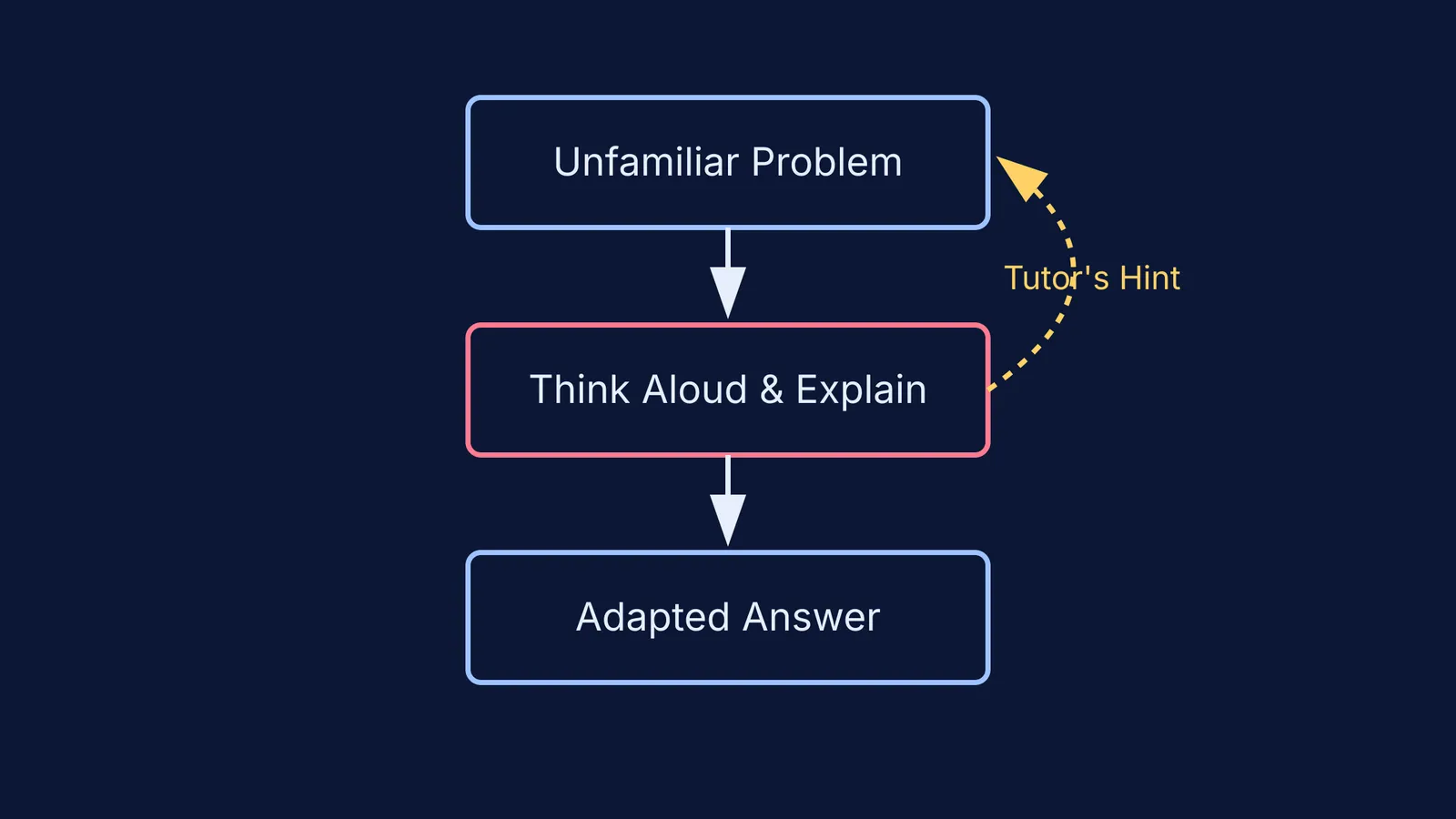
Tutors want to know if you are "teachable". They will often present you with an unfamiliar problem, a complex graph, or a challenging piece of text. It is entirely normal to find the questions difficult. The interviewers are deliberately pushing you beyond your current knowledge to see how you respond to being stuck and whether you can incorporate new information.
How to practise thinking aloud?
The most critical skill to develop before your interview is the ability to think aloud. Tutors cannot assess your reasoning if you sit in silence.
When you are given a problem, start by stating what you know and how you might approach it, even if you are not sure it will lead to the final answer. If you take a wrong turn, the interviewer will often give you a hint. Your ability to listen to that hint, reconsider your approach, and adapt your answer is exactly what they are looking for. Flexibility is seen as a sign of intellectual honesty, not a weakness.
To get used to this, try using the "Pause, State, Explain" framework when practising:
Pause: Take five to ten seconds to gather your thoughts when given a new prompt.
State: Clearly say your initial assumption or the principle you think applies.
Explain: Walk through your logical steps out loud, step by step.
For example, if you are asked a physics question about a projectile, do not just silently scribble equations. Say: "I am going to assume air resistance is negligible for now. If I start by resolving the forces vertically, I can find the time of flight." This shows the tutor exactly where your mind is going.
You can practise this at home by talking through your homework aloud, explaining each step to a friend, a parent, or even an empty room. This active engagement is also one of the most effective ways to study, as highlighted in the Ten study techniques rated: inside the 2013 Dunlosky review.
How to prepare using subject problems?
To prepare effectively, you must shift your focus from revising notes to solving unfamiliar problems in your subject. This builds the mental flexibility needed for the interview.
When you get stuck on a difficult question, do not immediately look up the final answer. Instead, try to break the problem down into smaller parts. If you are preparing for a STEM subject, the Fermi Problem Library has worked problems with a step-by-step solver that explains the reasoning rather than printing an answer. Using tools that explain the "why" rather than just the "what" mirrors the interview experience: being guided through the logic of a problem rather than just being given the solution.
Similarly, studying core concepts deeply rather than superficially is crucial. Knowing how to derive a formula from first principles will serve you much better than simply memorising it. For an example of this approach in physics, see Lev Landau and the theoretical minimum: how to learn physics whole.
What happens on the day of the interview?
Most interviews for both universities are currently held online. You will usually have more than one interview—Oxford, for example, conducts around 20,000 interviews for 10,000 shortlisted candidates (Oxford Admissions). These are often with different tutors or even at different colleges to ensure a fair assessment.
Re-read your application: Be prepared to discuss anything you mentioned in your personal statement, including books, projects, or work experience. If you cited an article, make sure you remember its key arguments and can defend your views on it.
Do not rush: It is perfectly acceptable to pause for a few seconds to gather your thoughts before answering.
Ask for clarification: If a question is ambiguous, ask the tutor to clarify. It is always better to check than to guess what they mean.
Remember that the interview is just one part of your application, alongside your predicted grades, admissions test scores, and personal statement. Focus on demonstrating your genuine interest in the subject and your willingness to engage with complex ideas.


