

On this page
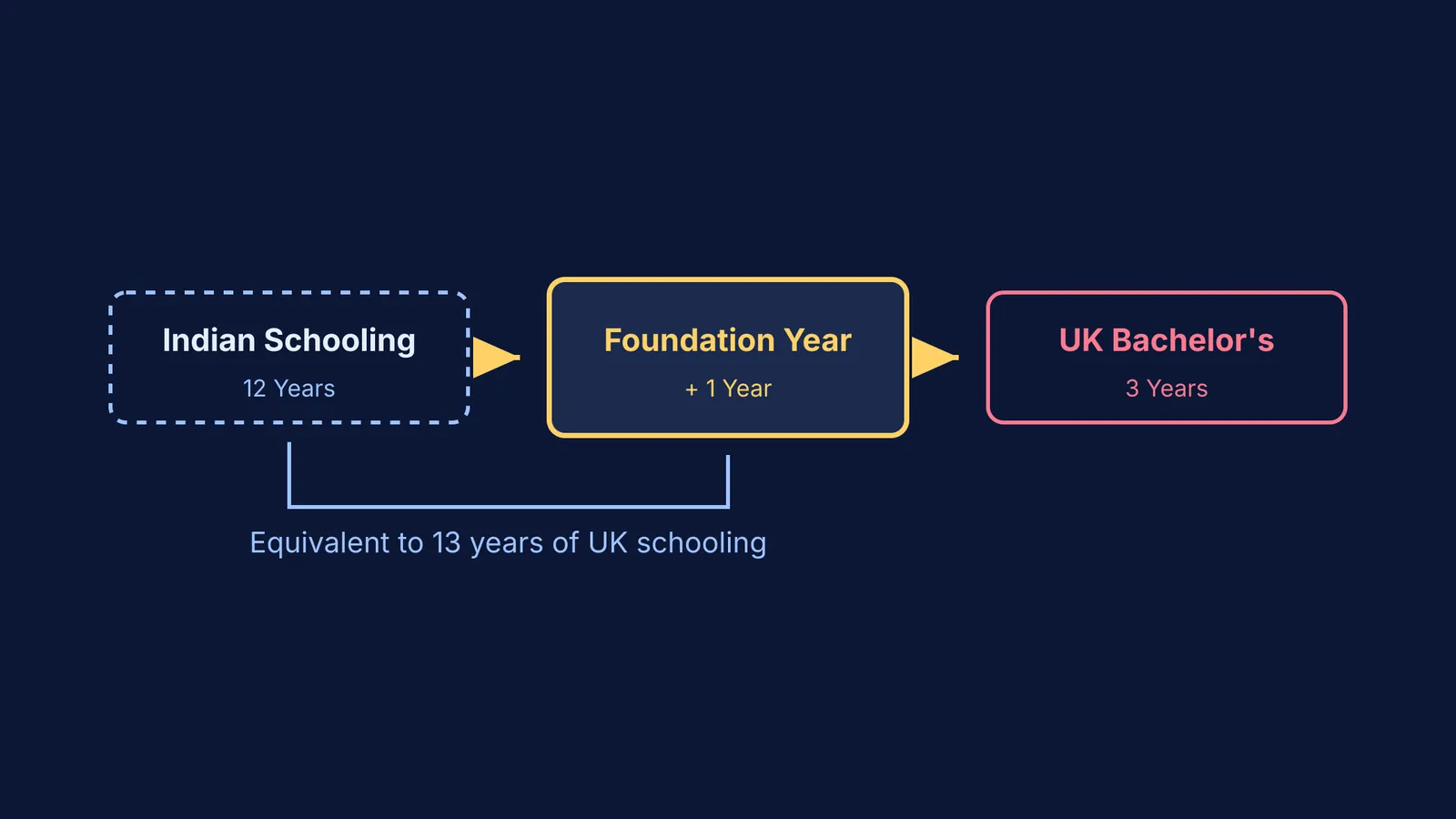
For many Indian students dreaming of a UK bachelor's degree, the first obstacle is the length of their schooling. The UK education system expects students to have completed 13 years of formal education (A-Levels) before starting university. Because the Indian system—including CBSE, ISC and State Boards—is 12 years long, many universities ask for very high marks or a separate bridging course called a foundation year.
Here is what you and your parents need to know about who needs this extra year, how much it costs, and how it leads to a full degree.
Do you need a foundation year?
There are three main reasons you might need a foundation year instead of applying directly to Year 1 of a UK bachelor's programme.
First, your Class 12 marks might be slightly below the direct entry requirement. While competitive courses demand 80% to 95% or higher, foundation years accept lower scores. For example, the University of Manchester requires 70% or higher in Standard XII for its integrated Science and Engineering foundation programme.
Second, you want to change subjects. If you studied Commerce in Class 12 but want to pursue an engineering or computer science degree in the UK, a foundation year provides the missing mathematics and physics background.
Third, some ultra-competitive universities rarely accept the Indian Class 12 exams for direct entry at all, asking instead for A-Levels, the IB diploma, or their own foundation year.
How does it lead to a UK degree?
A foundation year (often called "Year Zero") is not a standalone qualification like a diploma. It is explicitly designed to prepare you for a three-year UK bachelor's degree.
If you take an integrated foundation year, you apply for a four-year course through the central UCAS system. Once you are accepted, you are a full university student from day one. You attend classes on campus, live in student accommodation, and have access to all university facilities. Just like moving cities for study or staying home in India, moving to the UK requires careful financial and emotional planning.
Crucially, progression to Year 1 is guaranteed provided you pass your foundation exams. You do not need to reapply to the university.
If you are catching up on missed subjects like mathematics or physics, the step up in difficulty can be steep. You are compressing two years of A-Level material into nine months. If you find yourself memorising formulas without understanding why they work, the Fermi Problem Library has worked problems with a step-by-step solver that explains the reasoning rather than just printing an answer. For more intensive help catching up, Fermi's AI tutor can work out what you already know and build a plan for the session, so you sit down to a clear next step. This can be as effective as having a strong plan when deciding on your study method for JEE.
What does a foundation year cost?
A foundation year is an expensive extra step. You are paying for a full year of international tuition and living expenses before your degree even begins.
Tuition fees and living expenses vary widely based on the university and the city.
Before you accept a foundation year offer, ask the provider these three questions:
What is the progression rate? Ask what percentage of foundation year students successfully progress to Year 1 of their chosen degree.
What are the exact progression requirements? Some degrees require a simple pass, while competitive tracks like law or pharmacy might require you to score highly in your foundation exams to progress.
Is it taught by the university? Many foundation years are outsourced to private companies (like INTO, Kaplan or Study Group) and taught in separate study centres, rather than in the university's own lecture halls.
If you only missed the direct entry grades by a narrow margin, it is always worth asking universities if they offer an "International Year One". This fast-track course combines the foundation and first year into a single year, allowing you to progress straight to Year 2 and saving a full year of fees.


