

On this page
Most students ask about the timer the wrong way round. The real question is not whether to time yourself but when. A timer measures speed, and speed is only worth measuring once your method is right.
Why does a timer make you worse at a new chapter?
Psychologists call it the speed-accuracy tradeoff: faster decisions rest on less evidence, so they are less informed, as Richard Heitz explains in a 2014 review in Frontiers in Neuroscience.
A 2017 review of research on maths by Sara Caviola and colleagues found that results "seem to suggest that time pressure generally acts as a stressor, causing suboptimal strategy selection" (Frontiers in Psychology). The same review notes that worry about performance eats into working memory, the mental space you use to hold a problem in your head, and that there is some evidence that maths anxiety combines with timed conditions to lower scores further.
Pressure can also blunt the practice itself. In two experiments, Scott Hinze and David Rapp found that students scored about the same on high-stakes and low-stakes quizzes, but only the low-stakes quizzes led to better final test results than rereading (Applied Cognitive Psychology, 2014). Their pressure came from stakes, not a clock, but the lesson fits: early practice works best when mistakes cost nothing.
So when should you start timing yourself?
Practice testing (quizzing yourself instead of rereading) and distributed practice (spreading sessions out) were the two techniques rated high utility in a 2013 review of ten study techniques by John Dunlosky and colleagues. A timer does not replace either; it sits on top. So the plan below has you solving questions from day one and only changes how much time you allow.
First, work out your exam pace: the paper's total minutes divided by its number of questions. Take both numbers from the current information bulletin on the National Testing Agency website or from your board, because patterns change.
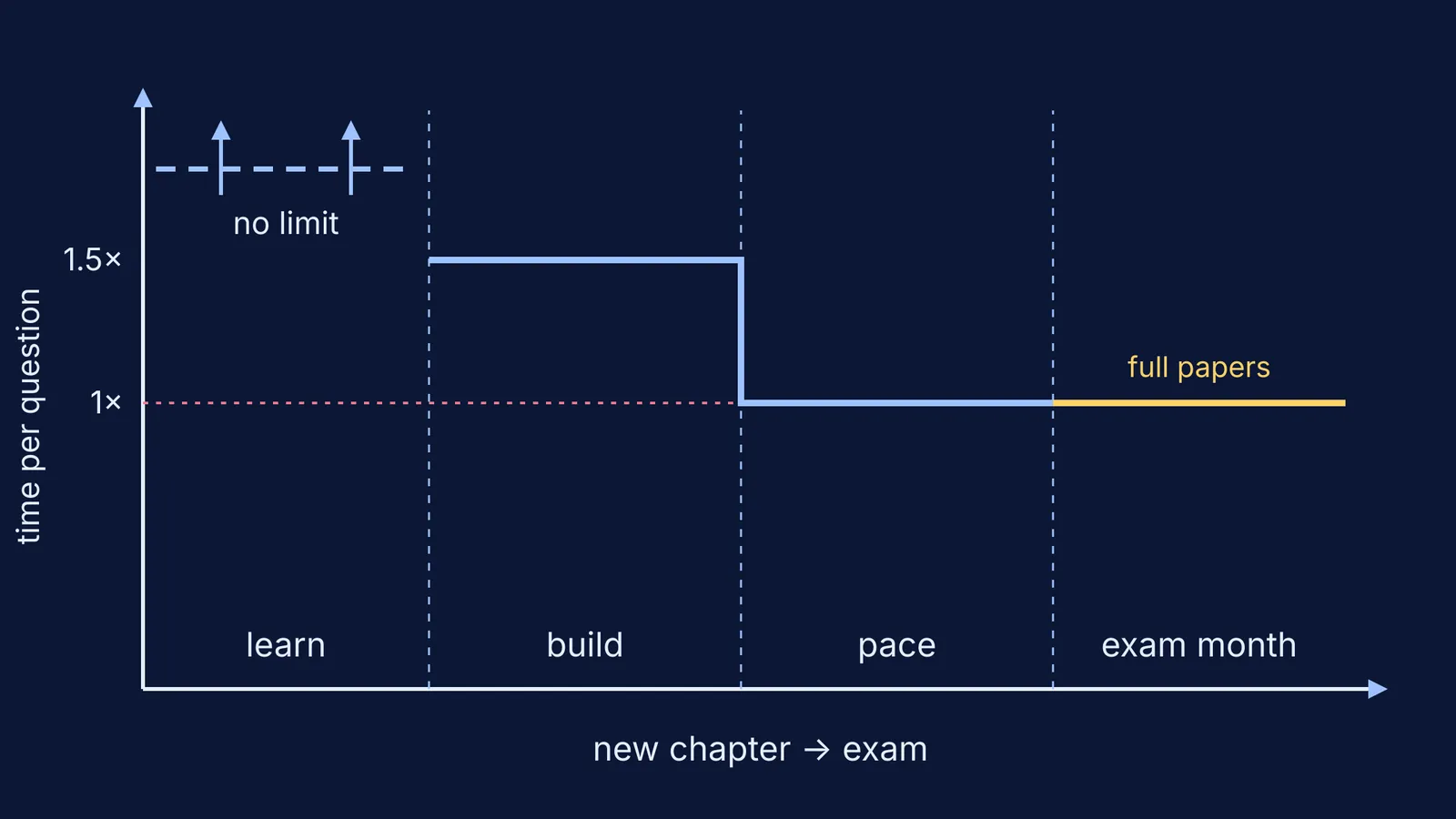
Learn (first week or two of a chapter): no limit. Run a stopwatch and note your time per question, but never stop early. Write the full method. Move on when you get most questions right without peeking at the solution.
Build: a generous timer, about one and a half times exam pace. Ten questions a sitting. When the timer rings, draw a line under where you are and finish in a different-coloured pen. You now have two scores: within time, and in the end.
Pace: exam pace, mixed chapters. Timed sets of 15 to 20 questions from several chapters, so you have to spot the method as well as use it. Our plan for interleaved practice shows how to mix them.
Exam month: full papers at the real time. Start at the same hour as the exam, sit once, then review. Read when to move from chapter tests to full mocks to decide how often.
A worked example. Say a practice paper gives 60 minutes for 30 questions, so exam pace is 2 minutes a question.
Learn: 10 kinematics questions, no limit. The stopwatch shows 41 minutes and you get 8 right. Your method is sound.
Build: the next 10 at 3 minutes each, so 30 minutes. You get 6 right above the line and 9 by the end. The three you finished late were slow set-ups, not wrong ideas. That is a speed gap, so keep timing.
Pace: 20 mixed questions from kinematics, laws of motion and work-energy in 40 minutes.
The two pens tell you what to fix. A much higher end score means a speed problem, so keep the timer. Two low scores mean an understanding problem, which no timer will fix.
When should you take the timer off again?
Drop back a phase when any of these happen:
Your within-time and end scores are both low.
You catch yourself guessing to beat the clock.
You make the same wrong-method mistake twice. Work it through in the Fermi Problem Library, whose step-by-step solver explains the reasoning rather than printing an answer, then retry it untimed.
The gap is a concept you never properly learnt. Fermi's Concept Library covers every concept in physics, chemistry, biology, mathematics and computing, each with its own lesson.
What if the timer makes you panic?
Keep the stakes low: no marks shown to anyone, no comparing with friends. If the clock makes your heart race, or you dread every practice set, talk to a parent, teacher or school counsellor. You can also call Tele MANAS, the government's free mental health helpline, on 14416 (Press Information Bureau).
Once you reach full papers, logging the time you spend on each question in a mock shows exactly where your minutes go.


