On this page
Engineering books are heavy, expensive, and often used for only a single semester. First-year subjects like basic electrical engineering, engineering graphics, and environmental science are introductory. Once you pass the final exam, you will likely never open those books again.
If you buy every book on the syllabus, you will spend thousands of rupees each semester. A 2014 survey by the U.S. PIRG Education Fund found that 65% of students had skipped buying a required textbook because it was too expensive. But skipping books entirely can leave you underprepared for assignments and exams.
Instead of an all-or-nothing approach, you need a system to decide what to buy, what to borrow, and what to share.
Should I buy textbooks in engineering college?
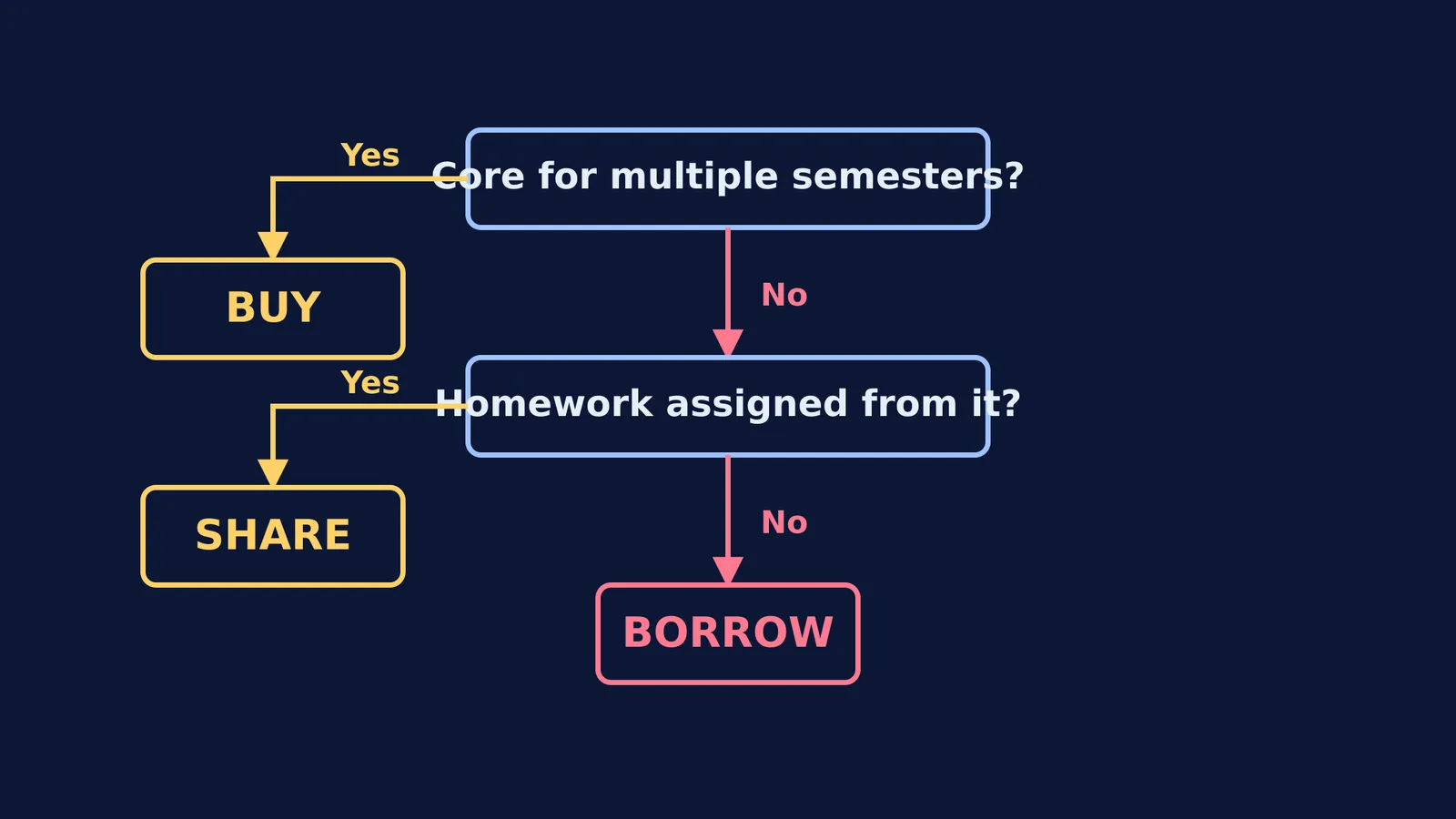
You should buy a textbook only if it covers core concepts you will need for multiple semesters, or if homework is assigned directly from it.
Do not buy books before the semester begins. Professors often list a primary textbook and several reference books on the syllabus, but they may only teach from their own presentation slides or rely on a single reference text. Attend the first few lectures to understand how much the professor actually uses the prescribed book.
To make the decision easier, run this "Syllabus Day" Book Audit during your first week:
Read the syllabus: Is the book marked "Required" or "Recommended"?
Ask the professor: "Will homework questions be assigned directly from the textbook?"
Check the library: Are there copies on reserve?
Ask a senior: "Did you actually use the book to pass this class?"
Which textbooks should I buy and which should I borrow?
Once you know what the course requires, sort your reading list into three categories:
What to borrow Every engineering branch studies physics, chemistry, basic programming, and maths in the first year. These books are abundant in the college library. If a professor assigns a heavy text for just two chapters, borrow it from the library and scan or photocopy those specific pages. If you are struggling with the basics, knowing how to learn physics from first principles, not formulas is far more useful than owning three different heavy physics textbooks.
What to share If a book is strictly necessary for assignments but too expensive, group up with three friends. One person buys it, and you rotate it during the week. This divides the cost among four people and ensures everyone has access to the homework questions.
What to buy In your second and third years, you will study the foundational subjects of your branch—like data structures for computer science, or thermodynamics for mechanical engineering. Buy standard, highly regarded books for these subjects. You will need them for graduate school entrance exams like GATE or technical job interviews.
How much do textbooks cost in engineering college?
Buying every new textbook can add thousands of rupees to your semester bill. If you must buy a book, look for second-hand markets. Every major student city has a hub where used engineering books sell for half their retail price.
Seniors are also a great resource. They are usually eager to clear their shelves and will sell you their old books cheaply, often complete with their handwritten notes and highlighted exam tips. As you approach graduation, you will realise that your core texts matter much more than first-year books. If you are looking at how to get a job off campus as a fresher in India, having your core branch books on hand for interview preparation is a huge advantage.
Using digital alternatives to physical books
If you choose not to buy physical books, your digital study system needs to be robust. Reading a PDF on a phone screen the night before an exam is a recipe for eye strain and poor retention.
If you are studying from digital copies, learn How to Set Up a Study Desk in a Hostel Room with a laptop stand. Treat digital reading as active reading: make physical notes on paper as you read the screen.
When you rely on library books or digital notes, you cannot write in the margins or highlight concepts for later. This is where Fermi's AI tutor helps. Instead of juggling multiple textbooks when you get stuck, you can ask the tutor to explain a specific step. The tutor works out what you know and builds a plan for the session, holding a line of reasoning across a session rather than just giving an answer. For quick definitions and visualising ideas, you can also use the Fermi Concept Library, which covers every concept in physics, chemistry, biology, mathematics and computing.