

On this page
You finish a chapter, flip through your notes, and it all looks familiar. But familiar is not the same as answering a question cold. To know if your method works, test it like a scientist: measure, study, measure again, compare.
Why can't you trust how well you feel you know a chapter?
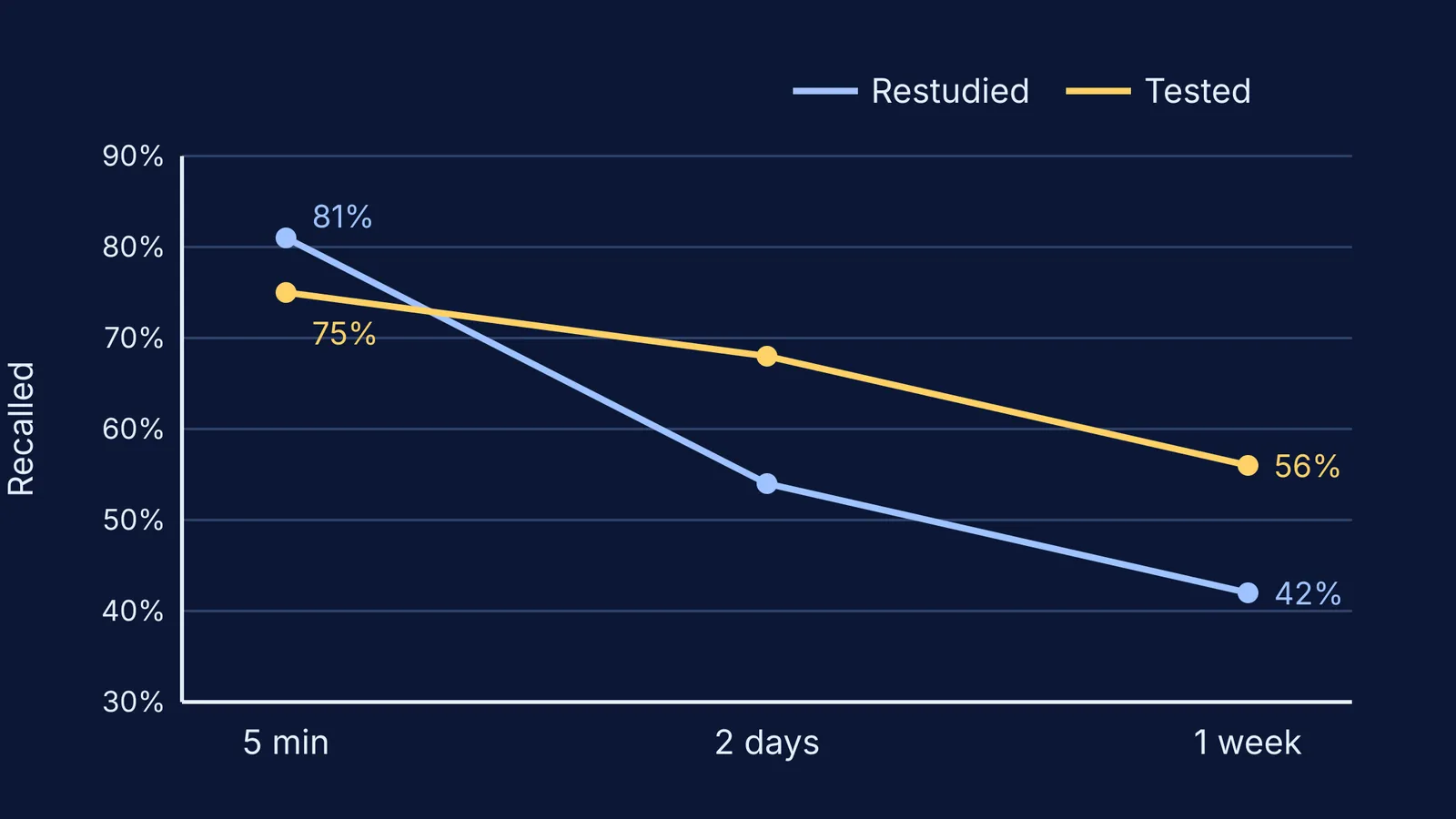
Rereading makes material feel learned faster than it makes it stick. In a 2006 Psychological Science experiment by Henry Roediger and Jeffrey Karpicke, students who restudied a short prose passage recalled 81% of it after 5 minutes, against 75% for students who took a recall test instead. A week later the order flipped: the restudy group recalled 42% and the tested group 56%.
In their second experiment, students who spent four study periods on the passage were more confident they would remember it a week later, yet recalled 40% at one week, against 61% for students who studied it once and then took three recall tests.
When Karpicke, Butler and Roediger surveyed 177 college students, a majority said they repeatedly read their notes or textbook, and relatively few tested themselves. The authors propose that many students experience illusions of competence while studying.
How do I set up a two-week test of my study method?
Pick one chapter you have not studied properly yet, such as a Class 11 physics or chemistry chapter.
Day 1: Make two sets of 15 questions, A and B, matched in topics and difficulty, from NCERT exercises, exemplar problems and past papers. Give set B to a parent, sibling or friend to keep.
Day 1: Take set A cold, closed-book, in 30 minutes. Mark it honestly and write down the score.
Days 2 to 11: Study the chapter with your usual method, without changing it. Log your minutes each day.
Days 12 and 13: No work on this chapter. A test taken straight after studying flatters rereading, as the 5-minute results above show.
Day 14: Take set B under the same rules as set A.
The pre-test is not wasted time. In five experiments by Lindsey Richland, Nate Kornell and Liche Kao, students who were asked questions before reading a passage did better on a later test than students who spent that time reading, even on the questions they got wrong at first.
How do I know if my score improved enough?
A raw jump can mislead, because a student who starts high has less room to grow. The normalised gain is the marks you gained divided by the marks you could have gained, (post − pre) ÷ (maximum − pre), based on the measure used by Richard Hake in a 1998 survey of 6,542 introductory physics students in 62 courses.
In that survey, traditional courses averaged a gain of 0.23 and courses that made substantial use of interactive-engagement methods averaged 0.48. Those are class averages on a physics concept test, so treat them as a rough reference, not a pass mark.
Worked example: say you score 4 out of 15 on set A for Laws of Motion, study by rereading and highlighting your notes, and score 7 out of 15 on set B. Your gain is (7 − 4) ÷ (15 − 4) = 3 ÷ 11 = 0.27. Now sort the questions you missed. Wrong law picked in numericals points to a problem-solving gap; a definition you could not state points to a recall gap.
Our rule of thumb, loosely anchored to Hake's averages:
Gain above 0.5: the method is doing its job. Keep it and test it on another subject.
Gain from 0.25 to 0.5: something works. Change one thing and test the next chapter.
Gain below 0.25: the method is mostly producing familiarity. Change it.
What should I change if my score barely moved?
A 2013 review of ten study techniques by John Dunlosky and colleagues rated practice testing and distributed practice as high utility, and rereading, highlighting and summarisation as low utility.
Swap one rereading session for the blurting method of revising from a blank page.
Spread the chapter over more, shorter sessions.
Once the basics are in, mix problem types with an interleaved practice plan.
Then run the two weeks again on a similar chapter and compare gains. Two chapters are not a study, so look for a large, repeated difference; five questions on correlation and causation help you judge your own results.
If the post-test shows you pick the wrong method in numericals, the Fermi Problem Library has worked problems with a step-by-step solver that explains the reasoning rather than printing an answer. If it shows a gap in an idea, the Fermi Concept Library has a lesson for each concept in physics, chemistry, biology and mathematics.
If tests leave you feeling very anxious or low, talk to someone you trust, or call Tele MANAS, the free national mental health helpline, on 14416.
Pick your chapter tonight, write set A, and take it tomorrow before you open the book.


