

On this page
A study-with-me video is a long recording or livestream of someone studying at their desk, often silently, sometimes with a timer on screen. Virtual study rooms work the same way, with several people on camera instead of one. They can help, if you use them as a tool for a set block and not as something to watch.
Do study-with-me videos help you focus?
The first broad study of these videos is a 2021 CHI conference paper by Yoonjoo Lee and colleagues, mostly at KAIST, which analysed 30 study-with-me videos on YouTube and interviewed 12 regular viewers. The videos they sampled ran from 45 minutes to 24 hours, with an average of 5 hours 45 minutes, and 14 of the 30 showed a timer on screen.
The authors sum up three main uses: a study ambience they could choose at low cost, "controllable peer pressure", and emotional support when studying alone. Eleven of the 12 said comparing themselves with someone studying steadily on screen inspired them. Two said they picked up their phone far less when the video was playing on it.
But it is a small interview study of mostly female college students. Nobody measured marks. A 2025 survey of 509 Chinese college students in Frontiers in Psychology linked a sense of peer support in these videos with higher motivation and lower test anxiety. It was a one-time survey, though, so it cannot show the videos caused either.
What do they do well?
A start signal. Pressing play is a small, fixed action that says "now I study".
Company without chatter. A late-night hostel room feels less lonely, and nobody next to you wants to talk.
A shared clock. Many videos run a study-and-break timer, so you don't have to decide when to stop.
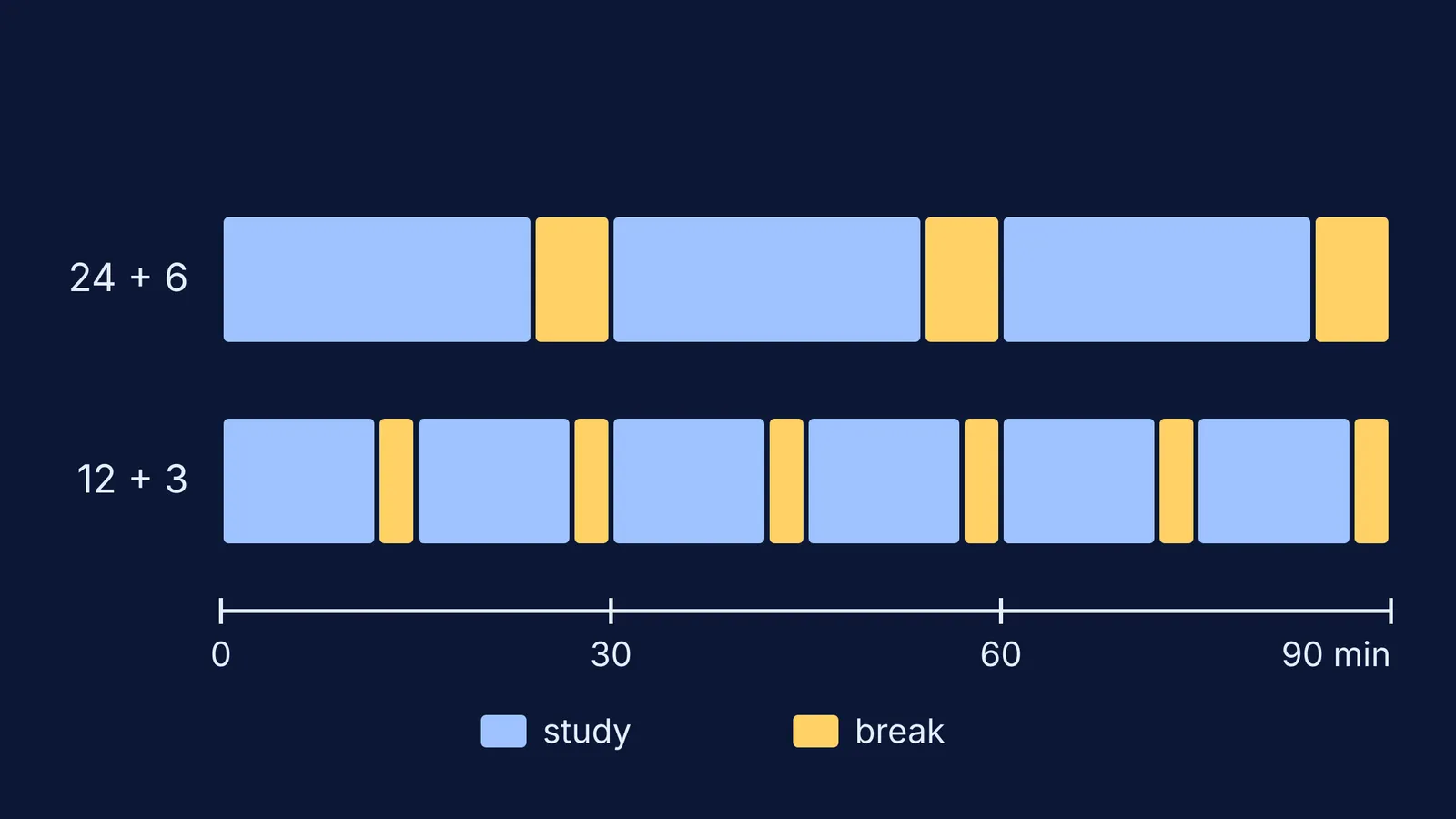
Fixed breaks, the idea behind that timer, have some support. In a 2023 study in the British Journal of Educational Psychology, 87 Dutch university students studied for a day with either fixed breaks (24 minutes on, 6 off, or 12 on, 3 off) or breaks whenever they chose. Students who chose their own breaks studied in longer stretches but reported more fatigue and lower concentration. All three groups got through a similar amount of work.
When does a study-with-me video become a distraction?
Sound is the first trap. A meta-analysis of 65 studies on auditory distraction during reading found that background noise, speech and music all slightly but reliably reduce reading performance. Intelligible speech and music with lyrics did the most damage. So a creator who chats, or a lo-fi mix with vocals, costs you most when you are reading theory.
The KAIST viewers had worked this out: some muted the sound, hid the video behind another window, or avoided creators who talk. The pull of the platform itself remains. One interviewee said: "when I sit in front of my computer, I keep wanting to enter YouTube and watch videos".
Warning signs the video is now the activity:
You spend more than a couple of minutes choosing a video.
You read the live chat, or watch the creator's desk more than your book.
You click a recommended video at the break.
You finish a block and can't say what you got done.
How should you use a study-with-me video?
Write the task first, in one line: "NCERT Chapter 3, Examples 1-6 and Exercise Q1-8."
Open one of two or three saved videos, so you never browse.
Match your blocks to its timer, or set your own: 24 minutes of work, 6 minutes of break, one of the fixed schedules tested with university students.
Choose silence or plain ambient sound for reading. Save music for routine work like copying formulas onto revision cards.
Hide the chat and shrink the video so your work fills the screen.
At each break, stand up, and jot any stray thought on a parking-lot sheet for random thoughts.
After three blocks, close the tab and tick off what you finished.
If you sit down and can't decide what the task should be, Fermi's AI tutor can work out what you already know and build a plan for the session, so your first block starts with a clear next step. If a block stalls on one question, the Fermi Problem Library has a step-by-step solver that explains the reasoning rather than printing an answer.
Should parents allow study-with-me videos?
Judge by the result, not the screen: ask your teen to show you the task line and what got ticked off. If the phone is the device, set up Focus mode on your teen's phone together. If what your child really wants is company, a video call study session with friends is worth trying too.
Long exam preparation can feel lonely. If low mood or worry lasts for weeks, talk to someone you trust, or call Tele MANAS on 14416, the Indian government's free, 24x7 mental-health helpline.
For tonight, write one task line, play one saved video, and do one timed block.


