

On this page
Many students now study on a muted video call with friends: cameras on, nobody talking, everyone on their own chapter. The habit has a name, body doubling, and a small body of research. Here is what research says, and a session plan to copy.
What is body doubling, and is there research on it?
Body doubling means working on a task while someone else is present, in the room or on a screen. In a 2024 survey of 220 people in ACM Transactions on Accessible Computing, Tessa Eagle, Leya Breanna Baltaxe-Admony and Kathryn Ringland report that the community roughly defines it as "using the presence of others to start, stay focused on, or accomplish a task."
The study surveyed neurodivergent people, but the practice is familiar to many students. The body double can be remote or in the room, live or recorded, a friend or a stranger, and tasks include studying. People used it to build momentum and stay on task, and many had done it for years before they knew the name.
Keep the limits in mind. A survey tells you what people do and why, not whether it raises marks. A small 2025 preprint with 12 adults with ADHD found they finished a virtual-reality bricklaying task faster with a human or AI body double than alone, but that is a lab task, not a revision session.
Does studying on a video call with friends help you focus?
It can, depending on the task. Psychologists have studied "social facilitation" for decades; Robert Zajonc's 1965 paper in Science argued that the mere presence of others changes how well we perform.
A meta-analysis of 241 studies by Charles Bond and Linda Titus found that the presence of others increased the speed of performance on simple tasks and lowered both speed and accuracy on complex ones, as summarised in this open social psychology textbook, which puts the total at over 20,000 participants.
A reasonable reading for students: a call suits work you already know how to do, such as a timed practice set, formula revision or flashcards. For a brand-new, hard topic, where you need to think slowly, a quiet room alone may serve you better.
The video itself has a cost. Jeremy Bailenson's 2021 paper on "Zoom fatigue" points to constantly seeing your own face as one likely cause of tiredness on calls; as this summary of the paper notes, one fix he suggests is to hide self-view.
How do you run a silent study session on a video call?
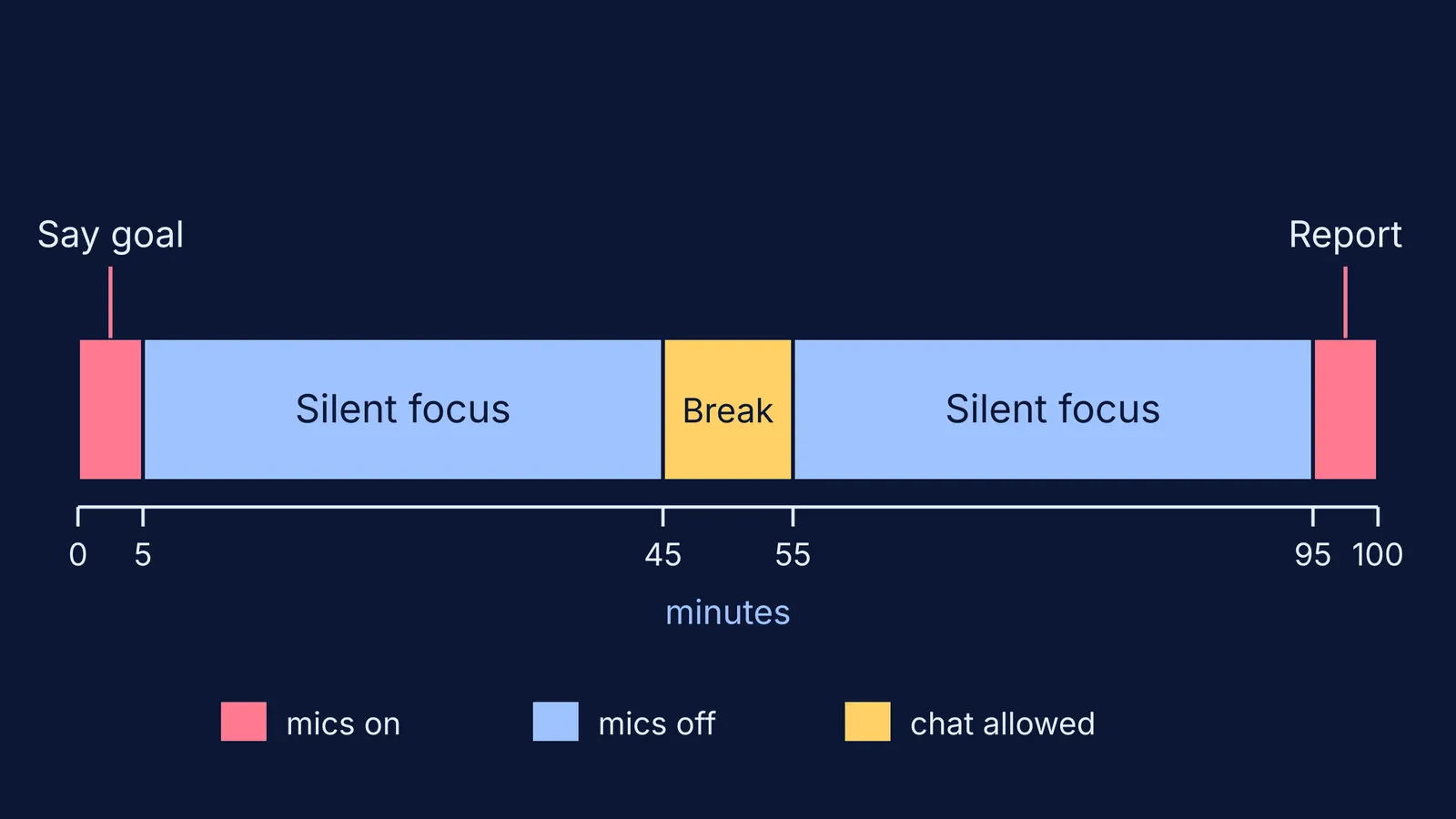
Here is a 100-minute plan for two to four friends.
Check-in, 5 minutes, mics on. Each person says one specific goal: "20 kinematics questions from chapter 3", not "physics".
Focus block, 40 minutes, mics off. Cameras on, self-view hidden, phone face down out of reach. One person runs a shared timer.
Break, 10 minutes. Stand up, drink water, talk if you like. This is where chat belongs.
Second focus block, 40 minutes, mics off.
Check-out, 5 minutes, mics on. Each person reports done, half done, or stuck, and names the first task for next time.
Block length is a choice, not a rule; our piece on what research on breaks says about the Pomodoro technique covers the trade-offs. If writing a goal is the hard part, try WOOP and if-then plans for study goals.
If you sit down and do not know what your goal should be, Fermi's AI tutor can work out what you already know and build a plan for the session, so you bring a clear first task to the check-in.
When does a study call turn into chat?
Watch for these signs:
Someone unmutes in a focus block for anything other than an emergency.
The check-in runs past 10 minutes.
You keep glancing at the grid to see who is still working.
The chat box has more messages than you have solved questions.
At check-out, most people report "half done" week after week.
If two of these happen in one session, reset: shorten the check-in, move all talk to the break, and close the chat box during focus blocks. If the group wants to discuss problems together, that is a different, useful session; plan it as one, using how to run a study group that actually helps you learn.
If a doubt is still unsolved after the break, the Fermi Problem Library has worked problems with a step-by-step solver that explains the reasoning rather than printing an answer.
What should parents know?
A quiet call with known classmates can make long revision days less lonely. Ask your child who is on it and what the plan is, rather than watching the screen. Some students find being watched uncomfortable, even on mute, and work better alone; that is fine too.
If studying feels overwhelming most days, talk to someone you trust. Tele MANAS, a free 24x7 national mental-health helpline, answers on 14416 or 1800-891-4416.
Start with one session this week: one friend, one goal, mics off.


