On this page
A recorded lecture has one big advantage over a live class: the pause button. Most students use it to catch up on typing. The better use is to stop, look away and write down what you just understood, in your own words, before pressing play again.
Why is transcribing a recorded lecture a trap?
Copying every word feels productive, but it lets the words pass from your ears to your fingers without much thinking in between. In three studies by Pam Mueller and Daniel Oppenheimer, students who took notes on laptops did worse on conceptual questions, and the authors linked this to their tendency to transcribe lectures verbatim rather than reframe the ideas in their own words.
The handwriting-versus-laptop part of that finding is less settled. A 2019 replication by Kayla Morehead, John Dunlosky and Katherine Rawson did not find a consistent advantage for longhand notes, and the Learning Scientists' summary of it points instead to what the notes capture. So the lesson is not "use a pen". It is "do not be a stenographer".
How do you take notes from a recorded lecture?
Use a simple loop we call pause, recall, flag. It works on paper or a laptop.
Watch a chunk without writing. Five or six minutes, or until the teacher finishes one idea; the Harvard lecture study described below used segments of about five and a half minutes. Keep your hands off the keyboard so your attention stays on the explanation.
Pause and recall. Stop the video, look away from the screen and write two to four lines on what that chunk said, from memory, in your own words. Include one example or equation if there was one.
Flag what you could not explain. If you got stuck mid-summary, write the timestamp and a short question, such as "05:10 why sin and not cos?". Do not rewind yet.
Play the next chunk. Repeat until the lecture ends.
Clear your flags. Rewatch only the flagged timestamps, then fix your summaries.
The "from memory" part is what does the work. A research review in Psychological Science in the Public Interest rated summarisation on its own as low utility but practice testing as high utility. Writing your summary with the video paused and the slides out of sight turns it into a small self-test on what you just heard.
Does pausing a lecture actually help you learn?
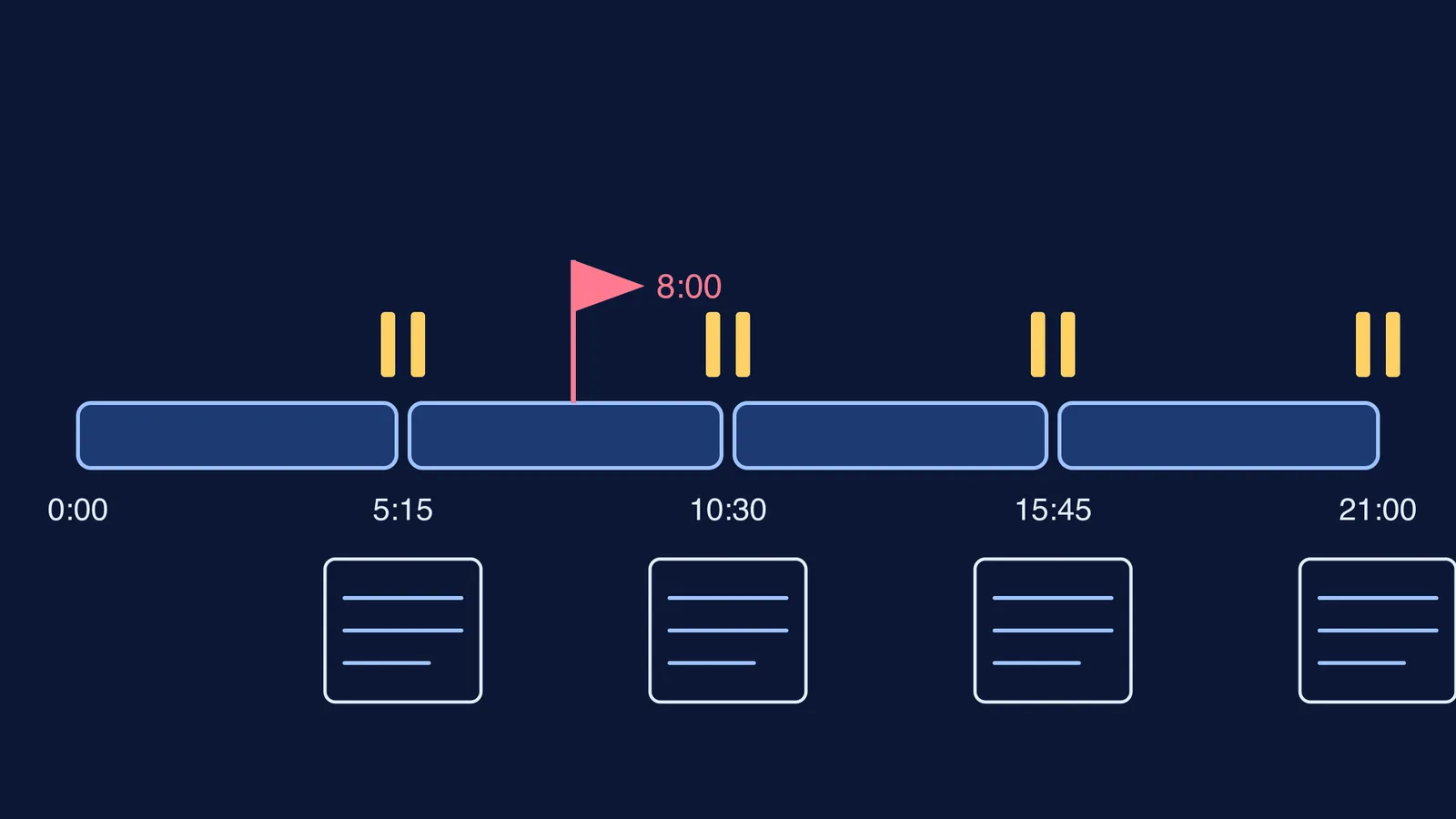
A Harvard study gives a strong hint. Karl Szpunar, Novall Khan and Daniel Schacter split a 21-minute recorded statistics lecture into four segments and gave some students a short quiz after each one. In their second experiment, the quizzed students reported mind wandering on 19% of thought probes, compared with 41% for students who were not quizzed until the end. The quizzed group also scored 90% on the final cumulative test, against 68% for the students who were not quizzed between segments.
In the first experiment, the quizzed students added notes on 17% of slides, against 6% for the others. That study used quizzes, not student-written summaries, so treat it as a strong reason to stop and test yourself, not proof of one exact method.
What does a good segment summary look like?
Here is a worked example from a recorded class on projectile motion, a Class 11 physics topic.
Transcribing (what most notes look like): "So now as you can see the horizontal component is u cos theta and there is no force in the horizontal direction so it will remain..."
Pause-and-recall summary at 06:40: "Horizontal velocity stays the same all the way because nothing pushes sideways (ignoring air resistance). Vertical motion is plain free fall with g. Time of flight T = 2u sin θ / g: time to go up until vertical velocity is zero, doubled."
Flag: "05:10 why does the vertical part use sin? Draw the triangle."
The summary is shorter than the transcript, and it shows you exactly what you have not yet understood.
What should you do with the timestamps?
Treat your flags as a short to-do list, not a reason to rewatch the whole lecture. After the lecture, open each flag, watch from a little before it, and rewrite that summary. If the idea still does not click after a second watch, the same explanation a third time may not help either; try a different one. The Fermi Concept Library has every concept in physics, chemistry, biology, mathematics and computing, each with its own lesson, so you can come back to the lecture with the gap filled.
If you study from Fermi Courses, the AI tutor is available on every lecture, so you can ask about the segment you just paused on rather than saving the question for later.
A day or two later, cover your summaries, read only the timestamps and questions, and try to answer them aloud. Tonight, pick one recorded lecture you have been putting off and try it with a timer set for your first chunk.