

On this page
You have 30 minutes before tuition, or while the rice cooks, or between school ending and a family errand. It feels too short to really study, so it often goes to the phone. But a short slot suits the study methods with the strongest evidence, as long as you choose the task before the slot starts.
Can you study effectively in 30 minutes?
Yes, if the task is self-contained. In a 2013 review in Psychological Science in the Public Interest, John Dunlosky and colleagues assessed 10 common learning techniques (Dunlosky et al., 2013). Practice testing and distributed practice were the two rated high utility, because they helped learners of different ages and abilities. Rereading and highlighting were rated low utility, and the authors suggest practice testing in place of rereading.
Both high-utility methods suit short slots. Testing yourself needs no setup, and spreading practice across the day is what short slots do anyway.
One study shows why the choice of task matters. Henry Roediger and Jeffrey Karpicke had students either reread prose passages or take recall tests on them (Roediger and Karpicke, 2006). On a final test 5 minutes later, rereading did better. On tests 2 days or 1 week later, the students who had tested themselves remembered substantially more, even though rereading made students feel more confident.
How should you split a 30-minute study slot?
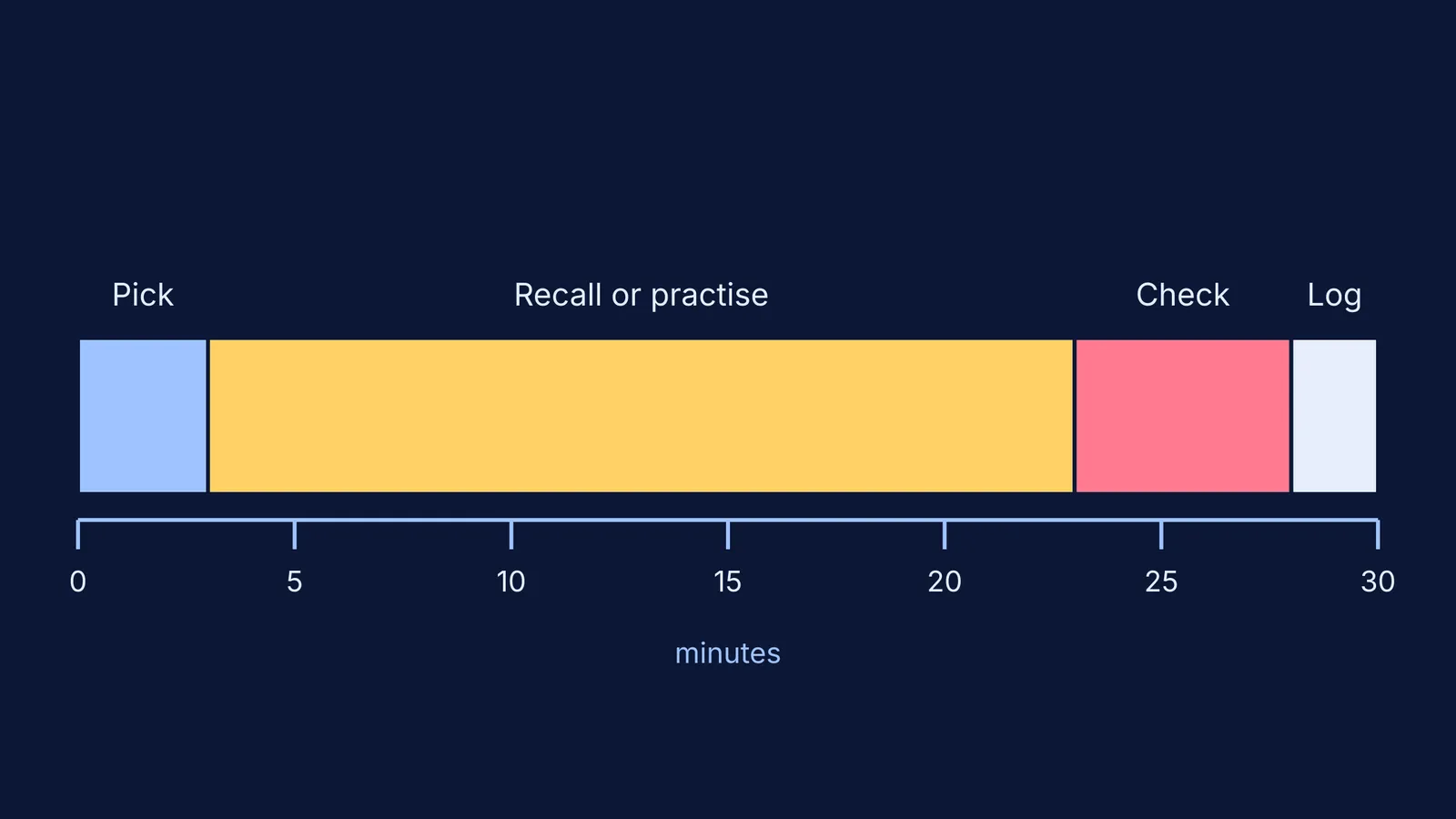
Use the same shape every time, so you do not spend the slot deciding what to do:
Minutes 0 to 3: pick. Take one task from the menu below, open the right page and put the phone in another room.
Minutes 3 to 23: recall or practise. Book closed for recall; timer on for problems.
Minutes 23 to 28: check. Open the book or answer key and mark what you missed in a different colour.
Minutes 28 to 30: log. Write one line: what you did, what you got wrong, and what the next slot should be.
That last line matters most. It means your next short slot starts with the decision already made.
What can you study in 30 minutes?
Pick one task per slot:
Blurt today's class. Write everything you remember from one lesson on a blank page, then check it against your notes. Our guide to the blurting method walks through it.
Five timed problems. One topic, physics numericals or maths, with a timer running.
A flashcard round. Chemistry reactions, biology terms, units and dimensions. Sort the cards into knew it and missed it.
Redo one wrong question. Take a question from your last test, cover the solution and solve it again from scratch.
A derivation from memory. Write out one derivation or proof without looking, then compare it line by line.
A diagram from memory. Draw and label a heart, a nephron, a ray diagram or a circuit, then check.
An old-topic review. Quick questions on a chapter you finished a while ago. This is spaced practice in action.
A mixed set. Three problems from three different chapters, so you practise choosing the method. Our interleaved practice plan explains why mixing helps.
Save new chapters, long reading and full mock tests for longer sessions.
Which task fits which gap?
Match the task to your energy and to what you have with you:
Straight after a class: blurt that class while it is fresh.
Tired, after school or chores: flashcards or a diagram from memory. They need less warm-up than problems.
Fresh, at a desk: timed problems or a derivation.
Only a phone or a notebook: flashcards or an old-topic review.
A much shorter gap: shrink the task, not the method. Our post on what to study in ten-minute gaps has smaller options.
What does a day of 30-minute slots look like?
Take Riya, an imaginary Class 11 student. She has 30 minutes after school before helping at home, and another 30 after dinner.
4:10 pm: She blurts that morning's chemistry class on the mole concept and misses the idea of a limiting reagent. Log: redo the limiting-reagent example.
8:30 pm: She redoes that example with the solution covered, then tries two similar problems. Log: physics flashcards on units tomorrow.
Neither slot needed a timetable. Each one started with a single line written at the end of the slot before.
If a problem stops you cold, do not spend the whole slot stuck. The Fermi Problem Library has a step-by-step solver that explains the reasoning rather than printing an answer, so you can see where your method went wrong and still finish the check. If the gap is a concept rather than a method, the Fermi Concept Library has its own lesson for every concept in physics, chemistry, biology, mathematics and computing.
Write your first log line tonight: one task for tomorrow's shortest gap.


