

On this page
You are waiting for a bus, sitting in the car, or caught in the gap between a coaching class ending and dinner starting. It is ten minutes—too little time to start reading a new chapter, but too much time to let slip away, especially when exams are approaching.
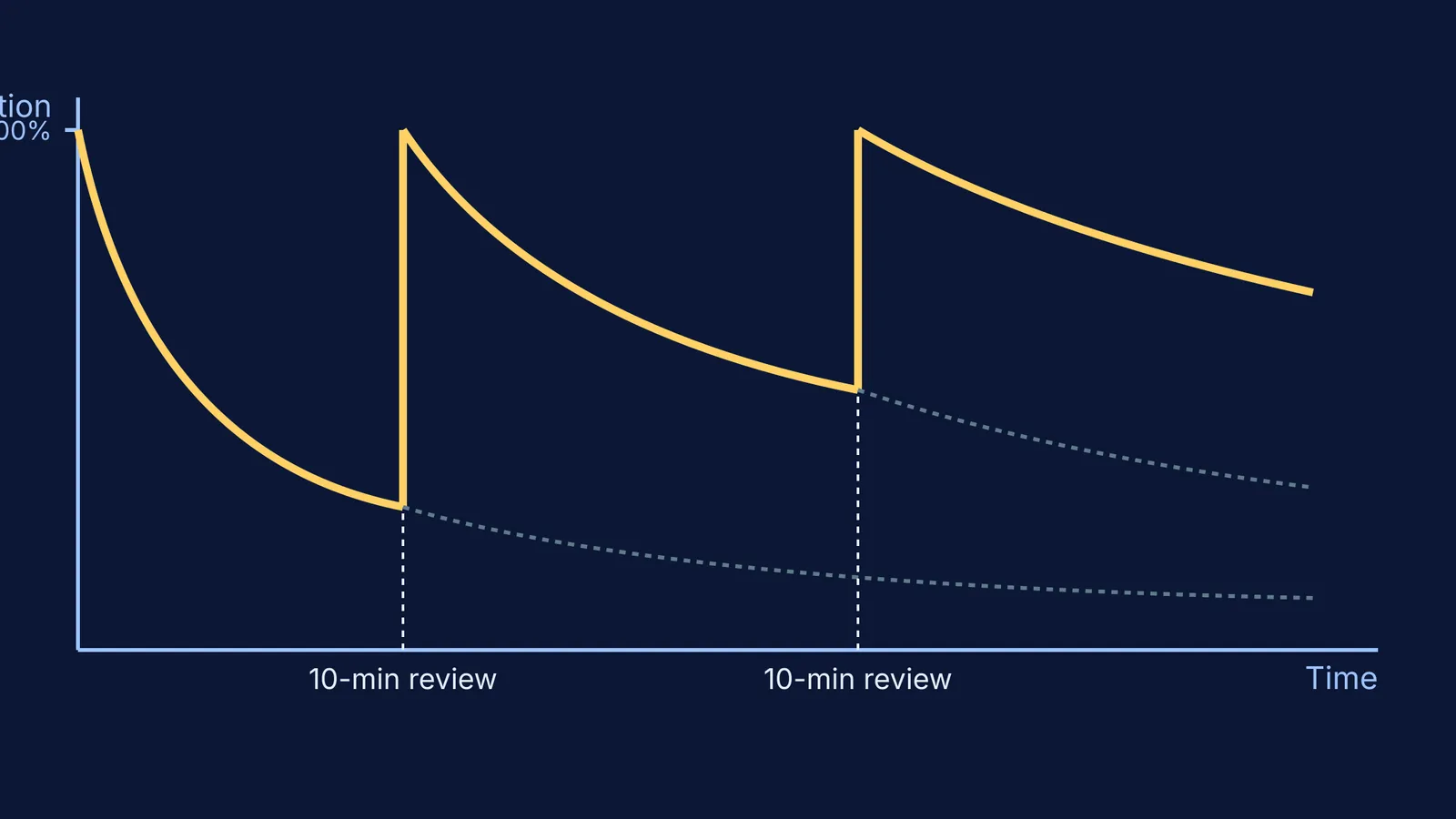
When you only have a sliver of time, the absolute best use of it is retrieval practice. A 2020 meta-analysis by Latimier, Peyre, and Ramus examined 29 studies and confirmed the robust benefit of spacing out retrieval practice episodes on long-term retention (Center for Open Science). Pulling facts out of your memory in short bursts tells your brain that this information matters and must not be discarded. Instead of passive reading, active recall strengthens the neural pathways required to access that knowledge during an exam.
What to study in ten minutes free time?
The biggest obstacle to micro-studying is friction. If you spend five minutes deciding what to do and finding your materials, the gap is already gone. To make this work, you need to eliminate decisions. Keep a physical notebook in your bag or a specific list on your phone of tasks that take exactly ten minutes. Here are four powerful ways to use those gaps.
Write out a formula sheet from memory: Take a completely blank piece of paper and try to write down every formula, chemical reaction, or mathematical identity you can remember from a chapter you studied last month. Do not look at your notes. The struggle to remember is the mechanism that builds retention. When the ten minutes are up, check your sheet against your textbook and correct your mistakes in a different colour pen. This instantly highlights your weak spots for your next full study block.
Complete a single MCQ set: Pick 10 to 15 multiple-choice questions from a topic you finished a week ago. Do not use this time to learn a completely new concept; use it to test an old one. This is pure retrieval practice. If you find that your method is wrong and you are not sure how to fix it, this is where the Fermi Problem Library comes in handy. It offers worked problems with a step-by-step solver that explains the reasoning rather than printing an answer, allowing you to quickly spot where your logic broke down.
Can short study sessions really help?
Yes, they make a measurable difference, not just in memory but in how you feel about the subject. Studying in small chunks—often called micro-learning—keeps cognitive load manageable and prevents the overwhelming feeling of a four-hour marathon.
A 2026 study by Mohd Nadeem evaluated visual micro-learning interventions over a four-week cycle in middle school mathematics. The findings demonstrated a statistically significant enhancement in conceptual retention and problem-solving accuracy (a normalized learning gain of 0.67 in the experimental group versus 0.28 in the control group). Crucially, the qualitative data revealed an 85.0% reduction in self-reported maths anxiety among the students (Springer Nature).
When you learn to use these gaps, you build a study routine that lasts because you are not relying solely on massive blocks of willpower.
How to use micro-learning to fix mistakes?
Review yesterday's mistakes: Often, students check the solution to a question they got wrong, nod in agreement, and move on. Ten minutes is the perfect amount of time to open yesterday's mock test, cover up the solutions, and re-solve the two hardest questions from scratch. If you still cannot find the path forward, Fermi's AI tutor can help by working out what you already know, building a plan for the session, and teaching through it—writing on a board and checking your understanding as it goes.
Run through targeted flashcards: Keep a small stack of flashcards for biology definitions, organic chemistry structures, or physics constants. A ten-minute ride is exactly enough time to sort a deck into "known" and "unknown" piles. Because the session is short, you are forced to focus intensely.
You can even fold these short tasks into your existing schedule when deciding what to do in a study break. Instead of picking up your phone to scroll through social media—which fragments your attention further—use a short gap to run a quick flashcard deck. It gives your brain a break from heavy problem-solving while still reinforcing your long-term memory.
A daily framework for finding ten-minute gaps
You do not need to invent more time; you just need to capture the time that is already slipping away. Look at your daily schedule and identify the structural gaps. These are periods where you are trapped by logistics but mentally free.
The commute gap: If you take a bus or train to school, this is a prime opportunity for flashcards or reading over your mistakes list.
The transition gap: The ten minutes between arriving home from school and taking off your uniform to eat. Before you relax, sit at your desk and write out a memory map of the last class you attended.
The waiting gap: Waiting for dinner to be served, or waiting for a teacher to arrive in the classroom. Use this for quick MCQs.
By treating these scattered minutes as valuable academic currency, you transform passive waiting into active preparation. Over a week, capturing just three ten-minute gaps a day adds up to three and a half hours of highly focused, high-retention study time, completely free of the fatigue that comes with long study sessions.


