

On this page
In India, Diwali often falls mid-term, Eid can land close to exams, and a cousin's wedding can take over a whole week of haldi, mehndi, sangeet and a late-night baraat. Trying to keep your full timetable through all that usually ends in guilt. A smaller plan works better: two short protected blocks a day, light tasks in them, and a planned catch-up once the house is quiet.
Should you study at all during Diwali, Eid or a wedding?
Yes, but less, and on purpose. The goal is to keep the thread going, not to finish a chapter, so school does not restart with an "I have forgotten everything" feeling.
Missing a day does less damage than it feels like. In a study of 96 volunteers who each chose an eating, drinking or activity behaviour to repeat daily for 12 weeks, Lally and colleagues found that missing one opportunity to perform the behaviour did not materially affect habit formation. Repeating the behaviour in a consistent context, such as "after breakfast", made it steadily more automatic, so tie your blocks to fixed moments.
How much can you realistically study on a festival day?
Plan for two blocks of about half an hour a day: one early, before the house wakes up, and one in a quiet gap, such as the afternoon lull before an evening function.
Tie each block to a cue with an if-then plan: "If it is 7 am, then I sit at the terrace table with my physics notebook." A meta-analysis by Gollwitzer and Sheeran pooled 94 independent tests and found that if-then plans like this had a medium-to-large effect (d = 0.65) on reaching goals.
Don't take the study time out of your sleep. The American Academy of Sleep Medicine recommends that teenagers aged 13 to 18 sleep 8 to 10 hours per 24 hours. After a 1 am baraat, move the morning block to the afternoon.
What should you study in a short block?
Pick tasks that need little setup:
Close the book, write down everything you remember from the last chapter, then check.
Do a handful of questions from a topic you have already studied.
Make or review flashcards for formulas, reactions or diagrams.
Redo two questions you got wrong in your last test.
Reread one short NCERT section that has already been taught in class.
Testing yourself suits a short slot well. In Roediger and Karpicke's experiments, students who took recall tests on prose passages remembered substantially more two days and one week later than students who restudied the passages instead. Save new chapters, long derivations and full mock tests for after the festival.
If a quick quiz shows a gap, the Fermi Concept Library has a lesson for every concept in physics, chemistry, biology and mathematics. For even smaller gaps between rituals, see what to study in ten minutes of free time.
A sample plan for a wedding week
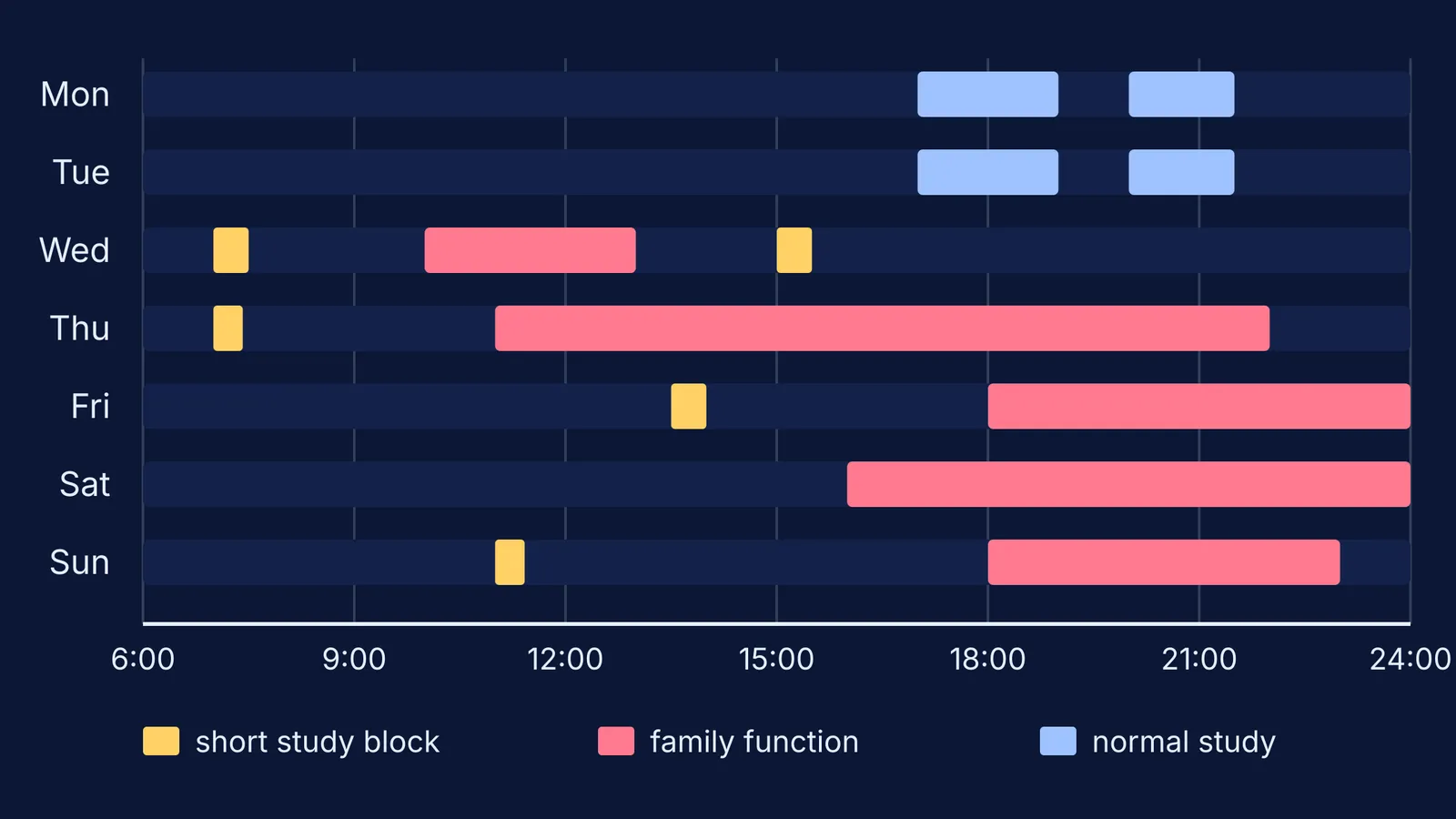
A Class 11 student with a cousin's wedding from Wednesday to Sunday might plan:
Monday and Tuesday (normal days): finish the topic you are on, so nothing is left half-done.
Wednesday (haldi in the morning): block one at 7 am, chemistry flashcards; block two at 3 pm, a short set of physics questions from the last chapter.
Thursday (mehndi, guests all day): block one early, written recall of one maths topic; skip block two if you need to.
Friday (sangeet at night): one block after lunch.
Saturday (wedding, very late night): rest. Write one line in your notebook about where to start on Monday.
Sunday (reception): one block reviewing the wrong answers from your last test.
The next three days: the catch-up plan below.
It is not much, but Monday starts from a note, not from zero.
What can you say to relatives who want you to join in?
Be clear and brief. Try: "I'll join you in half an hour. I just need to finish one set of questions." Or in the morning: "I'm doing a bit of study before everyone wakes up, so I'll be free for the function." For more on a full house, read how to manage relatives visiting during board exams.
How do you catch up after the festival?
Plan three catch-up days, not one marathon. Day one: list everything you missed, including homework, coaching sheets and test dates. Day two: clear the items with deadlines. Day three: return to your normal timetable plus one extra block for leftovers. Our guide on catching up after missing a week of classes has a fuller version.
If the list feels too long to start, Fermi's AI tutor works out what you already know and builds a plan for the session, so you sit down to a clear next step.
You can also call Tele MANAS, the free 24x7 national mental-health helpline, on 14416 or 1800-891-4416.


