

On this page
Almost every student has one: the subject you push to tomorrow, then to the weekend before the test. You do not need to start loving it. You need a routine small enough that you keep turning up, so the backlog never grows.
Why does a subject you dislike feel worse before you start?
For maths anxiety at least, part of the dread seems to be about the moment before you start, not the work itself. In a brain-imaging study, Ian Lyons and Sian Beilock (2012) found that the higher people's maths anxiety, the more activity they showed in pain-related brain regions while waiting for a maths task. The link did not appear while they did the maths. In the authors' words, "it is not that math itself hurts; rather, the anticipation of math is painful."
If the worst part comes before you begin, the plan should make beginning short, scheduled and easy.
How do you study a subject you do not like?
Use these four pieces together.
A fixed daily slot. Pick a time and place, and write it as an if-then plan: "After I finish dinner, I sit at my desk and do 20 minutes of chemistry." A meta-analysis of 94 independent tests by Gollwitzer and Sheeran (2006)38002-1) found that if-then plans like this had a medium-to-large effect on reaching goals (d = 0.65).
The easiest entry topic. Do not start with the chapter you fear most. Start with the one where you can get something right in the first ten minutes, such as definitions or a simple numerical. If you cannot tell which topic is easiest because you are missing basics, the Fermi Concept Library gives each concept its own lesson and its place in the map, so you can see what comes first.
A visible progress log. Keep a sheet on the wall or the first page of a notebook: date, minutes, topic, one thing you can now do. A meta-analysis of 138 studies with 19,951 participants by Harkin and colleagues (2016) found that prompting people to monitor their progress helped them reach goals (d = 0.40). The effect was larger when the progress was physically recorded, or reported to others or made public.
Pair it with something you enjoy. In a gym experiment, Milkman, Minson and Volpp (2014) let some people listen to gripping audiobooks only at the gym. At first, that group visited the gym 51% more often than the control group, though the effect faded over time. That was exercise, not study, but you can adapt it: save a favourite playlist for the disliked slot only, or follow the slot with your favourite subject.
What does a week of short daily slots look like?
Take an example student, Meera, in Class 11. She enjoys physics and dreads organic chemistry. Here is her first week:
Slot: 8:00 to 8:20 pm, desk, phone in another room. Physics problems follow at 8:20.
Monday: naming simple alkanes. Log: "named 10 of 12 correctly."
Tuesday: naming with branches. Log: "fixed the numbering mistake."
Wednesday: functional groups, flashcards. Log: "8 groups by sight."
Thursday: revise Monday to Wednesday with five mixed questions.
Friday: isomers, two examples.
Saturday: a short quiz from Thursday's mistakes.
Sunday: off. She looks at the log and picks next week's easiest topic.
By Sunday she has done two hours of organic chemistry, twenty minutes at a time. Once the slot feels routine, mix in older topics using an interleaved practice plan. If you keep losing the thread between sessions, try stopping mid-task so the next session is easy to restart.
How long until it stops feeling like a fight?
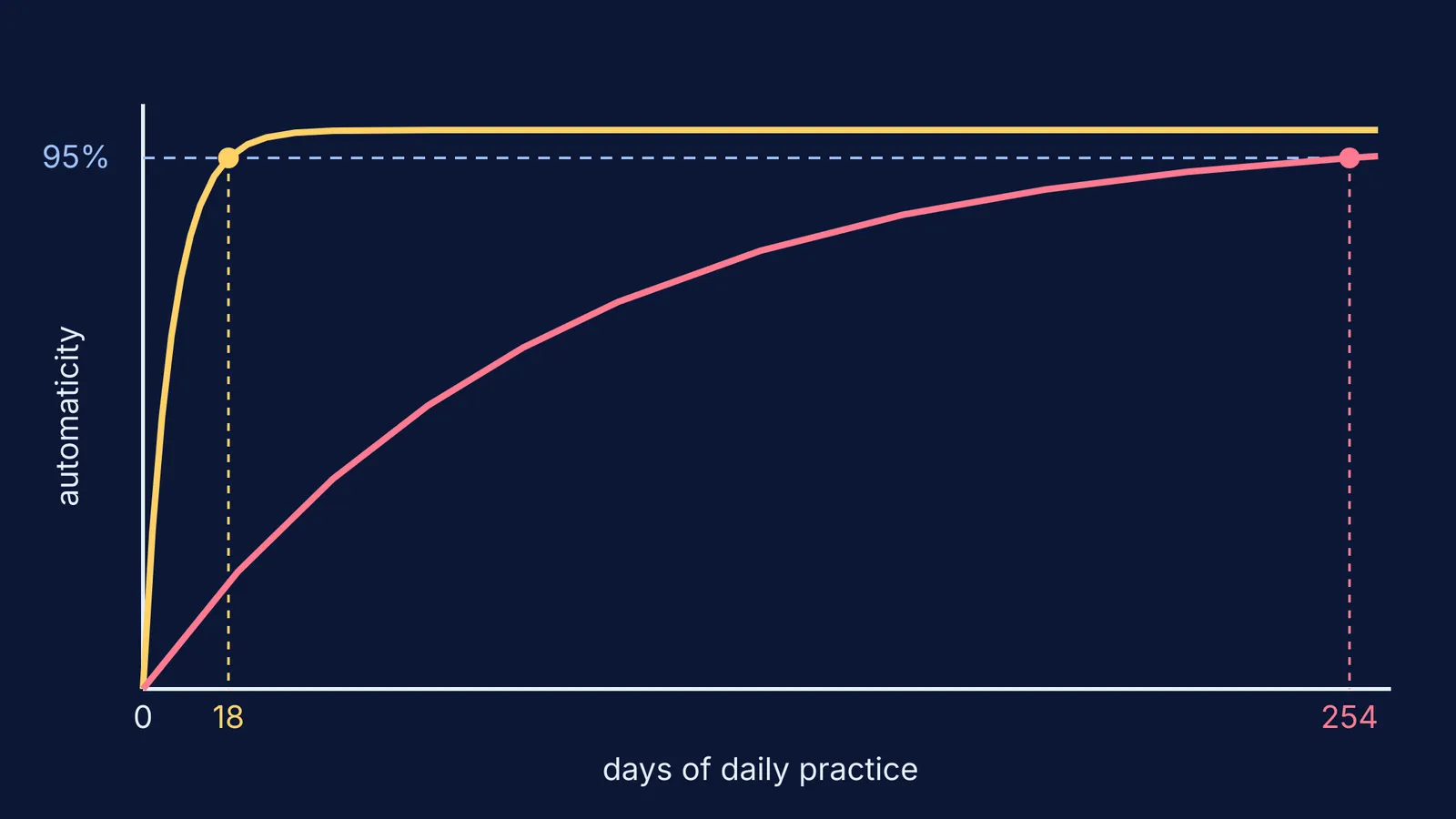
Longer than a week, and it varies widely. In a study by Lally and colleagues (2009), 96 volunteers repeated one daily behaviour in the same setting for 12 weeks. The estimated time it took people to reach 95% of their own plateau of automaticity ranged from 18 to 254 days. People who did the behaviour more consistently fitted the habit curve better. So judge yourself by the log, not by how you feel on day five.
If you have fallen far behind, a fixed slot alone will not be enough. Use a fuller weakest-subject rescue plan. If you are stuck on where to begin, Fermi's AI tutor works out what you already know and builds a plan for the session.
What can parents say to help?
Ask about the log, not the feeling. Try: "I saw you did twenty minutes again. What can you do now that you couldn't on Monday?" Avoid "Why do you hate chemistry so much?", which puts the dread at the centre.
Tele MANAS is a Ministry of Health and Family Welfare helpline; IIT Kanpur's Tele MANAS page lists its numbers. Tonight, choose your slot, pick the easiest topic and draw the first line of your log.


