

On this page
If you are in Class 12 and have not started JEE preparation, you are probably carrying two worries: that classmates started in Class 9, and that boards will swallow your year. Both are fair, but neither makes it too late. What changes is the target: a strong JEE Main score alongside good board marks.
Is it too late to start JEE preparation in Class 12?
NTA's public notice of 24 October 2026 says JEE Main 2027 will be held in two sessions, January 2027 and April 2027, with Session 1 on six days between 20 and 28 January. Applications for Session 1 close on 22 November 2026. Paper 1 has 75 questions in 3 hours, 25 each in maths, physics and chemistry, and wrong answers lose marks in both the MCQ and numerical sections.
So January is a real attempt and a rehearsal, and April is a second shot; see how the two JEE Main sessions work.
Your school is also teaching a large part of the syllabus. The JEE Main 2027 syllabus lists 20 units in physics, 20 in chemistry and 14 in maths, and physics units 11 to 19, electrostatics through electronic devices, are Class 12 chapters you study for boards anyway.
What it is too late for is covering every topic at coaching depth before January. Say that out loud at home, so nobody measures you against a plan you never had.
Which chapters give the most returns?
NTA does not publish chapter-wise weightage, so treat any "top chapters" list as an estimate. Instead, ask three questions of each chapter: does my board exam need it, do other chapters depend on it, and can I learn it in about a week? Start with chapters that score yes on two or three.
Physics: current electricity, electrostatics, magnetic effects of current, electromagnetic induction and AC, optics, and the three short modern-physics units (dual nature, atoms and nuclei, electronic devices).
Chemistry: Class 12 organic (compounds of halogens, oxygen and nitrogen), coordination compounds, d- and f-block elements, solutions, electrochemistry and kinetics.
Maths: calculus (continuity and differentiability, integrals, differential equations), vectors and 3D geometry, matrices and determinants, and probability.
Which Class 11 topics should you pick up?
Do not restart Class 11. Pick up only what your Class 12 chapters stand on, when a chapter needs it:
Maths: functions and trigonometry first, because calculus runs on them; then straight lines and conics, and permutations and combinations before probability.
Physics: kinematics, laws of motion and work-energy, because a charge in a field is a mechanics problem.
Chemistry: mole concept, chemical bonding and the basic principles of organic chemistry, without which Class 12 organic becomes memorising reactions; then equilibrium, which electrochemistry builds on.
When a Class 11 gap shows up mid-chapter, the Fermi Concept Library gives every concept in physics, chemistry and mathematics its own lesson and its place in the map, so you can find the missing idea and patch only that.
What does a month-by-month JEE plan for Class 12 look like?
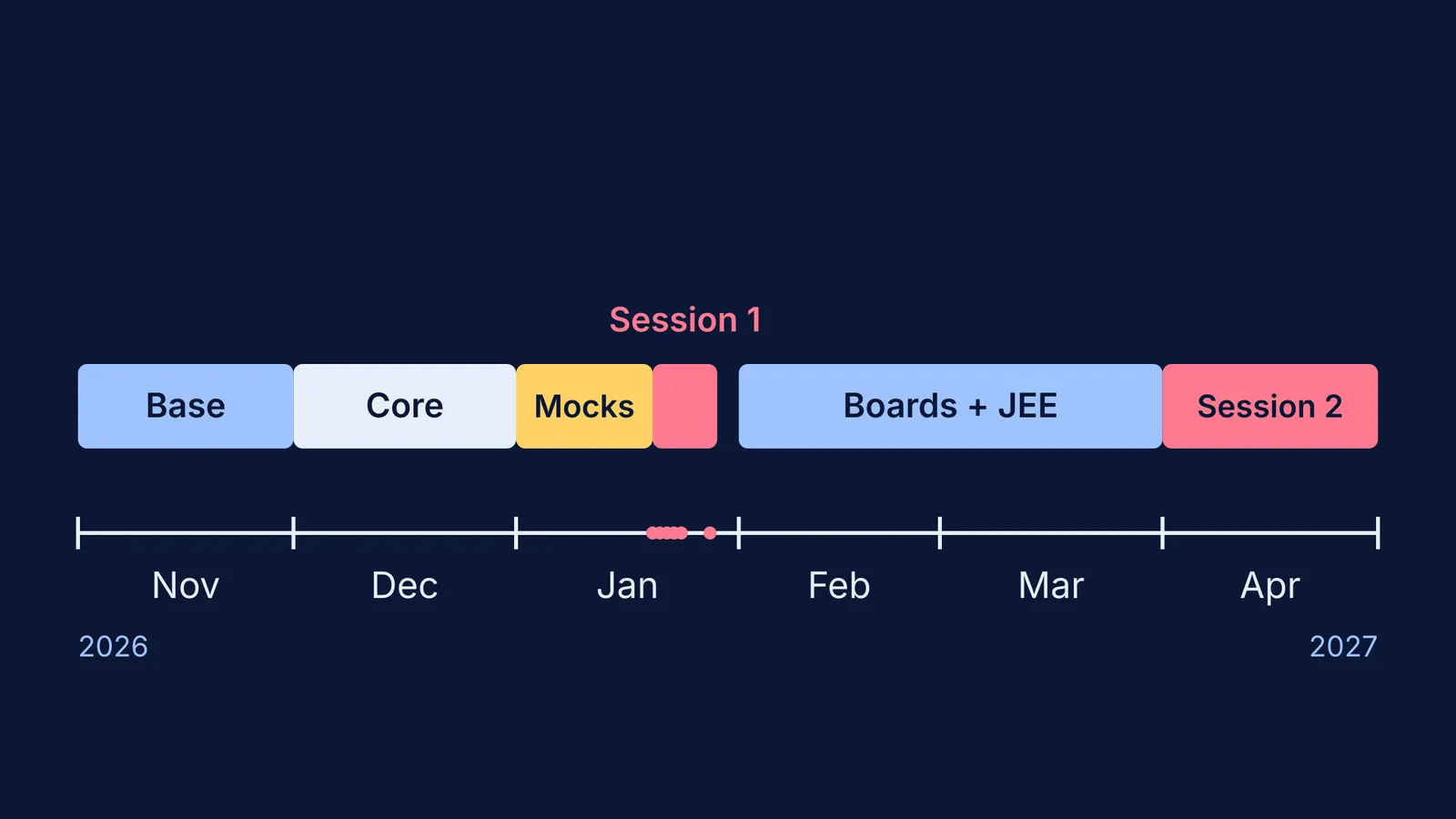
Here is a path for a student starting in November 2026. If you are reading this earlier in the year, stretch the first two months.
November, the base: sit one full paper under exam timing to see where you stand, then patch mole concept, functions and trigonometry, and kinematics.
December, the Class 12 core: electrostatics and current electricity, calculus, organic chemistry and coordination compounds. Take two full mocks and analyse each mock test by chapter and type of error.
January, Session 1: revise December's chapters and take a mock every three or four days. Afterwards, list the chapters that cost you marks.
February and March, boards in front: school and JEE overlap most. Keep a short daily block of JEE-style MCQs and numericals on the same chapters; see preparing for boards and JEE together.
April, Session 2: weekly full mocks, the weak chapters from your January list, and one or two parked Class 11 topics.
How you study matters as much as what. A review of 10 learning techniques by Dunlosky and colleagues (2013) rated practice testing and distributed practice as high utility, and rereading and highlighting as low utility. So solve questions from a chapter's first day, and return to each chapter in short rounds over weeks.
When a question goes wrong and you cannot see why, the Fermi Problem Library has a step-by-step solver that explains the reasoning rather than printing an answer, so you can find the step where your method slipped.
What can parents say to a late starter?
Try this instead of a pep talk: "You started later than some friends, and that's fine. Our aim is a good JEE Main score and good boards, not catching up on two years. What do you need from us this month?"
If worry turns into weeks of poor sleep, low mood or skipped meals, talk to a doctor or school counsellor, or call Tele-MANAS, the government's free 24x7 mental health helpline, on 14416 (see this PIB backgrounder).
Pick tonight's first chapter from the lists above, and put the January dates on the wall.


