

On this page
Over two years of JEE or NEET preparation you work through a huge pile of module and DPP questions. Most never need to be seen again. A small share taught you something: a trick, a trap, a method you would not have found alone. If you do not mark those as you solve, they get lost, and in the final month you end up rereading whole modules.
That rereading feels like work but does little. A 2013 review of ten study techniques by Dunlosky and colleagues rated rereading and highlighting as low utility, and practice testing and spaced practice as high utility. A symbol code turns your modules into material for the second kind of revision.
What symbols should you use to mark questions in modules?
Keep the code small enough to use without thinking. Draw these in pencil beside the question number the moment you finish or give up.
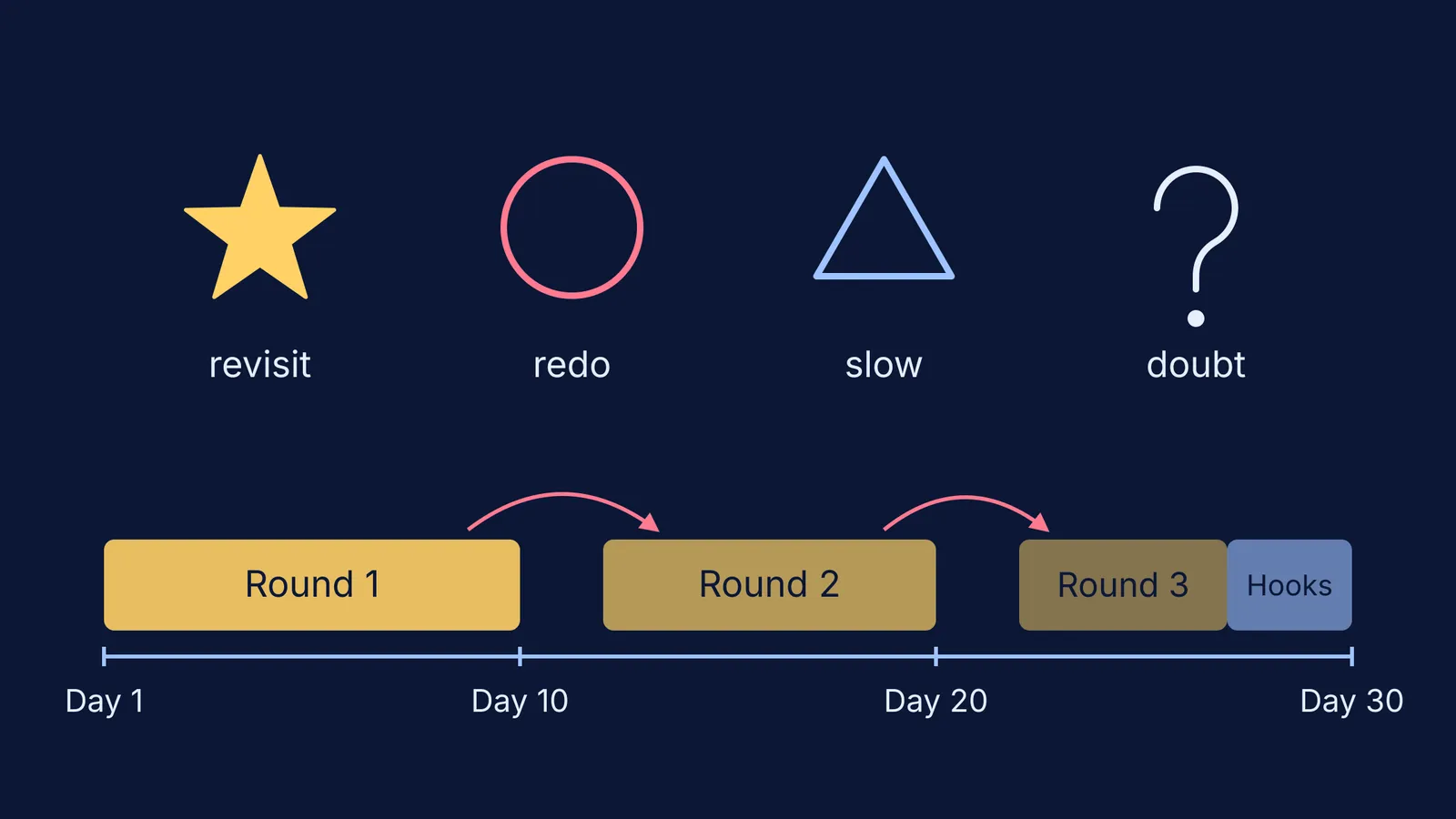
Star: worth revisiting. You solved it, but the idea was clever, new or easy to forget.
Circle: wrong or not solved. Redo it within a week, before looking at the solution.
Triangle: right but slow, well over the time you would have in the exam.
Question mark: a doubt the printed solution did not settle. Take it to a teacher or friend.
A question can carry two marks: a triangle with a star means "slow, and the fast method is worth learning". Unmarked questions were clean; let them go.
How do you mark a DPP while solving it?
Say you sit a 15-question rotational motion DPP. Afterwards the margin might read:
Q3: no mark. Standard moment of inertia, done quickly.
Q7: triangle and star, hook "rolling on incline: energy, not torque". You used torque and friction and took ages; the solution used energy conservation in three lines.
Q9: circle. You took the axis through the edge instead of the centre.
Q12: star, hook "angular momentum about contact point". You solved it only after a lucky guess about which point to pick.
Q14: question mark. The solution skips why friction does no work.
From 15 questions you keep two stars (one with a triangle), one circle and one question mark. The code keeps your final-month set small.
If you keep getting a circled question's method wrong, the Fermi Problem Library has worked problems with a step-by-step solver that explains the reasoning rather than printing an answer, so you can see where your approach went off. Once you get a circle right, star it if the mistake was an idea rather than a slip.
How do you turn starred questions into a final-month revision set?
About a month before the exam, stop adding stars and build the set.
Make an index. List every star by subject and chapter: source, question number and hook, such as "Rotation DPP 6, Q12, contact point".
Add the circles you still get wrong and any question mark that is still a doubt.
Mix the order across chapters, as in an interleaved practice plan. In the exam you will not be told which chapter a question is from.
Solve from cold, with a timer, without your old working. In Roediger and Karpicke's 2006 experiments, students who took recall tests remembered substantially more two days or a week later than students who restudied, even though restudying made them feel more confident.
Re-mark after each round. Clean and on time: tick it and drop it. Slipped: it goes into the next round.
Space the rounds. Round one over days 1 to 10, round two (only the slips) around days 13 to 20, round three (the stubborn ones) around days 23 to 27. In the last days, read the hooks and say each method aloud instead of solving.
Why spread the rounds out? In a study of more than 1,350 people learning a set of facts, Cepeda and colleagues found the best gap between study sessions was about 20 to 40% of a one-week delay before the test, and a smaller share for longer delays. For an exam weeks away, that points to gaps of days, not hours.
What if you have too many stars?
If the index runs past about ten sittings, you have been starring questions you simply liked. Keep a star only where the hook names an idea you could forget. A cluster of question marks in one chapter usually means a concept gap; the Fermi Concept Library covers every concept in physics, chemistry, biology, mathematics and computing, each with its own lesson, so you can fix the idea before returning to the questions.
The same habit works on textbooks: see how to annotate NCERT so it becomes your revision book, and how to split time between revision and new topics.
Start with today's DPP: four symbols, one hook per star.


