

On this page
If your coaching module splits each chapter into Level 1, Level 2 and an archive of past exam questions, finishing all of it can feel like the only safe choice. Trying usually means falling behind, then panic-skipping the wrong parts. A better plan: decide in advance what to do now, what later, and what not at all.
Should I solve all exercises in my coaching module?
Not in one go. Maths practice research points away from finishing every question before moving on.
In one experiment, students who solved nine practice problems of one type in a single session scored no better one and four weeks later than students who solved three (Rohrer and Taylor, 2006). The authors call this overlearning. In the same paper, spreading 10 problems across two sessions a week apart gave no benefit at one week but a very large one at four weeks.
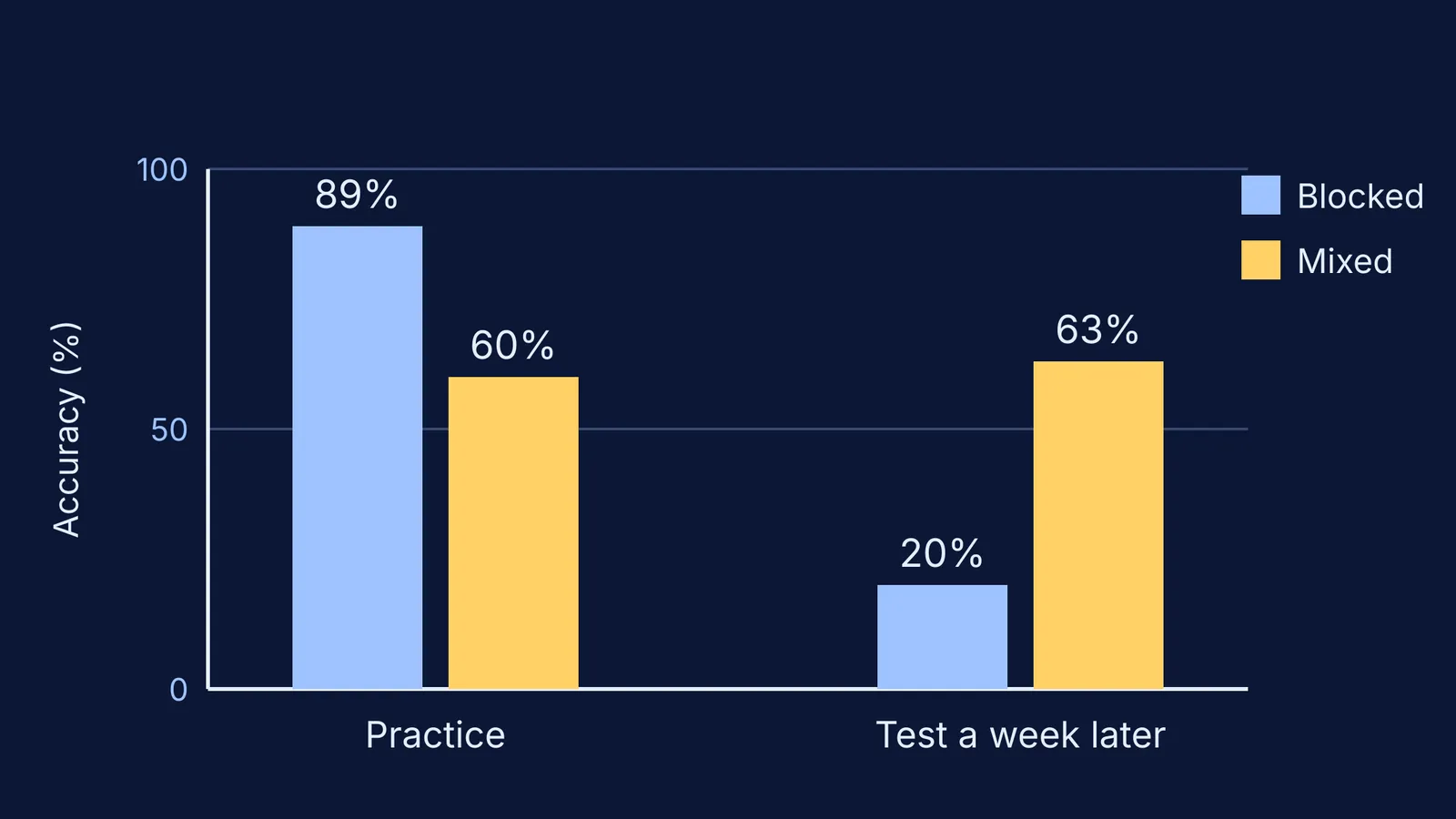
A follow-up study tested mixing problem types (Rohrer and Taylor, 2007). Students who practised in blocks, four problems of one type at a time, averaged 89% during practice but only 20% on a test a week later. Students who practised the same problems mixed averaged 60% during practice and 63% on the test. It was a small lab study of 18 undergraduates, so treat it as a strong hint: blocked practice felt easier but was retained far less.
A large review of ten study techniques rated practice testing and distributed (spread-out) practice as high utility, interleaved (mixed) practice as moderate, and rereading and highlighting as low (Dunlosky and colleagues, 2013). A module gives you the first two, if you stop treating it as a list to finish.
Which level should I do first: Level 1, Level 2 or the archive?
Just taught (first week). Do Level 1, but stop once you have solved three or four questions of each type correctly without the solution. Mark the rest "spare".
Consolidating (one to three weeks later). Do Level 2. These usually mix two or three ideas, so you must choose the method, which blocked Level 1 practice rarely asks.
Revision (a month or more later). Use the archive: past questions under time, mixed with other chapters. The official JEE Advanced archive has papers back to 2007.
Daily practice problems on top? See finishing DPPs without falling behind.
How should my chapter test score change the plan?
Your chapter test tells you which level you left too early. Read it by question type, not total marks.
Wrong on single-concept questions: the idea itself is shaky. Go back to the theory and a few spare Level 1 questions of that type. If a concept will not settle, the Fermi Concept Library gives every concept in physics, chemistry, biology and maths its own lesson.
Right on single-concept, wrong on mixed questions: you know the tools but not when to use which. Do Level 2 and mixed sets, not more Level 1.
Right method, wrong answer: this is calculation or reading. Re-solve the wrong ones slowly; do not add new questions.
Wrong method: find out why before you look at the answer. The Fermi Problem Library has a step-by-step solver that explains the reasoning rather than printing an answer.
Strong across types: skip the remaining Level 1 and move to archive questions sooner.
For how hard a question should feel, see picking practice questions at the right difficulty.
Which questions should I skip on purpose?
Skip these deliberately, and note it:
Level 1 questions of a type you have already solved correctly three or four times.
Questions that repeat the same steps with new numbers.
Archive questions on topics no longer in your syllabus. Check the current official syllabus, not the module's printing year.
Very long Level 2 or archive questions while the chapter is new. Star them for revision.
Never skip a type because the first attempt went badly; you need it most.
What does this look like for one chapter?
Say you have just finished Laws of Motion, and the module has 60 Level 1, 45 Level 2 and 40 archive questions.
Week 1: about 20 Level 1 questions, three or four per type. The other 40 become spares.
Weeks 2 and 3: 25 Level 2 questions over several days, mixed with your previous chapter.
Chapter test: suppose you lose marks on pulley and constraint questions. Do five spare Level 1 constraint questions, then redo the Level 2 ones you got wrong.
Week 6 onwards: the 40 archive questions in timed sets of 10, each set mixed with Work, Energy and Power. Our interleaved practice plan shows how to build these sets.
That is about 90 of 145 questions, each with a reason; the other 55 stay in reserve. If you are not sure where your gaps are, Fermi's AI tutor works out what you already know and builds a plan for the session.
Pick one chapter this week, mark its spares and stars, and compare your next test.


