

On this page
A DPP, or daily practice problem sheet, is the short set of questions most coaching classes hand out on the topic taught that day. DPPs are useful because they come daily, and that is also why they pile up: miss three days and you face three sheets plus today's. Here is a routine that stops the pile forming, and a plan for when it already has.
When should you do your DPP?
Do it on the same day as the class, after a short break and before you reread your notes. A DPP is a form of practice testing. A review of ten study techniques by John Dunlosky and colleagues rated practice testing and distributed practice (spreading practice over time) as the only two "high utility" techniques, because they help learners of different ages and abilities (Dunlosky et al., 2013). Trying questions before rereading shows you what you actually remember, not what looks familiar on the page.
Fix a slot instead of waiting for a free hour. Pick the first study block after you get home, not late at night once everything else is done. Our guide to building a study routine that lasts helps you fit the rest of the day around it.
How long should one DPP take?
Set the clock before you start. A simple rule:
First pass: give each question a cap, roughly 3 minutes for a single-answer question and 6 for a long numerical.
When the cap runs out, mark the question and move on.
Mark every question as solved, tried but wrong, or stuck.
Second pass: return to the marked ones with the time left, up to about an hour in total.
What should you do with the questions you could not solve?
Struggling first is not wasted time. A meta-analysis of 53 studies found that, on average, students who tried problems before being taught learned more than students taught first, though the trend reversed for children in second to fifth grade (Sinha and Kapur, 2021). So make a real attempt first, then climb this ladder instead of jumping to the answer key.
Reopen the concept in your notes, not the solution, and try once more for five minutes.
Read only the first line of the solution and finish the rest yourself.
If you are still stuck, read the full solution and write one line in a mistakes notebook: what you missed, in your own words.
Redo the question cold, without looking, three or four days later.
Our post on why making mistakes helps you learn shows how to keep that notebook useful.
If the gap is the idea itself, the Fermi Concept Library has a lesson for each concept in physics, chemistry, biology and mathematics, which fits step 1. If you follow the idea but not the method, the Fermi Problem Library has a step-by-step solver that explains the reasoning rather than printing an answer, which fits steps 2 and 3.
How do you catch up on a pile of pending DPPs?
First, today's sheet always comes first, so the pile stops growing. Second, you may not need every question on an old sheet. In the first experiment by Doug Rohrer and Kelli Taylor, college students who did two practice problems in one sitting instead of four scored about the same on a test a week later, 46% against 49% (Rohrer and Taylor, 2007). For old sheets, do the odd-numbered questions plus anything your teacher flagged.
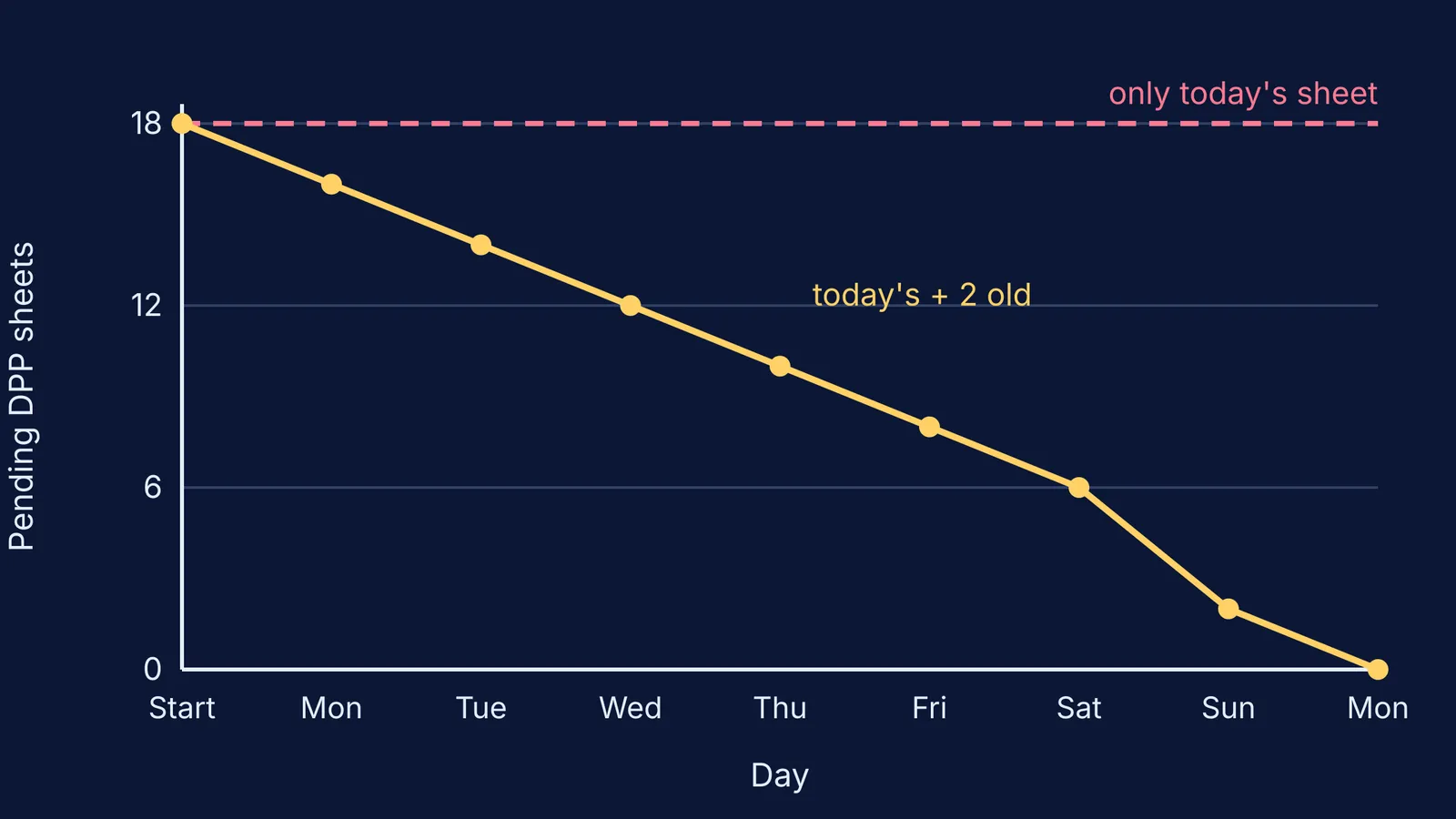
Third, mix chapters instead of finishing one at a time. In the same paper's second experiment, a small study of 18 college students (Rohrer and Taylor, 2007), students who practised mixed problem types scored 63% on a test one week later, against 20% for students who practised one type at a time. During practice the mixed group scored lower, 60% against 89%, so mixed practice can feel worse even when it is working better. The study mixed problem types within one topic, but the idea carries over to chapters.
That is roughly an extra hour a day for eight days. If your backlog is whole chapters rather than sheets, start with our triage plan to clear a JEE or NEET chapter backlog, then return to the DPPs.
What can parents say about DPPs?
Ask about the pile, not the marks. Try these instead of "Have you done your DPP?":
"How many sheets are pending right now?"
"Which question beat you today?"
"What time is your DPP slot tomorrow?"
If the backlog keeps growing for weeks, or your child seems anxious or worn out rather than simply behind, talk to their teachers and the school counsellor before adding more hours.
Tonight, count your pending sheets, write the number down and start with today's.


