

On this page
A crash course is a short, intense programme of revision lectures, timed tests and doubt sessions in the weeks before JEE Main or NEET-UG. Whether it helps depends more on where you are in your preparation than on who runs it.
What does a crash course actually offer?
Most crash courses sell three things:
Speed: each chapter in a lecture or two, assuming you have studied it before.
Structure: a daily timetable when your own plan has fallen apart.
Test practice: chapter tests and full mocks under exam timing.
What a crash course cannot offer is time. If a chapter is new to you, a fast recap gives you notes, not understanding.
Who benefits from a crash course, and who doesn't?
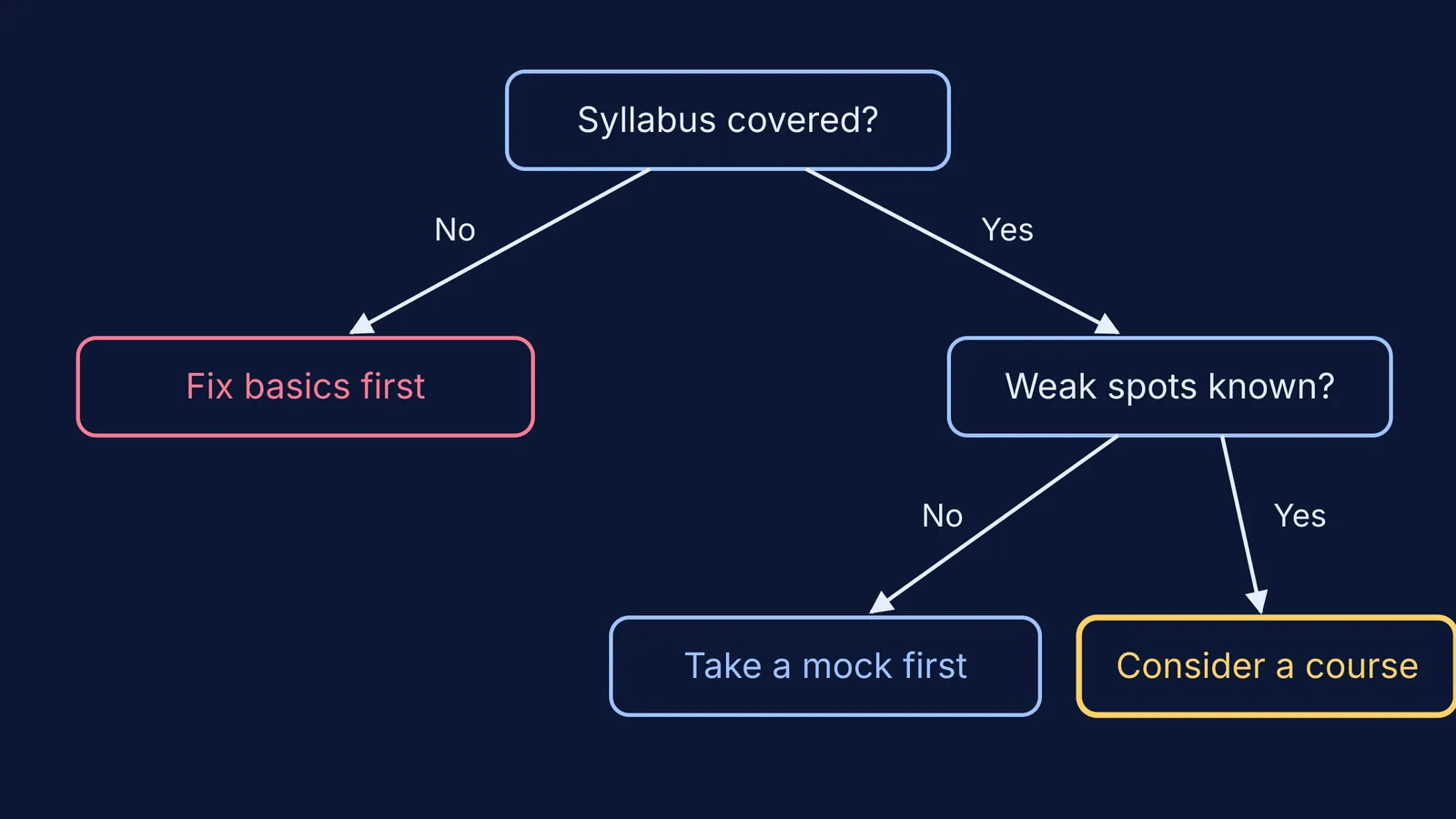
A crash course tends to fit you if:
you have covered most of the syllabus once, in school, coaching or on your own
you know your weak chapters from recent test scores
you need outside structure and timed papers more than new teaching
It tends not to fit if whole units are untouched, your full-year programme is already revising, or the commute would eat your day. If you already juggle several classes, our guide on how to judge each tuition class and drop the overlap applies here too.
What does research say about last-minute revision?
The useful part is the testing, not the lectures. In a 2013 review of ten study techniques, Dunlosky and colleagues gave only two a high-utility rating: practice testing and distributed practice (spreading study over time). Rereading and highlighting rated low.
In two experiments by Roediger and Karpicke (2006), students who took recall tests remembered more a week later than students who reread the same passage, even though rereading made students more confident. A lecture-heavy course can feel productive while doing the weaker thing.
A meta-analysis covering 317 experiments by Cepeda and colleagues found that the best gap between study sessions grows as the time until the test grows. So returning to each chapter several times beats one marathon pass; ask how often each chapter comes back in a course's test schedule. Our post on when to switch from chapter tests to full mocks shows one way to space them.
How do you check a crash course before paying?
The Ministry of Education sent states and union territories guidelines for regulating coaching centres on 16 January 2024, and a number of states have since brought in their own rules or laws, according to a written reply in the Rajya Sabha in August 2026. Under the central guidelines, a centre's website should list tutors' qualifications, course duration, fees, its exit and refund policy, and how many students got into higher education institutions.
The Central Consumer Protection Authority's guidelines on coaching adverts, issued on 13 November 2024, ban false claims about selection rates, ranks and guaranteed selections, and false urgency such as hints of limited seats (PIB). An advert showing a successful student must state the course they took and whether they paid for it.
Complaints are rising: students registered 16,276 grievances with the National Consumer Helpline in 2023-24, up from 4,815 in 2021-22, the release adds. If a centre will not refund you, call the National Consumer Helpline on 1915.
A checklist: should I join a crash course?
Answer yes or no:
Have I studied most of the syllabus at least once?
Can I name my three weakest chapters from recent test results?
Does the course give more hours to timed tests than to lectures?
Does each chapter come back more than once in its schedule?
Are the full fee and the exit and refund rules written down?
Is the commute under an hour each way?
Can my family afford it without the cost turning into pressure on me?
Five or more yeses: a crash course can fit. Three or fewer: spend the money and time on self-study and mocks first. Four: look at which answers were no.
A worked example. Aarav (not a real student) is in Class 12 with about ten weeks to JEE Main. His last three mocks show most marks lost in rotation and electrostatics. He answers yes to questions 1, 2, 5 and 7, but the course he found is mostly lectures, repeats no chapters and means a 90-minute commute. With four yeses and those noes, he holds off. He plans weekly full mocks plus spaced tests on his two weak chapters.
For chapter-level gaps like Aarav's, the Fermi Concept Library has a lesson for every concept in physics, chemistry, biology and mathematics, so you can rebuild one idea at a time. When mock errors come from the wrong method, the Fermi Problem Library has worked problems with a step-by-step solver that explains the reasoning rather than printing an answer.
If the last weeks feel too heavy, talk to someone you trust; the government's Tele MANAS helpline offers free support around the clock on 14416. Whatever you decide, decide it from your test results, not a poster.


