

On this page
The government's education survey for the National Sample Survey, run from April to June 2025, found that 27.0% of school students were taking or had taken private coaching that academic year, and 30.7% in urban areas. The same survey put the national average household spending on private coaching at ₹6,384 per student for the year at the higher secondary level. In Class 11 and 12, some students pay for a coaching institute and then add one or two home tuitions for the same subjects. Often the bigger cost is the hours, not the fee.
How many tuitions is too many?
There is no official number. A better test: if you spend more hours each week being taught than solving problems on your own, you probably have too many classes.
The reason is how memory works. Roediger and Karpicke (2006) found that students who took recall tests on prose passages remembered substantially more on tests two days or a week later than students who restudied them, even though restudying made them more confident. A large review by Dunlosky and colleagues (2013) rated practice testing and distributed (spaced) practice as the only two of ten techniques with high utility, and rereading and highlighting as low. Both are things you mostly do on your own, outside class. Passively copying notes has more in common with rereading than with testing yourself.
Warning signs that your timetable has tipped over:
Two teachers cover the same chapter in the same fortnight.
You do one class's homework while sitting in another.
You rarely attempt a question set without help before the next lecture.
How do you judge whether a tuition is worth keeping?
Score every class you attend, including the coaching institute, on four questions. Give 0 for no, 1 for sometimes, 2 for yes.
New: Does it teach something none of your other classes cover?
Fix: Does it fix a weakness you can name, such as organic reaction mechanisms or integration by parts?
Practice: Do you spend most of the time solving, with feedback on your mistakes, rather than copying?
Worth the hours: Counting travel and homework, is it a better use of the time than solving on your own?
A total of 6 to 8 means keep it. 3 to 5 means fix it: ask the tutor to switch to doubt-solving or timed practice, then rescore in a month. 0 to 2 means drop it at the end of the current fee period.
What does cutting tuitions look like in a real week?
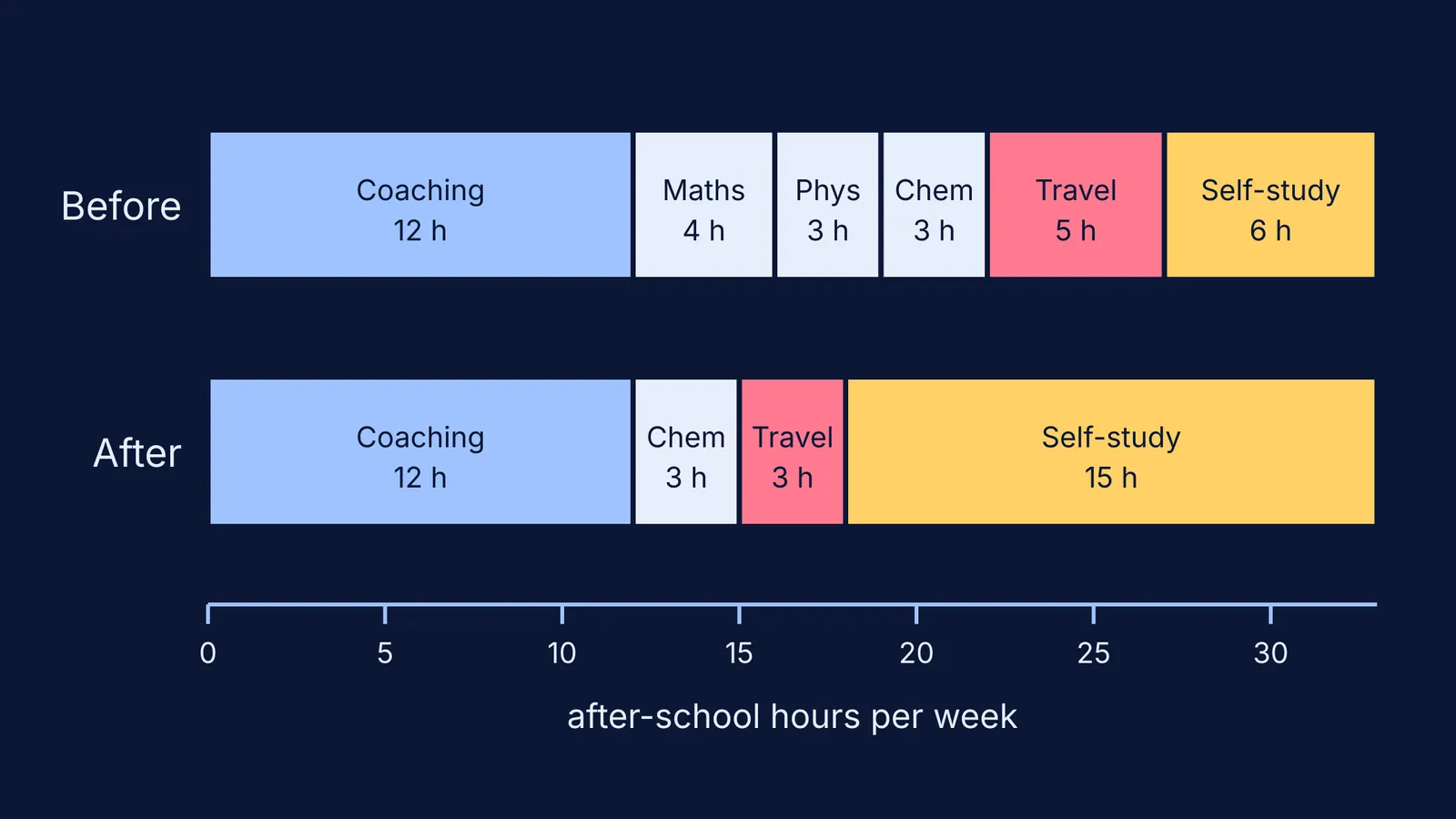
Take a Class 11 JEE aspirant we will call Aarav. Aarav's after-school week looked like this:
Coaching institute for physics, chemistry and maths: 12 hours
Home tuitions: maths 4 hours, physics 3 hours, chemistry 3 hours (online)
Travel: 5 hours
Self-study: 6 hours
The maths and physics tuitions scored 2 and 3. They followed the institute's chapters a week behind, so Aarav heard every topic twice. Chemistry scored 6, because the tutor drilled the organic mechanisms the institute rushed through. Aarav kept the institute and chemistry, dropped the other two, and moved those 7 class hours and 2 travel hours into self-study. The week stayed at 33 hours, but self-study went from 6 to 15.
How do you tell your parents you want to drop a tuition?
Bring your scores, not a complaint. You could say:
“I've scored each class. Maths tuition repeats what the institute teaches a week later, so I hear it twice and never get time to practise. Can I stop after this month and use those four hours for timed problem sets? If my next two maths test scores drop, we bring it back.”
The trial offer turns an argument into an experiment the family can check. Parents weighing the bigger decision can read our guides to choosing between coaching, online classes and self-study for JEE and evaluating a coaching institute before you pay the fee.
If the pressure of your schedule feels heavy, talk to someone you trust. Tele MANAS, the government's free mental health helpline, answers on 14416 at any hour.
What should you do with the freed-up hours?
Freed hours disappear unless they go into the timetable. Block them on fixed days, as in our guide to time blocking for students juggling school and coaching, and fill them with the high-utility work from the review above:
Attempt a problem set from today's class with the book closed.
Check your answers and write one line on why each wrong answer went wrong.
Before new work, answer ten quick questions on last week's chapter.
If you sit down to a free hour and don't know where to begin, Fermi's AI tutor can work out what you already know and build a plan for the session. When a problem beats you, the Fermi Problem Library has a step-by-step solver that explains the reasoning, so you can check your method after trying it yourself.
Rescore every class at the end of each term. The right number of tuitions changes as your weak spots do.


