On this page
A scholarship essay answers one question for the committee: why should this money go to you rather than to the next applicant? The structure below has four parts, in the order a reader needs them: who you are, what you need or have earned, where you are going, and why this particular scholarship gets you there.
What should a scholarship essay include?
The University of Washington Bothell's financial aid office tells applicants to understand why the scholarship is being offered and how you fit the need. Its checklist also asks you to name the organisation in your opening paragraph, address every criterion in the essay prompt, and explain special circumstances in your financial situation. Those points map onto four parts:
Your story. One specific moment that shows why you care about your subject.
Need or merit. For a need-based award, the facts of your situation. For a merit award, what you achieved and what it took. If the award is merit-cum-means, cover both briefly.
Your goals. What you will study and what you want to do after, in terms someone could check later.
Why this scholarship. The specific reason this award, with its purpose and eligibility rules, matches you.
If you are still building your list of awards, start with our guide to private foundation scholarships for undergraduates.
How do you structure a 500-word scholarship essay?
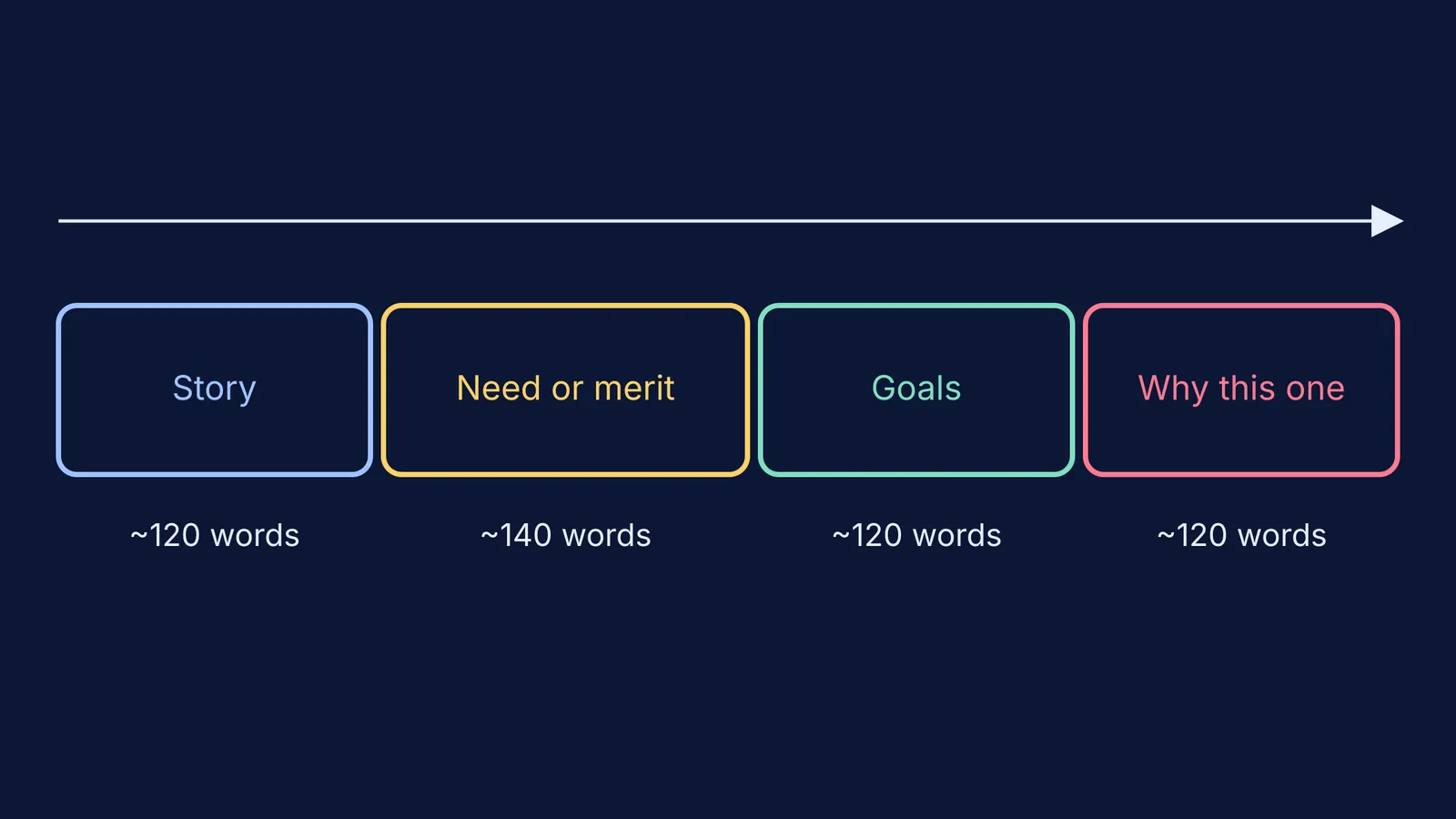
Give each part roughly a quarter of the space, with a little extra for need or merit. For a 500-word limit, that is about 120 words of story, 140 on need or merit, 120 on goals and 120 on fit, ending with a one-line thank-you. Keep the same proportions for other limits.
A worked example
Here is how an invented Class 12 student from Nashik, applying for a foundation scholarship to study BSc Physics, could fill each part. Square brackets mark where your real details go.
Story. Weak: "I have always been passionate about science." Stronger: "In Class 9 our village lost power for three days in the monsoon, and I spent them taking apart a dead inverter with my uncle to find out why it would not hold charge."
Need. Weak: "My family is poor and cannot afford college." Stronger: "My father drives a shared auto and my mother stitches at home. Together they earn ₹[amount] a year; my first-year fees and hostel would cost ₹[amount]."
Goals. Weak: "I want to become a successful scientist." Stronger: "I want to complete a BSc and MSc in Physics and work on battery storage for village microgrids."
Fit. Weak: "This scholarship will help me a lot." Stronger: "The [scholarship name] is meant for first-generation college students in science, which describes me; it would cover the hostel fees that are the main reason I might otherwise study from home."
Notice that every stronger line is something a reader can picture or check.
How do you write about financial need without sounding like you're begging?
State the facts once, plainly, then show what you did with what you had. A useful pattern is three sentences: the situation, what it cost you, and what you did anyway. For example: "After my father's shop closed, I moved to a government college to save fees. It had no physics lab, so I learned circuits from a library book and a borrowed multimeter."
The UW Bothell checklist adds two limits: leave out personal information that is not relevant to the scholarship, and never misrepresent your achievements. Every figure you write should match your income certificate and mark sheets.
What do scholarship readers mark down?
Chevening received more than 70,000 applications for its 2023-24 cohort, and its reading committees shared what went wrong in their published feedback to applicants. Their advice applies well beyond that award:
Give examples using STAR: the situation, the task, the action you took and the result.
Write "I" rather than "we" for your own achievements; in team work, say what your role was.
Do not paste text from university websites or lean on rankings as your reason for a course.
Make your career plan achievable; the strongest responses included specific, measurable goals.
If AI tidies your grammar, the story and facts must still be yours; see how to use AI on application essays honestly.
What should you check before you submit?
The scholarship's name is in your first paragraph.
Every criterion in the prompt is answered, in the prompt's order.
Each claim about you has an example: a moment, a mark, a result.
Your goals are concrete enough to check in five years.
You are within the word limit, and a teacher has read it and can say back your main point.
If you are shortlisted, expect questions on the subject you named. The Fermi Concept Library has a lesson for every concept in physics, chemistry, biology, mathematics and computing, so you can go deeper on the topic in your story. Then work through our scholarship interview preparation guide.
Start your first draft this week, not the night before the deadline.