

On this page
Higher education costs are rising steadily, but government schemes are not the only way to fund a degree. Corporate Social Responsibility (CSR) initiatives and private trusts in India provide significant financial support to undergraduate students. By law, large Indian companies must spend a portion of their profits on CSR, and higher education has become a primary focus area for these funds. These scholarships often focus on "merit-cum-means"—a combination of academic excellence and verifiable financial need.
While government scholarships often have rigid state-domicile rules or strict caste-category requirements, private foundation scholarships can sometimes offer broader eligibility across streams and states. Provided you meet their income and marks criteria, you can secure funding regardless of where you live or study.
What are the eligibility criteria for private scholarships?
Private scholarships generally look at three core areas: your household income, your academic track record in Class 12, and the specific course you are taking at university.
Financial need: Most trusts set an annual family income ceiling to ensure funds go to those who need them most. The Reliance Foundation Undergraduate Scholarship is open to students whose household income is less than ₹15,00,000, though preference is actively given to those below ₹2,50,000.
Academic merit: Strong academic performance in Class 12 is standard for many general undergraduate scholarships. However, highly competitive ones set the bar higher to filter applicants. The Kotak Kanya Scholarship requires girls to have scored at least 75% in their board exams.
Course of study: Some foundations fund any undergraduate stream, offering flexibility. Others are narrow: the Kotak program strictly funds professional graduation courses like Engineering, MBBS, Architecture, and Integrated LLB.
How much do corporate scholarships in India pay?
The funding amounts vary widely, ranging from small one-time textbook grants to full tuition and living expense coverage.
Reliance Foundation Undergraduate Scholarship This is one of the largest corporate programs in the country, selecting up to 5,000 first-year undergraduate students annually. The Reliance Foundation provides up to ₹2,00,000 over the full duration of the degree. Students from any stream can apply, provided they pass a mandatory online aptitude test that assesses their logical reasoning and analytical skills.
Kotak Kanya Scholarship Aimed exclusively at supporting young women pursuing professional courses, this Kotak initiative awards up to ₹1,50,000 per year until the degree is complete. It covers tuition fees, hostel charges, and even incidental expenses like laptops and internet connections.
FAEA Scholarship The Foundation for Academic Excellence and Access supports about 50 students a year, primarily from SC, ST, and Below Poverty Line (BPL) backgrounds. The FAEA Scholarship also accepts general category students if they scored 90% or above in Class 12. It is one of the few private schemes that can cover full tuition, maintenance, and hostel fees for the entire course, providing a comprehensive safety net.
How do I apply for private foundation scholarships?
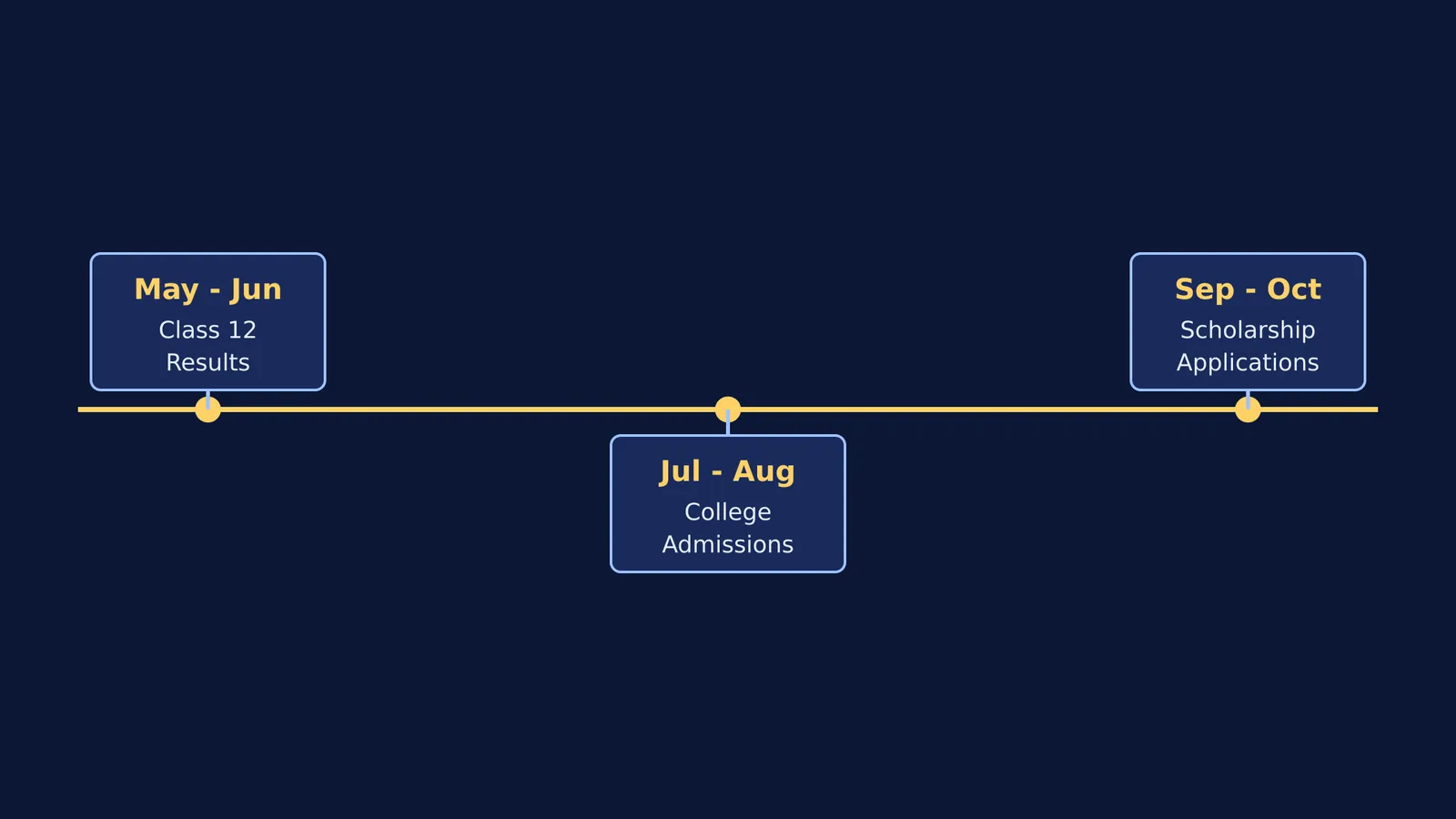
Navigating the application process can seem daunting, but knowing when to act makes it manageable. Most corporate scholarship windows open between July and October, directly following college admissions.
Find the right portal: Large trusts like Reliance and FAEA host applications directly on their own websites. Many other corporate programs are managed and centralized through scholarship aggregators.
Clear the shortlisting: If your application passes the initial income and marks screening, you may be invited for a telephone or video interview. The panel typically wants to verify your financial constraints and understand your career goals.
Keep your grades up: Merit-cum-means scholarships are rarely a free ride for the duration of your degree. You usually must maintain a minimum CGPA and submit your college transcripts annually to renew the funding for the next year.
What are common mistakes when applying?
Many students miss out on vital funding not because they lack merit, but due to simple, avoidable application errors.
Missing deadlines: Scholarship windows are strict and often close rapidly by October or November once quotas fill up.
Incorrect income certificates: A self-declared income statement or an outdated tax return is usually rejected. You must provide a valid certificate issued by a designated government authority (like a Tehsildar or SDM) for the current financial year.
Ignoring document formats: Portals often require files in specific sizes or formats. Uploading blurry images or fragmented pages can lead to automatic rejection.
Applying for the wrong course: Read the fine print carefully before applying. A scholarship designated for a Bachelor of Engineering (B.E.) will not fund a Bachelor of Science (B.Sc.), even if you meet all the marks criteria.
Maintaining a strong academic record is the most consistent requirement for both earning and renewing private scholarships. If you are struggling to keep your grades up in challenging subjects, Fermi's AI tutor can work out what you already know and build a plan for the session, so you sit down to a clear next step.
For more places to look, check our guide on Scholarships for science students in India: where to look. And once your classes start, finding a framework from How to build a study routine that lasts longer than a week will help you keep the grades required to renew your funding.


