On this page
Winning a scholarship is a life-changing event, but getting past the written application is only half the battle. When you sit down for a scholarship interview, the committee is not just testing your academic knowledge—they want to see how you think, how you handle pressure, and whether you genuinely need the funding. Your goal is to prove that you are a sound investment for their organisation.
What do panels look for in a scholarship interview?
An interview is often the final filter, and highly competitive awards are exceptionally selective. For example, the Rhodes Scholarship subjects shortlisted candidates to a 30- to 45-minute panel interview to test their authenticity and character (Application Overview | Rhodes Trust). Committees look for clear evidence of leadership, a genuine connection to your proposed field of study, and a realistic plan for what you will do after graduation.
Whether you are applying for a global program, a national award like the INSPIRE-SHE scholarship, or exploring other scholarships for science students in India, the panel wants to meet the person behind the essays. They will likely question inconsistencies in your resume and test how well your stated goals align with the scholarship's mission.
How to answer common scholarship interview questions?
Interviewers use behavioral questions to see how you have acted in the past. It helps to use the STAR method—Situation, Task, Action, and Result—to structure your answers.
"Tell us about yourself." Do not just recite your resume. Focus on the passions and values that drove you to apply for this specific award.
"Why do you need this financial support?" This is the moment to explain your finances honestly. Committees appreciate transparency. Outline exactly how the funds will cover your tuition and living costs. A good script is: 'I have secured part of the tuition through a student loan, and this scholarship will cover the remaining balance and my first-year living expenses, allowing me to focus entirely on my research.'
"Describe a time you solved a complex problem." The panel wants to see resilience. Often, students falter when they cannot immediately see the answer to an academic problem or a life challenge. Practicing with the Fermi Problem Library—a step-by-step solver that explains the reasoning rather than just printing an answer—builds the habit of articulating your thought process clearly.
"What will you do if you do not get this scholarship?" This tests whether your ambition depends solely on the award. Answer by showing alternative paths, proving that your long-term goals remain intact.
What documents should you carry?
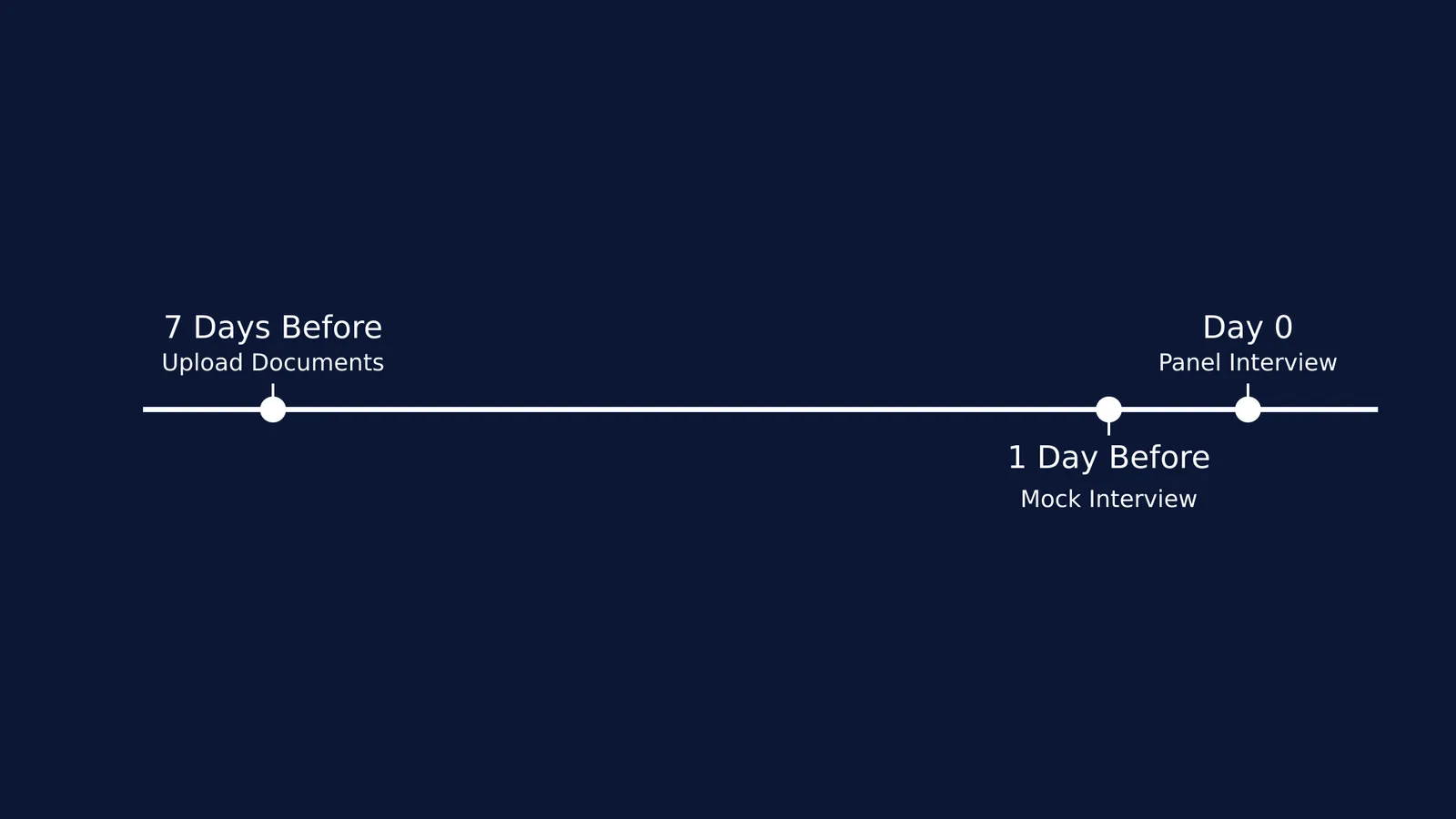
For in-person or virtual interviews, having your paperwork in order is non-negotiable. For instance, the UK Chevening Scholarship requires candidates to upload their photo ID, degree certificates, and references to their online system at least seven working days before their interview (Application timeline | Chevening).
In India, verification is increasingly digital. For schemes on the National Scholarship Portal, a unique 14-digit One-Time Registration (OTR) number is now required, which involves face authentication using your Aadhaar data (National Scholarship Portal: NSP).
Keep a physical folder ready with:
Your identification: A passport or Aadhaar card.
Academic records: Original degree certificates and transcripts.
Financial proof: Income certificates or tax returns, especially for need-based government scholarships. Ensure they match what you submitted in your application.
Reference letters: Signed originals of the letters submitted by your recommenders.
How can you rehearse without sounding scripted?
Mock interviews are essential for your preparation. Have a mentor or teacher ask you difficult questions under timed conditions to simulate the pressure of the real event. If you freeze on a technical question, it is better to admit you do not know the exact fact but explain how you would figure it out. This shows intellectual honesty—the same step-by-step approach Fermi's AI tutor uses when it works out what you already know and builds a plan for the session.
Record yourself answering common questions on video. Watching the playback helps you catch nervous habits, wandering eyes, and filler words like 'um' or 'like', so you can walk into the real interview with confidence and polished delivery.