

On this page
Your friends are heading out for chaat, the group call has started, or someone wants “one quick match”. You have a chapter test on Monday. Saying no feels rude, and saying yes costs you another evening. The way through is to say no to the time, not to the person, and then put a real plan for seeing them on the calendar.
Why does saying no to friends feel so hard?
Because friendships matter, and part of you knows it.
The World Health Organization’s Commission on Social Connection found in 2025 that 17% to 21% of people aged 13 to 29 reported feeling lonely, with the highest rates among teenagers (WHO, 2025). The same report found that teenagers who felt lonely were 22% more likely to get lower grades or qualifications.
The goal, then, is not fewer friends. It is fewer unplanned hours with them during study time, and more planned time you can actually enjoy.
What can I say to friends when I need to study?
Keep it short, honest and friendly. A good refusal has four parts: thanks, a clear no, a one-line reason and a specific offer.
Scripts you can copy or adapt:
An outing: “Sounds fun, but I’m skipping this one. Evenings this week are for my physics backlog. Can we do Saturday afternoon instead?”
A call in the middle of a session: “Hey, I’m studying till 8. Can I call you back at 8:15?” Then call back at 8:15.
A game invite: “I don’t play on weekdays this term. Sunday night, I’m in.”
A friend who needs you: if someone is upset or in trouble, the study block can wait. Listen, and if it sounds serious, help them reach a trusted adult.
Notice the words “I don’t” in the game script. In four studies, Vanessa Patrick and Henrik Hagtvedt found that framing a refusal as “I don’t” rather than “I can’t” helped people resist temptation, especially when the goal was their own (Journal of Consumer Research, 2012). They linked the effect to a sense of empowerment: “I don’t” presents the choice as yours, not a rule someone else set.
How do I say no without losing friends?
One no is unlikely to end a friendship. The bigger risk is when no becomes the only answer and friends never hear when yes will be. Three habits help:
Pair every no with a time. “Not today” lands softer with “but Saturday”.
Keep the promise. If you said you would call back at 8:15, do it.
Tell close friends your routine once. “Weekdays 5 to 8 I’m studying, weekends I’m around” saves you refusing the same invite five times.
For parents: try agreeing fixed friend slots with your teen instead of banning outings, so the no comes from a plan you made together.
How do I plan time with friends around study?
Use if-then plans. An implementation intention is an if-then plan that links a situation to a response decided in advance. In a meta-analysis of 94 independent tests, Peter Gollwitzer and Paschal Sheeran found that these plans had a medium-to-large positive effect on reaching goals (d = 0.65) (Advances in Experimental Social Psychology, 2006). Yours might be: “If friends call during my study block, then I reply that I’ll call back at 8:15.”
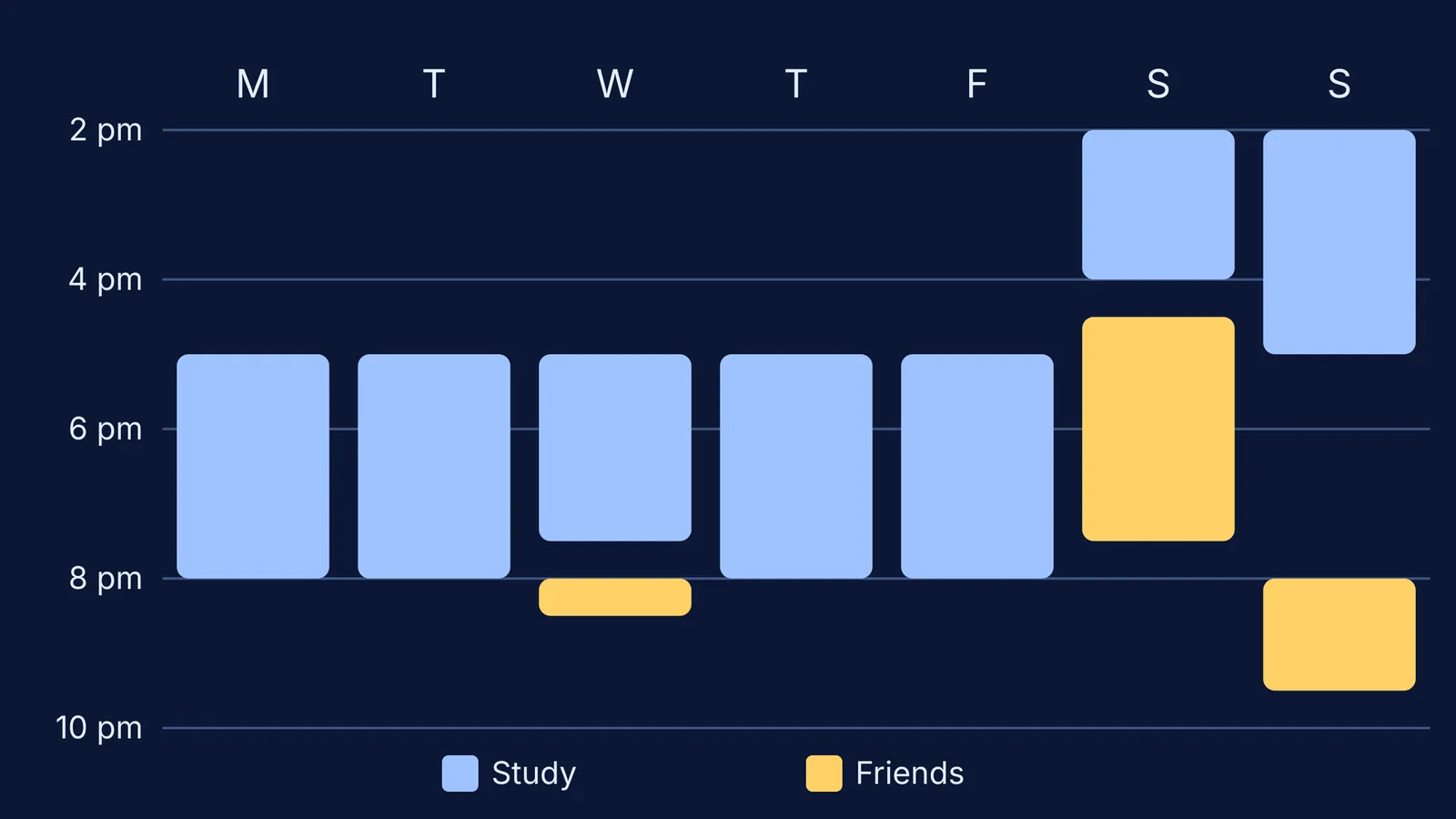
Here is a worked week for a Class 12 student whose school ends at 3 pm:
Monday, Tuesday, Thursday, Friday: study 5 to 8 pm, phone on silent.
Wednesday: study 5 to 7:30 pm, then a 30-minute call with a friend at 8.
Saturday: study 2 to 4 pm, then 4:30 to 7:30 pm with friends: cricket, a walk, food.
Sunday: study 2 to 5 pm, game night 8 to 9:30 pm.
That adds up to 19.5 hours of study and 5 hours of planned friend time. Because the friend slots are fixed, a Tuesday invite already has its answer: “Saturday works.” Leave some slack as well; our guide to building buffer time into a study plan explains why. If your weekends carry coaching or mock tests, adapt the plan using a weekend study plan for JEE and NEET.
If you sit down to a study block not knowing where to start, Fermi’s AI tutor can work out what you already know and build a plan for the session, so the evening you said no for begins with a clear next step.
What if saying no starts to feel lonely?
If you notice you have stopped seeing anyone, or you dread every free hour, add friend time back rather than pushing through. It can be harder in a drop year; our post on coping with social isolation as a dropper has ideas. If low mood lasts, talk to a parent, teacher or school counsellor. In India, you can also call Tele MANAS, the national mental health helpline of the Ministry of Health and Family Welfare, on 14416 or 1-800-891-4416 (Tele MANAS).
Pick one script above, save it in your phone’s notes, and use it the next time an invite arrives during a study block.


