

On this page
You have an exam in a week, a notebook full of red marks, and a tempting idea: skip what you already know and revise only the questions you got wrong. It feels efficient. It is half right.
Mistake review is one of the best uses of your time, but on its own it leaves two gaps: answers you got right by luck, and chapters you knew weeks ago and are quietly forgetting. Here is what the research says, and a weekly plan that covers both.
Why do mistakes deserve most of your revision time?
Because feedback on a wrong answer changes what you remember later. In a study of 258 people learning Luganda-English word pairs, Pashler and colleagues (2005) found that showing the correct answer after an incorrect response increased retention on a test a week later by 494%. The same study found that feedback after correct responses made little difference. Each red mark is a wrong idea that can resurface in the exam unless you replace it.
Mistake review works best when:
you redo the question from a blank page, not just reread the correction
you write one line on why you went wrong: wrong concept, wrong method, careless slip or time
you come back to the same question two or three days later and do it again cold
A review of ten study techniques by Dunlosky and colleagues (2013) rated practice testing and spaced practice as high utility, and rereading as low utility. Redoing a mistake days later is both.
For wrong-method errors in physics or maths, try a similar problem in the Fermi Problem Library, whose step-by-step solver explains the reasoning rather than printing an answer. To spot patterns across several tests, see how to ask AI to find the pattern in your mistakes.
What does revising only your mistakes miss?
Lucky right answers. A tick does not mean you knew it. In two experiments where people rated their confidence after each answer, Butler, Karpicke and Roediger (2008) found that feedback doubled the retention of correct answers given with low confidence, versus no feedback (Pashler's study saw little such effect). If you guessed and got it right, treat it as a mistake.
Things you knew, then stopped practising. In a Science study, Karpicke and Roediger (2008) had students learn foreign-language vocabulary. In three of four conditions, a word recalled correctly was then dropped from further study, testing, or both. Extra studying after that had no effect on delayed recall; continued testing had a large positive effect. Students' predictions of their own performance were uncorrelated with how they actually did.
That is the risk of a mistakes-only plan: the chapter you were solid on two months ago gets no retrieval practice now, and you will not feel it slipping.
How do you split revision between mistakes and the full syllabus?
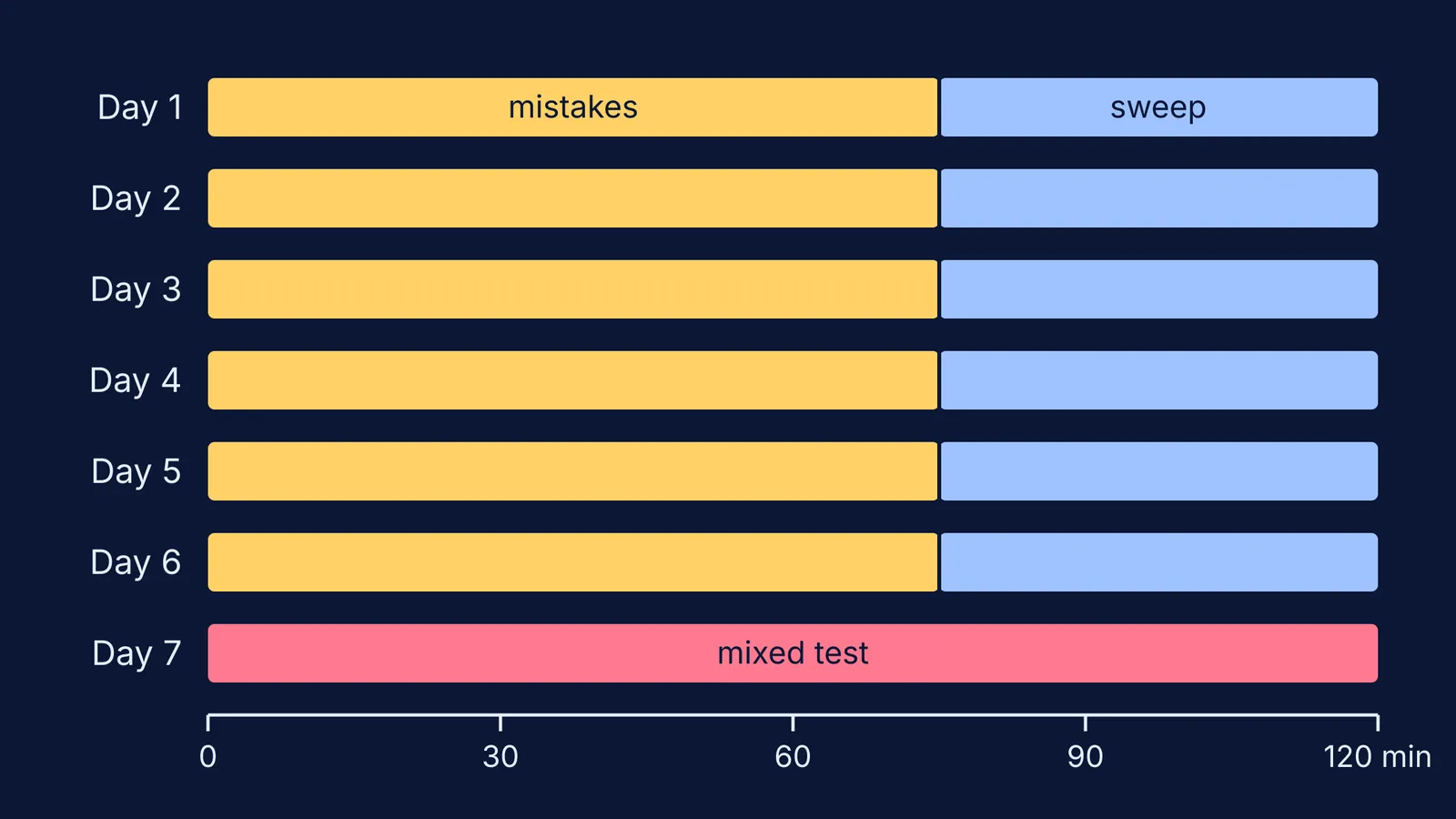
Spend most of each session on mistakes and a smaller, fixed slice on a sweep of everything else. The sweep is recall, not rereading: close the book and test yourself. Here is a one-week plan for a two-hour daily block; change the minutes to fit, but keep the ratio.
Days 1 to 6, first 75 minutes: the error log. Redo six to ten logged questions from a blank page. Mark one "fixed" only after you get it right on two separate days.
Days 1 to 6, last 45 minutes: the sweep. Split your chapters into six groups, one group a day. For each chapter, write the key formulas, definitions and one diagram from memory, check your notes, then solve three quick questions.
Anything you miss in the sweep goes into the error log for the next day.
Day 7: one timed, mixed test across all chapters, then log every wrong or guessed answer. Next week starts from that log.
Mixing chapters in the sweep also gives you some of the benefits of an interleaved practice plan.
A worked example
Take a Class 12 student, call her Riya, revising physics. Her log has 34 entries: 20 from electrostatics and current electricity, 9 careless sign slips, and 5 where she cannot say why she went wrong.
On day 1, in her 45-minute sweep, she takes ray optics and wave optics. Writing the lens formula from memory, she gets the sign convention wrong. It goes into the log, though she has never lost marks on optics. A mistakes-only plan would have missed it.
The five "cannot say why" entries are concept gaps, not slips. For those, she relearns the idea first, for example in the Fermi Concept Library, and only then redoes the question.
When is revising only mistakes enough?
It can be, if your error log comes from recent full-syllabus tests so every chapter was checked lately, or if it is the final day or two and you have just finished a full sweep. If your log comes only from chapter tests, run the split. Our piece on chapter tests versus full mocks explains how to use each.
Tonight, open your last test and circle every tick you guessed. Those are the first new entries in your error log.


