

On this page
Weeks away from your books can make the first day back feel impossible. The fix is not one heroic 10-hour day but a planned ramp: short sessions, easy wins, an honest check of what you still know, and a steady climb back to full days over two weeks.
What happens to what you learned during a long break?
Some of it fades, unevenly. A review by Harris Cooper and colleagues of summer vacation studies in Review of Educational Research looked at 39 studies; combining the 13 most recent, it found summer loss equalled about one month on a grade-level scale.
The same review found the loss was larger for maths than for reading, and largest for maths computation and spelling. One explanation its authors suggest is that fact- and procedure-based knowledge is forgotten more easily than conceptual knowledge.
For a JEE or board student, that suggests your understanding of why a block slides down an incline is likely to hold up better than your speed with formulas, units, reaction names and algebra steps. Those rusty skills are what your first week should target.
Why start with short sessions instead of a full day?
Because the hardest part of restarting is starting. A full timetable on day one often collapses within days, and each collapse can make the next start harder.
A simple if-then plan helps. In a meta-analysis of implementation intentions by Peter Gollwitzer and Paschal Sheeran, 94 independent tests showed that plans spelling out when, where and how you will act had a medium-to-large effect on reaching goals (d = 0.65). Yours could be: "After breakfast, I sit at my desk and open the maths notebook."
Protect sleep too. The US CDC's school sleep guidance lists 8 to 10 hours per 24 hours for teenagers aged 13 to 18. Move your wake-up time earlier in stages, not all at once.
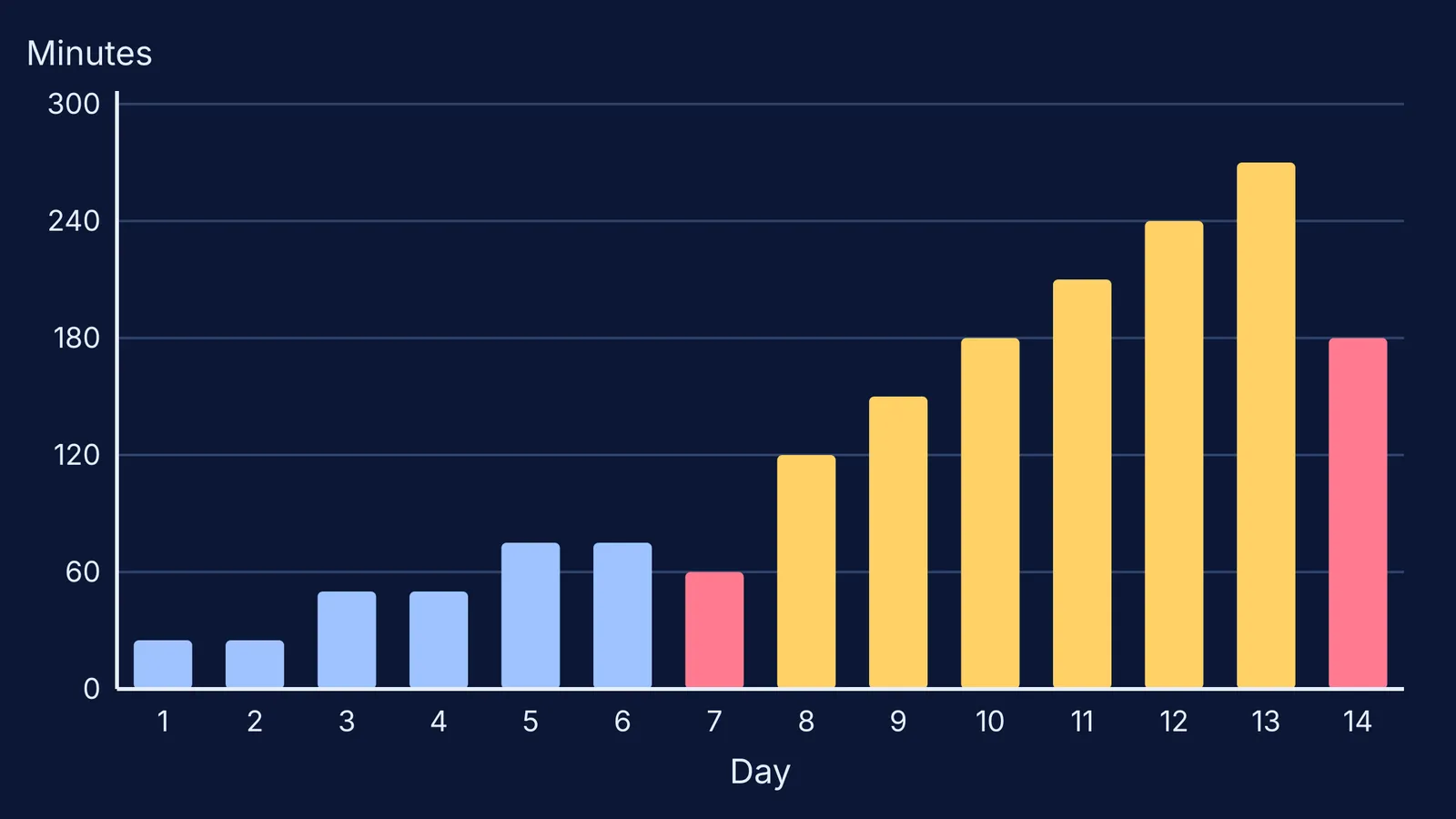
How to restart studying after a long break: the two-week plan
Times are total focused study per day. Adjust them to your school hours, but keep the shape.
Days 1-2: one 25-minute session. Pick your strongest subject and redo five problems you have solved before.
Days 3-4: two 25-minute sessions. Add a short re-test of basics in one subject (see the next section).
Days 5-6: three 25-minute sessions, one per subject. Fix one gap the re-test showed.
Day 7: a lighter day of about 60 minutes. Re-test the same basics as day 3 and compare.
Days 8-10: build from 2 to 3 hours, in blocks of 40-50 minutes with breaks. Start one new topic.
Days 11-13: build from 3.5 to 4.5 hours. Add one timed set of mixed questions.
Day 14: a check-in day of about 3 hours. One short timed paper, then a review of every mistake, then plan week three at your normal load.
Missed a day? Repeat the previous day's load. Some students find that stopping halfway through a task they know how to finish makes the next start easier; our guide on stopping mid-task so you can restart easily explains how.
If you do not know where to begin at all, Fermi's AI tutor can work out what you already know and build a plan for the session, so you sit down to a clear next step.
How do you re-test the basics without losing confidence?
Test yourself before you reread. In experiments by Henry Roediger and Jeffrey Karpicke on test-enhanced learning in Psychological Science, students who took recall tests remembered more on final tests 2 days and 1 week later than students who restudied, even though restudying made students more confident. Restudying only won on a test 5 minutes later.
A 20-minute re-test for one subject looks like this:
Write down, from memory, the 10 formulas or facts you use most in the chapter you last studied.
Solve three easy problems without notes.
Check against your book and mark each item: knew it, half-knew it, forgot it.
Turn only the "forgot it" items into tomorrow's first task.
A blank page is information, not failure. If a forgotten item is a whole concept, the Fermi Concept Library has a lesson for every concept in physics, chemistry, biology and mathematics, so you can rebuild that piece before moving on. To turn a big chapter into small, doable steps, see how to break a chapter into tasks.
What can parents say to help a teen restart?
Try lines like these:
"What is the smallest thing you could do today?"
"Want me to sit nearby with my own work for 25 minutes?"
"You did two sessions today. That is the plan working."
Avoid comparisons with other students. If the break meant missed school, our piece on catching up after missing school has more ideas.
If low mood, worry or exhaustion lasts beyond the break, talk to a doctor or counsellor. In India, the government's Tele MANAS helpline is toll-free on 14416 or 1800 891 4416.
Your first step is small: tonight, write your if-then plan for tomorrow's 25 minutes.


