

On this page
In many Indian colleges, your marks in a course are not your final result. They become a letter grade, the letter becomes grade points, and the grade points become your SGPA and CGPA. Relative grading changes only the first step.
What is relative grading in college?
Relative grading means the cut-off marks for each letter grade are set after seeing how the whole class did, so your grade reflects where you stand in the class. The University Grants Commission's guidelines on adopting the choice based credit system note that some institutions convert marks “to letter grades based on absolute or relative grading system”. Absolute grading uses a fixed table instead: in those guidelines, 90 to 100 marks is the top grade and below 40 a fail.
IIT Kanpur's aerospace engineering department's page on the academic system says grades “are usually awarded on the basis of relative performance, i.e. using the percentile marks rather than the actual marks.”
How does relative grading work, step by step?
Details differ, but the broad sequence is:
Your quiz, assignment, mid-sem and end-sem marks are combined using the announced weights.
The instructor looks at the spread of total marks across the class.
The instructor sets a cut-off for each letter grade on that spread.
Each letter converts to grade points, usually on a 10-point scale.
Step 3 is where judgement enters. IIT Goa's grading rules say “Instructors are free to set the grading criteria of their courses”, and IIT Kanpur's academics orientation for new faculty says “Grading is left entirely to the instructor”.
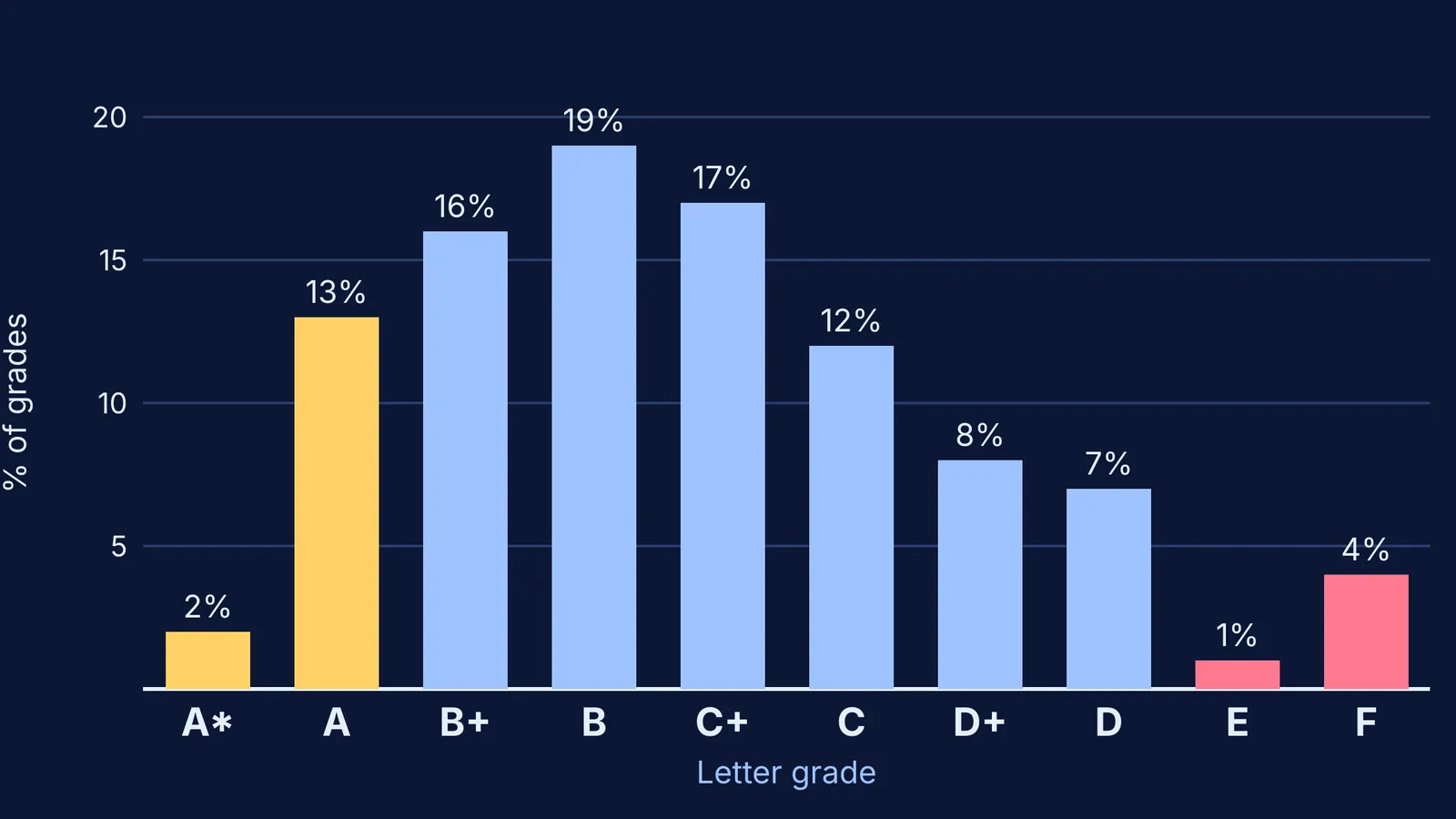
In IIT Kanpur's statistical report of grades awarded in the first semester of 2024-25, 2% of undergraduate grades were A*, 13% A, 16% B+, 19% B, 17% C+, 12% C, 8% D+, 7% D, 1% E and 4% F. Most grades sat in the middle.
How are SGPA and CGPA calculated?
UGC's model curriculum for undergraduate courses under CBCS uses a 10-point scale: O (Outstanding) is 10, A+ is 9, A is 8, B+ is 7, B is 6, C is 5, P (Pass) is 4 and F is 0. Your college's letters may differ; the arithmetic is usually the same.
SGPA is the sum of credits × grade points for every course in a semester, divided by that semester's total credits. CGPA does the same across all semesters. New to credits? Start with how the college credit system works.
UGC's worked example, semester one:
Core course 1: 6 credits, grade A (8), so 48 credit points
Core course 2: 6 credits, grade B+ (7), so 42
Ability enhancement course: 2 credits, grade B (6), so 12
Generic elective: 6 credits, grade B (6), so 36
That is 138 credit points over 20 credits, an SGPA of 6.9.
Now change one grade. One step higher in any of the three 6-credit courses adds 6 credit points: 144 ÷ 20 = 7.2. The same step in the 2-credit course adds 2: 140 ÷ 20 = 7.0. Credits decide where an extra hour of study pays off most.
CGPA also gets harder to move as credits pile up. UGC's six-semester example ends at 7.71 over 140 credits. A final 24-credit semester one full grade point better would have lifted that by only about 0.17 (24 ÷ 140). A weak first year takes several good semesters to dilute.
What does relative grading mean for your study plan?
Read the course handout in week one. IIT Kanpur's orientation says it is important to announce course policies, including evaluation weights, in the first or second lecture. Note the heaviest components first.
Give hours by credits. A 6-credit core deserves more of your week than a 2-credit course.
Use the mid-sem as a map. A hard paper is hard for everyone; what matters is which topics cost you marks that classmates scored. See how much mid-semester exams matter.
Check your answer scripts. The orientation warns that errors in calculations “may go unnoticed unless the student is alert”, so add up your marks and raise errors through the formal process.
If the mid-sem gap is a concept you never understood, the Fermi Concept Library has a lesson for every concept in physics, chemistry, biology, mathematics and computing. If you picked the wrong method, the Fermi Problem Library has a step-by-step solver that explains the reasoning.
What relative grading does not mean
It is not necessarily a fixed quota. The rules we read leave cut-offs to the instructor, not to a set number of top grades or fails.
Your marks still matter: they decide where you sit in the spread.
A CGPA is hard to compare across colleges, because different classes and cut-offs produced it. For how recruiters weigh it, read whether CGPA or skills matter more for placements.
A grade is not a verdict on you. If marks are causing stress that does not ease, talk to someone you trust or your college counsellor, or call the free national Tele MANAS helpline on 14416.
Before next semester, find your college's grading rules, list your courses by credits, and plan from the heaviest down.


