

On this page
You are 40 minutes into a paper. Question 14 gives you 34.6 m, and the options say 17.3, 20, 40 and 69.3. You redo it. Same answer. Is the paper wrong, or are you?
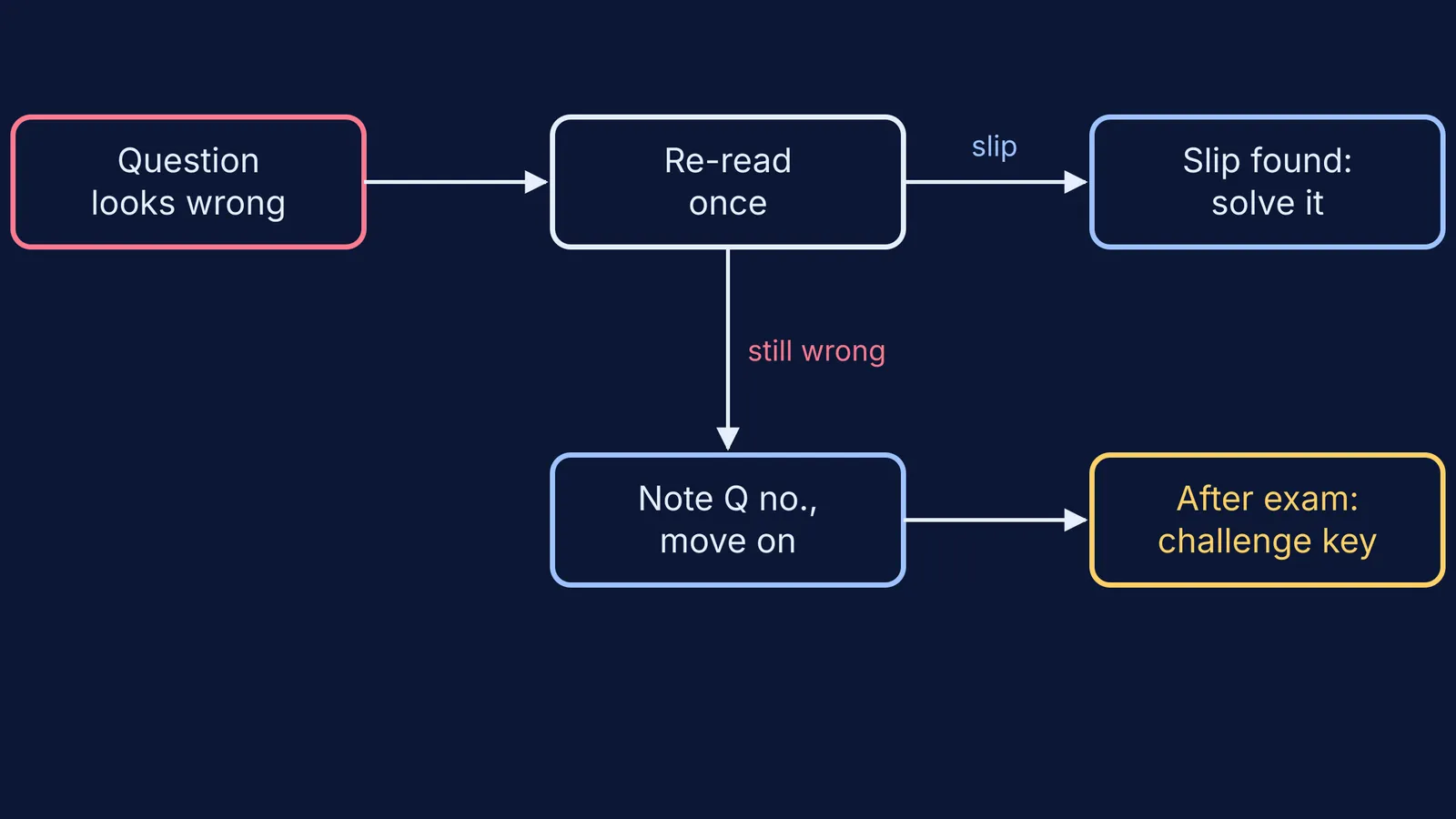
The fix is a short routine: re-read once, decide, note it, move on, and settle it later through the answer key challenge. We use NTA’s JEE Main rules as the example.
Why does a question sometimes look wrong?
Usually it is a misread: a skipped “not”, g = 9.8 when the paper says 10, or a different quantity from the one asked. Sometimes the paper really is wrong, and exam bodies plan for that. NTA’s JEE (Main) 2026 Information Bulletin says “every effort will be made to ensure that each question has only one unique answer”, then sets out what happens when a question has more than one correct option or must be dropped.
What should you do when a question seems wrong in the exam?
One careful re-read, then a decision. Not three re-solves.
Re-read the words, not the numbers. Look for “not”, “except”, “approximately”, “nearest integer”, the unit asked for, and any constants given.
Compare with the options. Off by a factor of 2, 10 or √2, or by a sign? That usually points to your own slip.
Decide. If one option is clearly the most defensible, mark it. If none is, leave it.
Write one line on your rough sheet. For example: “Phy Q14: got 34.6 m, options 17.3/20/40/69.3, used g = 10.”
Move on. Come back only if time remains at the end.
JEE Main Paper 1 has 75 questions in 3 hours, according to the JEE Main 2026 bulletin, which is about 2.4 minutes per question. Ten minutes fighting one doubtful question is the time of roughly four others.
What does a misread look like in practice?
Question 14: a ball is thrown at 20 m/s at 30° to the ground, with g = 10 m/s². You computed the range: R = u² sin 2θ / g = 400 × 0.866 / 10 ≈ 34.6 m. No option matches.
Your one re-read finds the question asked for the horizontal distance when the ball reaches its highest point. That is half the range, about 17.3 m: the first option. The question was fine; the reading was not.
Should you answer or skip a question with no correct option?
It depends on your exam, so read your own bulletin. For JEE Main 2026 multiple-choice questions, the marking rules in NTA’s bulletin are:
A wrong answer costs one mark; an unanswered question scores zero.
If more than one option is found correct, +4 goes only to those who marked one of them.
If all options are found correct, +4 goes to everyone who attempted the question.
If a question is dropped, full marks go to all candidates who appeared in that shift, whether or not they attempted it.
So if two options both look right, marking either is reasonable. If you are sure no option works, skipping costs nothing if the question is dropped, while a guess risks −1 if the experts keep an answer.
In board papers with written answers, state your assumption in one line (“Taking g = 10 m/s²”) and solve on that basis. If a page is misprinted or missing, tell the invigilator straight away.
How do you challenge an answer key after the exam?
Here your rough-sheet note pays off. According to the JEE Main 2026 bulletin:
NTA displays the provisional answer key with your recorded responses, likely for two to three days.
A challenge costs ₹200 per question, paid online and non-refundable.
Only paid challenges through the official link count, and those without justification or evidence are not considered.
Subject experts review challenges and declare the final key used for results.
Download your response sheet while it is up; the bulletin says it will not be provided later.
Before you pay, re-solve the question at a desk and write the justification as short steps: given data, formula, working, conclusion (“No option matches; the question should be dropped”). If a coaching key or an AI tool disagrees with the official one, see what to do when the answer key and AI disagree. The Fermi Problem Library has a step-by-step solver that explains the reasoning rather than printing an answer, so you can see where your working and the key part ways before you spend ₹200.
Skip the debate outside the centre, though; here is why discussing answers right after a paper rarely helps.
What if a doubtful question rattles you?
A slow breath and the written note help you let it go. If your mind goes blank, try what to do when you blank out during an exam. If exam stress stays with you for days, talk to someone you trust; Tele MANAS, the government’s 24x7 tele-mental health service, has a toll-free number, 14416, according to the Press Information Bureau.
Write your note, mark or skip, and turn the page.


