

On this page
You finish a question from your coaching sheet, and the answer key disagrees with you. An AI chatbot gives a third answer. Asking the AI again won't settle it. Checks you can do yourself usually will, and a teacher settles the rest.
Which one is usually wrong: the answer key, the AI or you?
Any of the three can be. Answer keys are typed by people, and a swapped option or a dropped minus sign is easy to miss. Even official keys get corrected: NTA lets candidates challenge its provisional answer keys, and NTA says that when subject experts accept a challenge, the revised key applies to every candidate. If you ever need that process, here is how to challenge an NTA provisional answer key.
AI chatbots don't break the tie either. In a Stanford-led study in Frontiers in Education, ChatGPT running GPT-4 solved 62.5% of well-specified college physics problems but only 8.3% of under-specified ones. The authors traced its wrong answers to three failure modes: a wrong model of the physical situation, poor assumptions about missing data, and calculation errors. Newer models score higher on structured exam questions: a 2026 preprint found four widely used AI systems averaged 82-92% on AP Physics free-response questions, yet they still misread diagrams and got vector directions and circuit layouts wrong.
And you can be wrong too. So stop asking which source to trust, and check the physics itself.
What should you do when your answer and the answer key differ?
Work through these five steps in order.
Line up all three answers as formulas. Ask the AI for its final expression in symbols, not just a number. Sometimes two answers agree once rearranged, and the "disagreement" was rounding or a different value of g.
Check the units. Every term must have the same dimensions, and an acceleration must come out in m/s². A formula that fails this is wrong, however confident it sounds.
Test limiting cases. Send one quantity to zero or infinity, or make two quantities equal, and ask what must happen physically. Any answer that predicts something impossible is out.
Solve it a second, different way. If you used forces, try energy. If you used algebra, try a graph or a special case. Two independent methods agreeing is strong evidence.
Take what is left to a teacher. If two answers survive every check, the question may be ambiguous, or it may use an idea you haven't met yet. That is the moment to ask.
The same checks catch AI slips in maths too; this guide explains why AI chatbots get maths wrong.
Worked example: one Atwood machine, three answers
Two masses hang over a light, frictionless pulley, with m₁ heavier than m₂. Find the acceleration.
You: a = (m₁ − m₂)g / (m₁ + m₂)
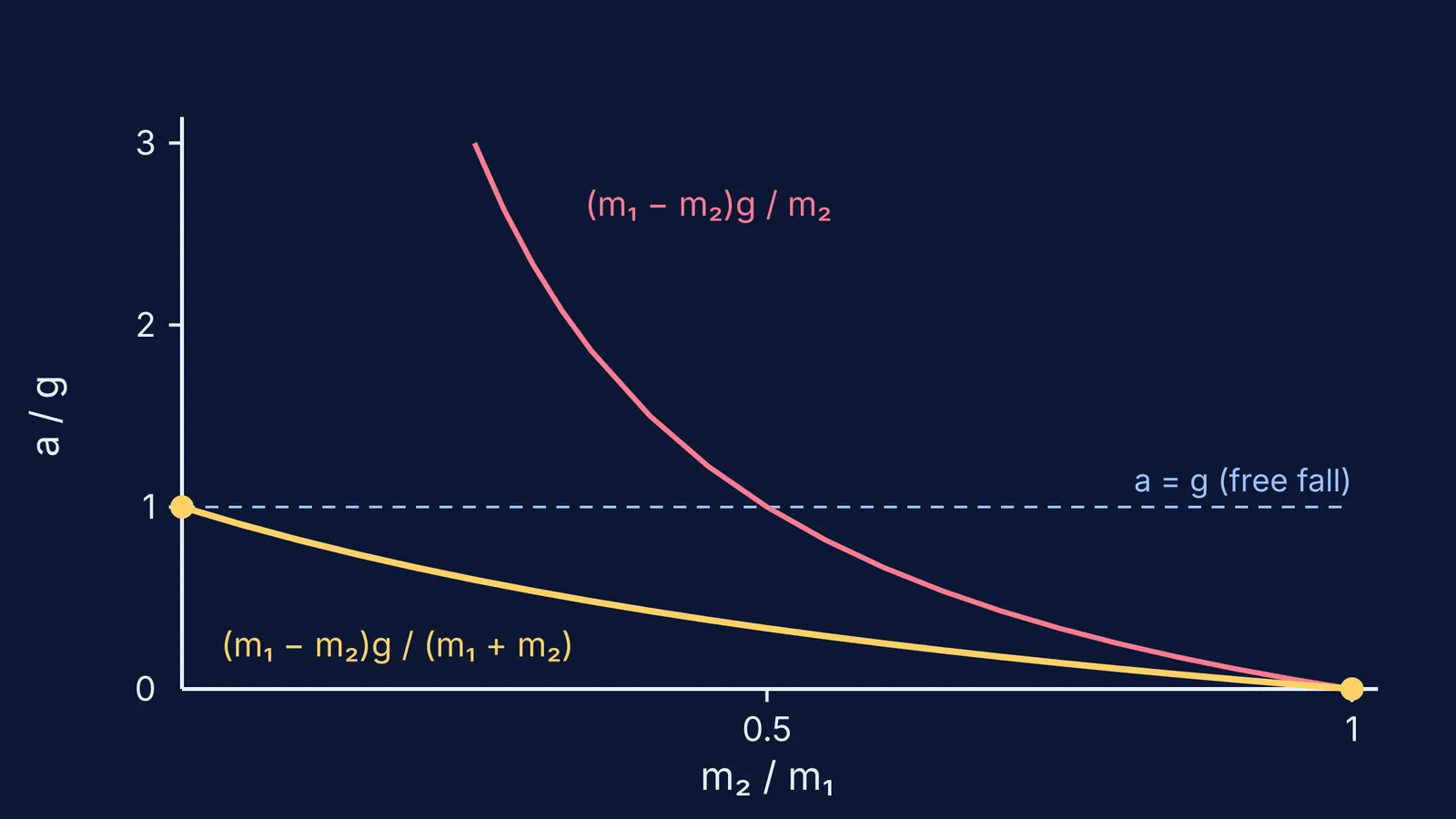
Answer key: a = (m₁ − m₂)g / m₂
AI: a = (m₁ − m₂) / (m₁ + m₂)
Units. The AI's answer is mass divided by mass, a pure number, so it cannot be an acceleration. It dropped g. Out.
Limiting cases. Let m₂ shrink to zero. Nothing holds m₁ back, so it should fall freely with a = g. Your formula gives g. The key's formula blows up to an infinite acceleration, which is impossible. Out. One more check: if m₁ = m₂, the masses balance and a = 0. Your formula passes again.
Second method. Use energy. When m₁ falls a height h, m₂ rises by h, so (m₁ − m₂)gh = ½(m₁ + m₂)v². With constant acceleration, v² = 2ah, which gives a = (m₁ − m₂)g / (m₁ + m₂). Two methods agree with yours.
The key most likely has a typo. Note it, tell your teacher and move on. For slips that are specific to AI in physics, see how to check an AI's physics solution.
What should you say to your teacher?
Bring your working, not just the question. Try this:
"For question 14, I got (m₁ − m₂)g / (m₁ + m₂). The key says (m₁ − m₂)g / m₂. I checked units and the limit where m₂ goes to zero, where the key's answer becomes infinite, and an energy method gives my answer. Is the key wrong, or am I missing something?"
If you do have a gap, this makes it easy to spot.
Where does an AI tutor fit in?
Use AI for steps 3 and 4, not as the judge. Ask it to test a limit, or to solve by a different method and explain each line. The Fermi Problem Library has a step-by-step solver that explains the reasoning rather than printing an answer, so you can compare it with your working line by line. Fermi's AI tutor holds a line of reasoning across a session and decides whether to explain, ask or show. It is still an AI, so run the same five checks on it.
Next time three answers disagree, take a blank page and start with the units.


