On this page
A technical seminar in college asks three things of you: do you understand your topic, can the room follow you, and can you handle the questions at the end. This guide takes those in order: choosing a topic, making slides with few words, and practising your answers.
How do you choose a seminar topic?
A common problem is a topic that is too big, so you end up reading definitions off slides. A good seminar topic is one question you can answer.
Run your idea through three tests:
The one-sentence test. Can you state your main point in one sentence a classmate understands? If not, narrow it.
The picture test. Is there a diagram or graph that shows the idea?
The question test. Can you answer "why?" two levels deep? If not, pick something closer to what you have studied.
A worked example: "Machine learning" fails all three. "How a spam filter decides an email is spam" passes. It has one main point, a clear picture (words going in, a score coming out) and questions you can predict. The same narrowing helps when you choose a final-year project topic.
How many words should a seminar slide have?
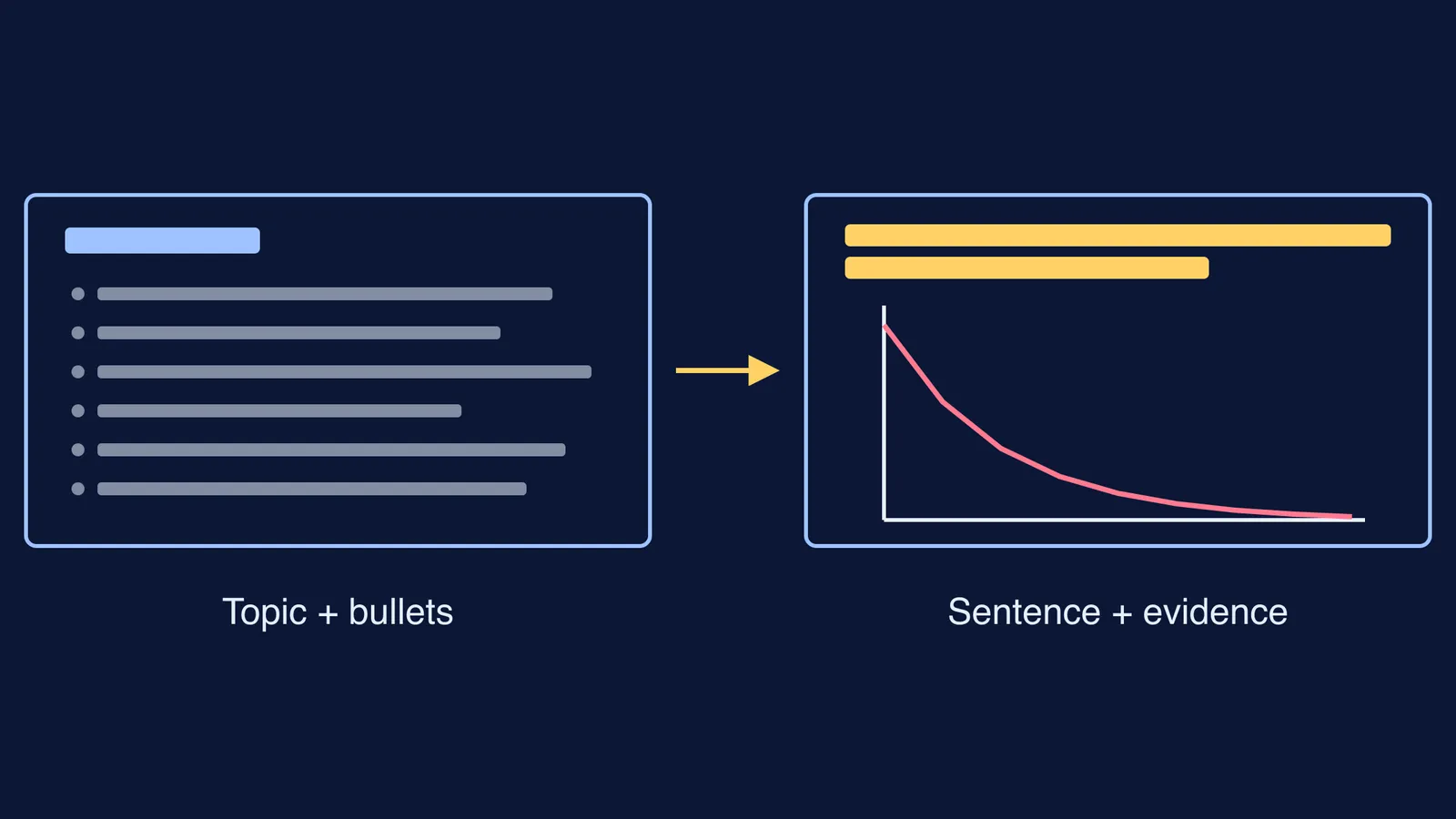
Fewer than you think, arranged differently. One layout with research behind it is the assertion-evidence slide: the headline is one full sentence stating the point, and the body is visual evidence for it (a graph, diagram or photo), with text only where needed.
In a 2013 experiment, Joanna Garner and Michael Alley showed 110 engineering students a technical presentation with either default bullet-list slides or assertion-evidence slides. The assertion-evidence group showed better comprehension and fewer misconceptions in their essays. They also rated the talk as less mentally demanding and showed stronger recall on a delayed test.
The paper offers a reason: hearing words while reading the same words on screen seems to reduce the working memory people have free for understanding. If your slide says what you are saying, the room has to read and listen at once.
There is a bonus for you as the speaker. A follow-up study listed on Penn State's slide research page found that student presenters who built assertion-evidence slides understood their own content better than those who used topic-and-bullet slides.
One slide, redone:
Before: headline "Spam filters", then five bullets: "Uses probability", "Looks at words", "Trained on data", "Gives score", "Threshold".
After: headline "A spam filter adds up word clues into one score and compares it with a cut-off", then a diagram of an email with three highlighted words, arrows to a score, and a line marking the cut-off.
If you cannot picture the idea yourself, your slide will not either. For science topics, an interactive simulation in the Fermi Simulation Lab can help you see the idea before you sketch your own figure.
How do you practise answering questions after a seminar?
Practise out loud, not in your head. In a semester-long study of public speaking students, Pearson, Child and Kahl (2006) found that more total preparation time went with higher speech grades, and students who spent more time on delivery and practice earned higher grades. That is a correlation, not an experiment, but rehearsing aloud costs you little.
Build a question bank before your first rehearsal, with two questions of each type:
Definition: "What exactly do you mean by a threshold?"
Why: "Why use words and not the sender's address?"
Limits: "When does this method fail?"
What if: "What if a spammer misspells every word?"
Source: "Where did this graph come from?"
Answer each one aloud in two or three sentences. If a definition question trips you, go back to the underlying idea; the Fermi Concept Library has a lesson for each concept in physics, chemistry, biology, mathematics and computing.
You will still get a question you cannot answer. Have a script ready: "Good question. I did not look at that case, but my guess is X, because Y. I will check and tell you." It is honest and shows you can reason.
What does a one-week seminar plan look like?
Day 1: Narrow the topic until it passes the three tests. Write your one-sentence main point.
Day 2: Read two or three good sources. Note figures you could reuse, with credits.
Day 3: Write one sentence headline per slide on paper.
Day 4: Add one picture of evidence under each headline. Delete every bullet you can.
Day 5: Rehearse aloud alone and time it. Cut the slide you rush through.
Day 6: Rehearse for a friend or family member who asks questions from your bank. Our guide to practising a class presentation with AI has more ways to rehearse.
Day 7: One final run-through, then stop. Check the projector and file format.
Start with your one-sentence main point today; the rest of the seminar is built on it.