On this page
If you took Physics, Chemistry and Biology in Class 12, engineering is not closed to you, but only some doors are open. The national rulebook for technical colleges names the branches a biology student can enter and the ones that still expect maths. Here is what it says and what to check before you pay any fee.
Which engineering branches accept PCB students?
The All India Council for Technical Education (AICTE) sets the minimum entry rules for BE and BTech courses in the colleges it approves. Annexure 8 of its Approval Process Handbook 2024-25 to 2026-27 says a BTech applicant must pass Class 12 in subjects from a list of 14, including Physics, Chemistry, Mathematics, Biology and Biotechnology, with at least 45% marks (40% for reserved categories) in those subjects taken together.
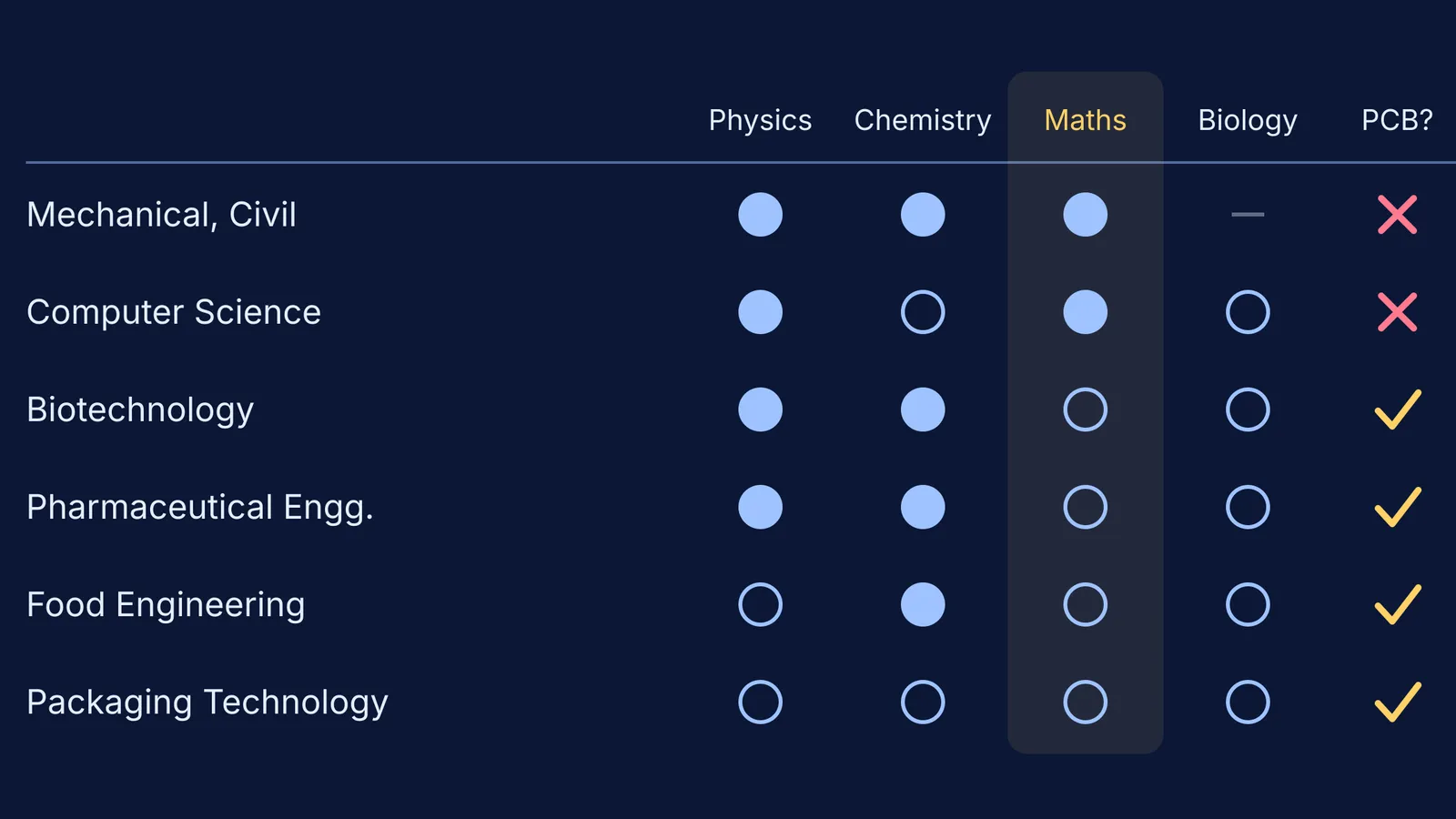
A branch-by-branch table in the same annexure then narrows it down. For a PCB student, it splits like this:
Open with PCB: Biotechnology and Pharmaceutical Engineering need Physics and Chemistry plus one of Biology, Biotechnology or Maths. Printing Engineering needs Physics and Chemistry plus any one subject from the list.
Open with PCB: Agriculture Engineering takes Physics and Chemistry (or the agriculture stream) plus Maths, Biology, Biotechnology or agriculture.
Open with PCB: Food Engineering, Leather Technology and Textile Chemistry need Chemistry plus any two subjects from the list; Packaging Technology and Fashion Technology have no fixed subject.
Not open without maths: Computer Science, Electrical and Electronics Engineering need Physics and Maths; Civil, Mechanical, Chemical, Aeronautical and most other core branches need Physics, Chemistry and Maths.
A worked example: say your Physics, Chemistry and Biology marks average 52%. You clear AICTE's 45% floor for biotechnology, but under AICTE's table you are not eligible for computer science at an approved college, however high your marks.
Will you have to study maths anyway?
Almost certainly. The AICTE handbook's branch table marks biotechnology, pharmaceutical, printing and agriculture engineering with a note: the first one or two semesters may be designed so that students with a biology or biotechnology background get adequate courses in maths, after which the class studies at the same level. For BTech in general, the handbook says universities will offer bridge courses such as mathematics, physics and engineering drawing for students from different backgrounds.
So you skip maths at entry, not in the degree. Expect to meet functions, calculus and equations early on, alongside classmates who studied them for two years. Our guide to what a BTech in genetic engineering covers is a useful next read if biotech is your target.
Entrance exams are the second gate. Paper 1 of JEE (Main), used for BE and BTech admission at NITs, IIITs, other centrally funded institutes and institutions funded or recognised by participating state governments, has 75 questions in Mathematics, Physics and Chemistry, with 100 of its 300 marks for maths, according to NTA's JEE (Main) 2027 Information Bulletin. The same bulletin tells candidates to satisfy themselves about eligibility for each institute, because NTA is responsible only for conducting the exam.
What should you check before applying?
Run this five-step check for every college on your list:
Find your branch in the college's prospectus for this year and copy the exact Class 12 subject line.
Note how it admits: a state entrance test, JEE (Main), its own test, or Class 12 marks. Write down whether that test has a maths section.
Ask whether a maths bridge course runs in the first year, whether it is graded, and whether it costs extra.
Confirm that the college and the course are AICTE-approved for the current academic year.
Ask how many students in last year's batch came in without maths, and how they did in first-year maths.
A script for the admissions call or email:
"I passed Class 12 with Physics, Chemistry and Biology, without Mathematics. Am I eligible for BTech in [branch] this year? Which entrance score or marks do you accept? Is there a maths bridge course in the first year, and is it graded? Please point me to the line in this year's prospectus."
Get the answer in writing, and keep it with your application.
Can you add maths after Class 12?
The JEE (Main) 2027 bulletin gives the example of a candidate who passed Class 12 with Physics, Chemistry and Biology in 2025 and then passed Mathematics in 2026; for JEE (Main), 2025 still counts as the passing year. Adding maths can open more branches, but it does not give you extra years of JEE (Main) eligibility.
Either way, start maths early. Work through Class 11 basics first: sets and functions, trigonometry, then limits and derivatives. The Fermi Concept Library gives each maths concept its own lesson and shows its place in the map, so you can see what comes before calculus. When a worked question goes wrong, the Fermi Problem Library has a step-by-step solver that explains the reasoning rather than printing an answer.
Still comparing engineering with other science routes? Read our parents' guide to PCB degrees beyond NEET and our look at biomedical engineering jobs in India.