

On this page
Your coaching batch is still on the second chapter. Your school unit test is in six weeks and covers four. You are not imagining the problem, and you do not have to wait. A slow class gives you time to preview what comes next, practise what you have done, and keep your school calendar in view.
Is it okay to study ahead of your coaching class?
Yes, and it can make the class itself more useful. When you have already met a chapter once, the lecture becomes your second pass, and you can spend it on the hard parts instead of copying definitions.
It also helps to try questions before you are taught. In a 2009 study, Richland, Kornell and Kao found that people who attempted questions before reading a passage scored better on a later test than people who simply got more time to read. This held across five experiments, even for the questions they had answered wrongly at first. Getting a preview question wrong is not wasted effort.
Preview, don't race: aim to stay about one chapter ahead, no more.
How do you preview a chapter before coaching teaches it?
Use the free NCERT textbooks for your class as the base. A preview fits into one short session:
Read the headings, the summary and the figures. Do not take notes yet.
Pick three questions from the end-of-chapter exercises and try them cold. Write down what you guessed.
Read the sections those questions need, then check your guesses.
Write two lines: what made sense, and one thing you want the teacher to explain in class.
If a term in the chapter rests on something you never really understood, such as vectors before kinematics, fix that first. The Fermi Concept Library has a lesson for every concept in physics, chemistry, biology, mathematics and computing, so you can patch one gap without opening a whole new book.
What extra problems should you do while you wait?
The chapters coaching has already finished are your practice ground. A large review of study methods by Dunlosky and colleagues (2013) rated two techniques as high utility: practice testing and spreading practice out over time. It rated rereading and highlighting as low utility.
So instead of rereading your notes, mix problems from two or three finished chapters in one sitting, and come back to each chapter every week or so. Our guide to why mixing problem types works has a ready plan for this.
When you get a problem wrong and cannot see why, look at the method, not just the answer. The Fermi Problem Library has worked problems with a step-by-step solver that explains the reasoning rather than printing an answer.
How do you keep school tests and coaching in step?
Plan backwards from the school date, not forwards from the coaching timetable. Here is a worked example.
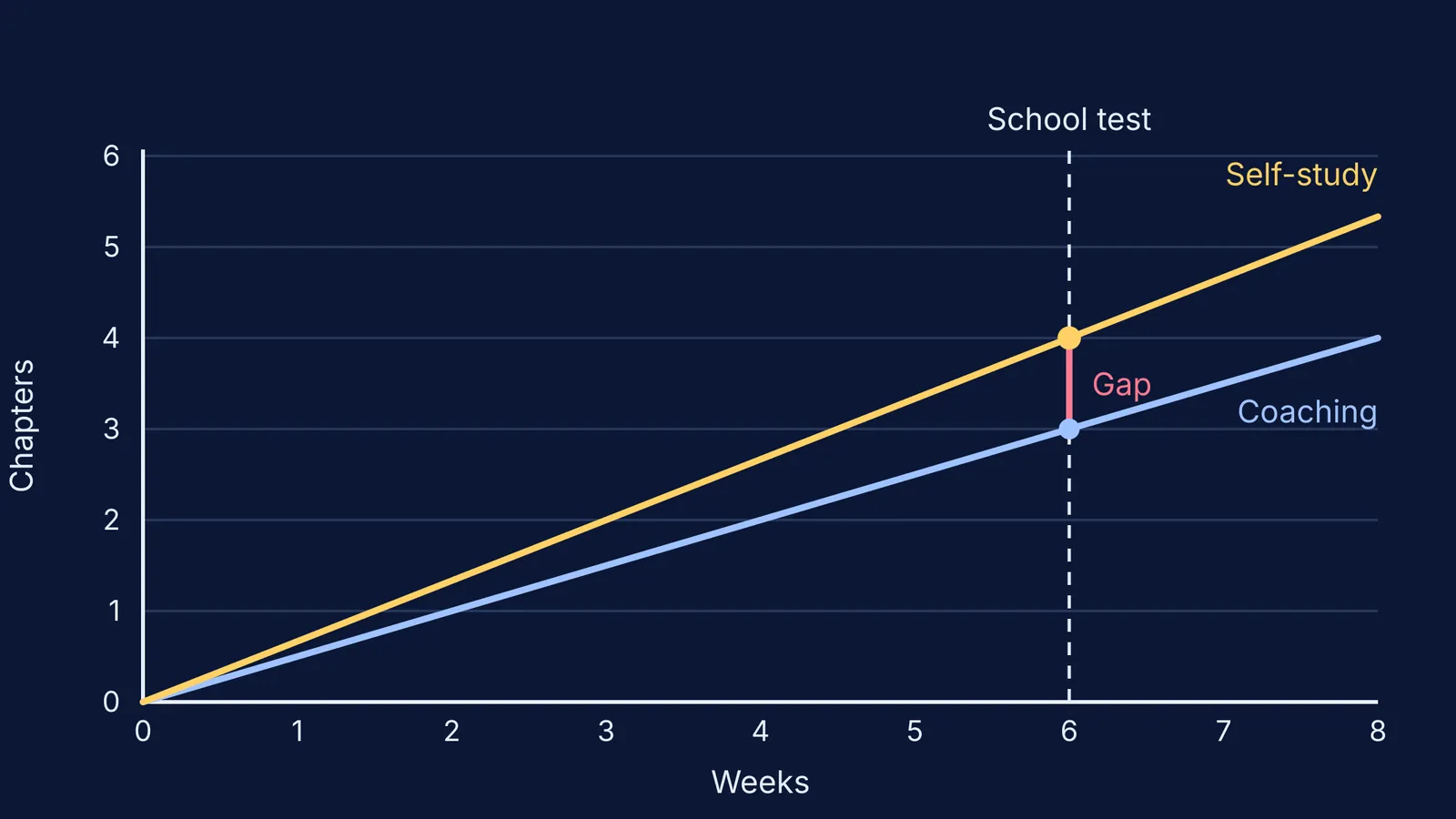
Say your coaching does about one physics chapter every two weeks. Your school test is six weeks away and covers four chapters. By test day, coaching will have reached three. You are one chapter short.
Chapters needed by the test: 4
Chapters coaching will cover: 3
Gap: 1 chapter
Your self-study pace: 4 chapters in 6 weeks, which is two chapters every three weeks
In practice, that is one preview session and one mixed-problem session a week, plus one extra session in weeks 4 and 5 to finish the fourth chapter from NCERT. If you want to run the numbers for a full syllabus, see how many chapters per day you need. If your school and coaching are on completely different chapters, read what to do when coaching and school teach different chapters.
If you find it hard to decide where to start each week, Fermi's AI tutor can work out what you already know and build a plan for the session, so you sit down to a clear next step.
Should you tell your coaching teacher or parents?
Yes. A teacher may not know your school test is coming. Keep it short and specific. You could say something like:
*"Sir, our school unit test on the 14th covers Laws of Motion, and we haven't started it here. Could you tell me which module questions to do first so I can prepare on my own?"*
For parents, show your Sunday check: a written gap and a plan are easier to discuss than a complaint.
The Tele MANAS number comes from the Ministry of Health and Family Welfare. Start small this week: pick the next chapter, try three questions cold, and write down the one thing you want explained.


