

On this page
If your school is teaching Motion in a Plane while your coaching class has moved on to Laws of Motion, you are not doing anything wrong. Many Class 11 and 12 students in India attend a school and a coaching institute that plan their year separately, so the two rarely move in step. Keep one list of active chapters and one set of notes per chapter, and use the gap on purpose.
Why do coaching and school teach different chapters?
Schools follow their board's curriculum and their own calendar of unit tests, practicals and term exams. Coaching institutes plan around entrance-exam timelines and often reorder chapters, teaching one early because later topics lean on it.
The trouble comes from three places: two sets of notes on one chapter that never meet, a coaching lecture that assumes something school has not taught yet, and too many chapters open at once.
Is it bad to learn the same chapter twice, weeks apart?
Usually it helps, because meeting a chapter again weeks later is a form of spaced practice. In a review of ten study techniques, Dunlosky and colleagues rated practice testing and distributed (spaced) practice as high utility, because both helped learners of different ages and abilities across many kinds of tests (Dunlosky et al., 2013). The same review rated interleaved practice, mixing problem types in one session, as moderate utility, and rereading as low utility.
Seeing questions before a lesson can help too. In five experiments, people who tried to answer questions before reading a passage did better on a later test than people given extra reading time, even on questions they first got wrong (Richland, Kornell and Kao, 2009).
The catch: the second pass helps most if you test yourself, not if you just listen or reread.
How do you keep one active chapter list?
On one page, or one note on your phone, list every chapter open anywhere right now. Give each one a tag:
C (coaching first): the school lesson becomes your revision pass.
S (school first): coaching will add harder problems on top.
B (both now): do one set of practice, not two.
N (next at school, not started anywhere): try five questions before the first lesson.
Keep new chapters few: if more than two are open in one subject, finish practice on the older one first. Update the list every Sunday.
How should you link school and coaching notes?
File notes by chapter, not by institution: one section per chapter that both classes write into.
Mark each block in the margin with S or C.
Add a short "differences" box: notation, sign conventions, and where the two teachers used different methods.
Copy mistakes from both classes into one error list for that chapter.
Before a school test, read the S blocks and the differences box first.
What does this look like in a real term?
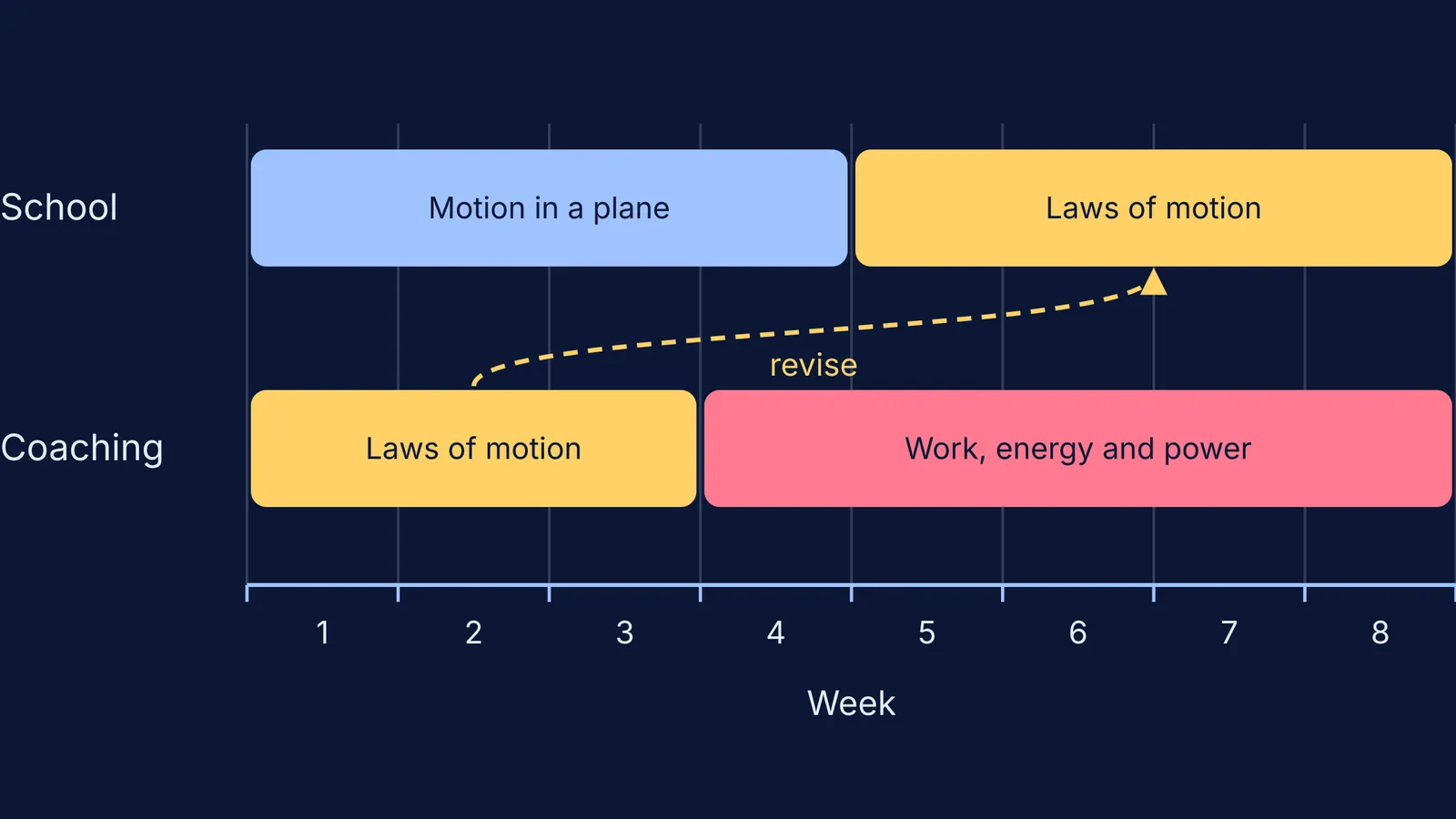
Say you are in Class 11. School teaches Motion in a Plane in weeks 1 to 4, then Laws of Motion in weeks 5 to 8. Coaching teaches Laws of Motion in weeks 1 to 3, then Work, Energy and Power.
Weeks 1 to 3: two new physics chapters at once. Laws of Motion needs resolving vectors, which school is teaching at the same time. If a coaching lecture uses an idea you have not met, look it up that evening. The Fermi Concept Library gives every concept its own lesson and its place in the map, so you can see what a chapter depends on.
Week 4: Laws of Motion moves to tag C. Once a week, do ten mixed questions from both chapters.
Weeks 5 to 8: school reaches Laws of Motion. Before each lesson, try the textbook exercise from memory, then use the class to fill gaps and note board-style derivations.
Mixing works in real classrooms too. Among 126 seventh-grade students practising maths over three months, mixed practice beat one-type-at-a-time practice on surprise tests one day and 30 days after a final review (Rohrer, Dedrick and Stershic, 2015).
If you sit down on Sunday unsure where to begin, Fermi's AI tutor can work out what you already know and build a plan for the session. See also our guides to balancing Class 12 boards with JEE preparation, clearing a chapter backlog and a 4-week spaced revision schedule.
What can you say to your teachers?
To your school teacher: "Our coaching covered Laws of Motion last month. When you teach it, could you tell me which derivations and diagrams the school exam expects?"
To your coaching teacher: "School is still teaching vectors. Is there a short section I should read before Thursday's class?"
If the double load leaves your child exhausted or anxious for weeks, talk to the school counsellor, or call Tele MANAS on 14416, the government's toll-free, 24x7 tele-mental health line (PIB).
This Sunday, write your active chapter list and tag each chapter C, S, B or N.


