

On this page
If organic chemistry in Class 11 felt like a pile of reactions you could not tell apart, you are not behind for good. Class 12 organic leans heavily on a small set of ideas from one Class 11 chapter. Rebuild those, then work a few mechanisms by hand.
Can you restart organic chemistry if Class 11 never made sense?
Yes, and the place to restart is NCERT Class 11 Unit 8, Organic Chemistry: Some Basic Principles and Techniques, often called GOC. Its stated objectives include understanding organic reaction mechanisms and explaining how electronic displacements affect structure and reactivity.
Class 12 assumes you have it. The NCERT Class 12 haloalkanes chapter opens nucleophilic substitution with “You have learnt in Class XI that nucleophiles are electron rich species.” If that sentence means nothing to you, go back to GOC before more Class 12 reading.
What should you relearn first in GOC?
Skip purification and quantitative analysis for now. These six ideas, all in NCERT Unit 8, carry most of the mechanism work:
Bond-line structures. Line ends and corners are carbons; you fill in the hydrogens.
Curved arrows. A curved arrow starts where an electron pair is and ends where it moves to. A half-headed “fish hook” arrow moves one electron.
Nucleophiles and electrophiles. A nucleophile brings an electron pair to a reaction site; an electrophile takes an electron pair away.
Inductive effect. A polar bond pulls electron density through neighbouring sigma bonds, and NCERT notes the effect becomes vanishingly small after three bonds.
Resonance and hyperconjugation. Both spread charge out. Hyperconjugation explains why carbocation stability runs tertiary > secondary > primary > methyl: (CH3)3C+ has nine C–H bonds that can help, while CH3+ has none that can.
Four reaction types. NCERT sorts organic reactions into substitution, addition, elimination and rearrangement.
For each idea, write one line in your own words and one example. Where you cannot, you have found a gap. The Fermi Concept Library gives each chemistry concept its own lesson and its place in the map, useful when one idea depends on another you skipped.
What does one mechanism look like with these ideas?
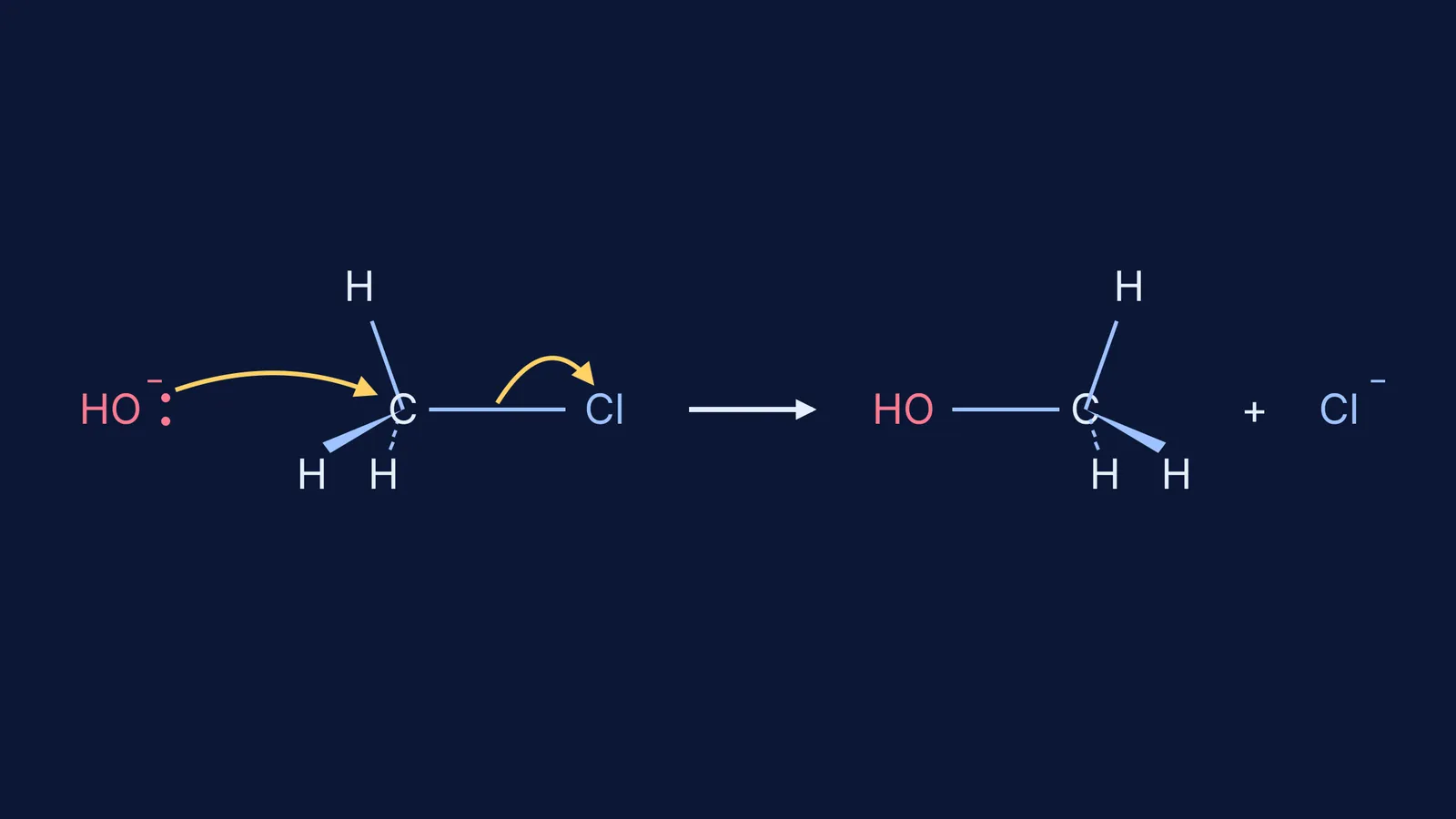
Here is SN2 from the Class 12 haloalkanes chapter, using the six ideas.
Find the electrophile. In CH3Cl, chlorine is more electronegative than carbon, so carbon carries a partial positive charge (idea 4).
Find the nucleophile. OH⁻ has lone pairs to donate (idea 3).
Draw the arrows. One arrow goes from an oxygen lone pair to the carbon, on the side opposite chlorine. A second goes from the C–Cl bond onto chlorine (idea 2).
Name the reaction type. One group replaces another, so it is substitution (idea 6).
Read off the consequences. NCERT describes a single step with no intermediate, a rate that depends on both reactants, and the carbon’s configuration inverted “much the same way as an umbrella is turned inside out.”
Predict the trend. Because the nucleophile must reach the carbon, methyl halides react fastest and tertiary halides slowest by SN2.
Then do the same for SN1, where carbocation stability (idea 5) takes over. Our guide on how to check the arrows in an AI-written mechanism is useful once you start writing your own.
How should you practise so organic sticks?
Close the book and write it out. In a 2006 study by Roediger and Karpicke, students who took recall tests on prose passages remembered more at 2 days and 1 week than students who restudied, even though restudying made them feel more confident.
Arrows deserve the most practice. A 2005 Journal of Chemical Education study of how graduate-level students propose mechanisms calls the curved-arrow formalism “one of the most vital skills in the organic chemist’s repertoire.”
If you get a product right but cannot say why, the Fermi Problem Library has worked problems with a step-by-step solver that explains the reasoning rather than printing an answer.
What does a three-week restart plan look like?
Fit this in alongside school with a short session each day.
Week 1: GOC. Ideas 1 to 4 above. Read one section a day, then write its definitions and two examples from memory.
Week 2: effects and reaction types. Resonance, hyperconjugation, the four reaction types, and the reactions NCERT says you meet next in Class 11 Unit 9.
Week 3: first mechanisms. SN2 and SN1 from the haloalkanes chapter, using the six-step routine. Draw every arrow yourself.
Every day: a few minutes of blank-page recall on yesterday’s topic before you start anything new.
After week 3, mix organic with physical and inorganic; see our guides on balancing physical, organic and inorganic chemistry and on building an interleaved practice plan.
If you are unsure where your gaps start, Fermi’s AI tutor can work out what you already know and build a plan for the session, so you sit down to a clear next step.


