

On this page
Chemistry rarely slips all at once. One branch slips first, and you notice only when a mock test shows it. Physical, organic and inorganic chemistry also ask for different kinds of work: physical is numericals, organic is reasoning about where electrons move, and inorganic is a large body of facts and trends. The plan below gives each branch its own time and its own method.
Why does one branch of chemistry always fall behind?
Often for two reasons: we drift towards the branch that feels comfortable, and we study the hard one in a way that feels productive but does little. A 2013 review of ten study techniques by John Dunlosky and colleagues rated practice testing and distributed (spaced) practice as high utility, and rereading and highlighting as low utility (Psychological Science in the Public Interest). Rereading the inorganic chapter of NCERT for the third time feels like work, but it is a low-utility technique.
Which study method suits each branch of chemistry?
For physical chemistry, use mixed problem sets. In an exam, a numerical does not tell you whether it is a mole concept, equilibrium or thermodynamics question. In a classroom study by Doug Rohrer and colleagues, 126 seventh-grade students practised the same maths problems over three months, either mixed by type (interleaved) or grouped by type (blocked), and the mixed group scored higher on a surprise test given 1 or 30 days later (Journal of Educational Psychology). That study was in maths, not chemistry, but physical chemistry numericals pose the same challenge of picking the right formula.
So study one worked example on a new topic, then solve problems on it, and end every session with two or three numericals from older chapters. Our guide to physical chemistry numericals and a practice plan for them lists the chapters to rotate through.
For organic chemistry, explain every arrow. The same review rated self-explanation and elaborative interrogation (asking yourself why a fact is true) as moderate utility (Dunlosky and colleagues). For organic, that means redrawing a mechanism on a blank page and saying, for each curved arrow, why the electrons move there. An arrow you cannot explain is your gap. See why organic chemistry rewards learning mechanisms, not lists.
For inorganic chemistry, test yourself, then space it out. In a study by Henry Roediger and Jeffrey Karpicke, students who were tested on a passage remembered more of it two days and one week later than students who reread it, even though rereading won on a test five minutes later (Psychological Science). Rereading also made students more confident. For inorganic, close the book, write down everything you remember about a block or a group of elements, then check NCERT and mark what you missed. More on learning inorganic chemistry with retrieval, not rote lists.
What does a balanced weekly chemistry timetable look like?
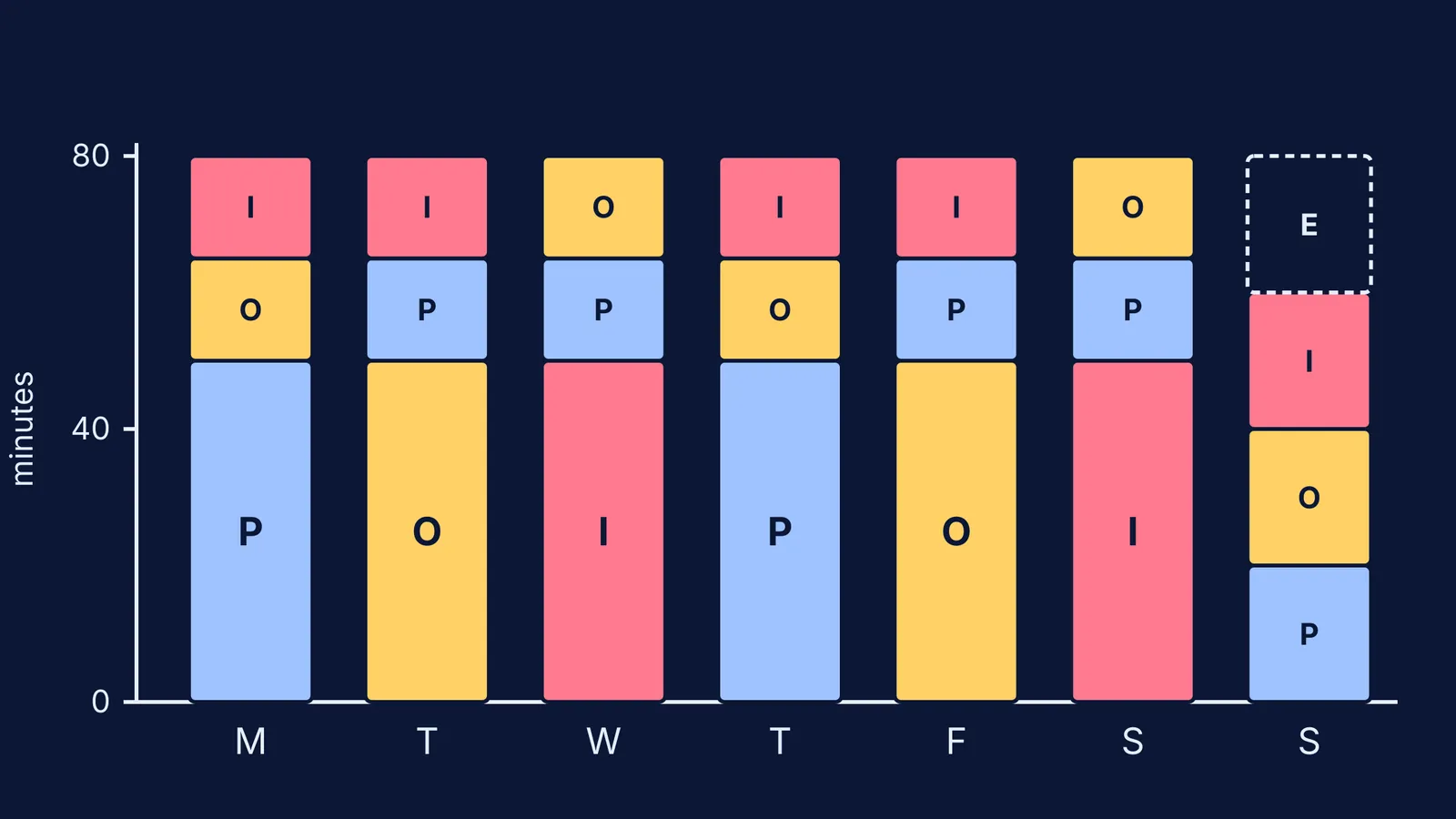
The plan spreads every branch across the week, because spaced practice is one of the two high-utility techniques in the Dunlosky review. It assumes about 80 minutes of chemistry self-study a day on top of school or coaching; scale it, but keep the shape. Each day has one 50-minute deep block and two 15-minute short slots.
Monday: physical deep block (worked example, then problems). Short slots: one organic mechanism from memory, one inorganic self-test.
Tuesday: organic deep block (new mechanisms, explained aloud). Short slots: two mixed physical numericals, one inorganic self-test.
Wednesday: inorganic deep block (blank-page recall, then NCERT check). Short slots: physical numericals, one organic conversion from memory.
Thursday: physical deep block. Short slots: organic, inorganic.
Friday: organic deep block. Short slots: physical, inorganic.
Saturday: inorganic deep block. Short slots: physical, organic.
Sunday: one mixed, timed set of 20 minutes per branch, then a 20-minute error log noting what went wrong and in which branch.
Add it up and each branch gets 180 minutes a week, and every branch is opened every day.
When a physical numerical goes wrong and you cannot see why, the Fermi Problem Library has worked problems with a step-by-step solver that explains the reasoning rather than printing an answer.
What if one branch is already behind?
Do not drop the strong branches to catch up. Rebalance instead:
For three weeks, turn two of your strongest branch's short slots into slots for the weak one.
Give the weak branch the Sunday error log first.
After three weeks, take one mixed test and compare your error log with week one's.
If the gap is a concept you never understood, rather than facts you forgot, more self-testing will not fix it. The Fermi Concept Library has a lesson for every concept in chemistry, so you can go back to the idea underneath. And if you do not know where to start, Fermi's AI tutor can work out what you already know and build a plan for the session.
Print the seven-day list, stick it above your desk, and tick each short slot as you do it.


