On this page
A take-home exam gives you the questions, your notes and a day or two to answer. It feels easier than a sit-down paper, but the marks usually go to argument and evidence, and the time pressure moves to your own calendar. Here is how to plan the hours, cite properly and keep the work your own.
Why is a take-home exam harder than it looks?
Take-home questions usually ask for analysis, not facts you could look up. A 2019 systematic review of research on take-home exams by Lars Bengtsson concluded that they may be the better choice for higher-level questions, because they promote higher-order thinking and allow time for reflection, but are not recommended for the lowest level, such as simple recall, because of the risk of cheating.
The second trap is preparing less. In a 2011 experiment by Pooja Agarwal and Henry Roediger, students told to expect an open-book test spent less time studying and did worse on a later closed-book test than students who expected a closed-book one. Notes only help if you already know what is in them, so revise as you would for any exam; our guide on how to study for an open-book exam covers that part.
How should you plan your time on a take-home exam?
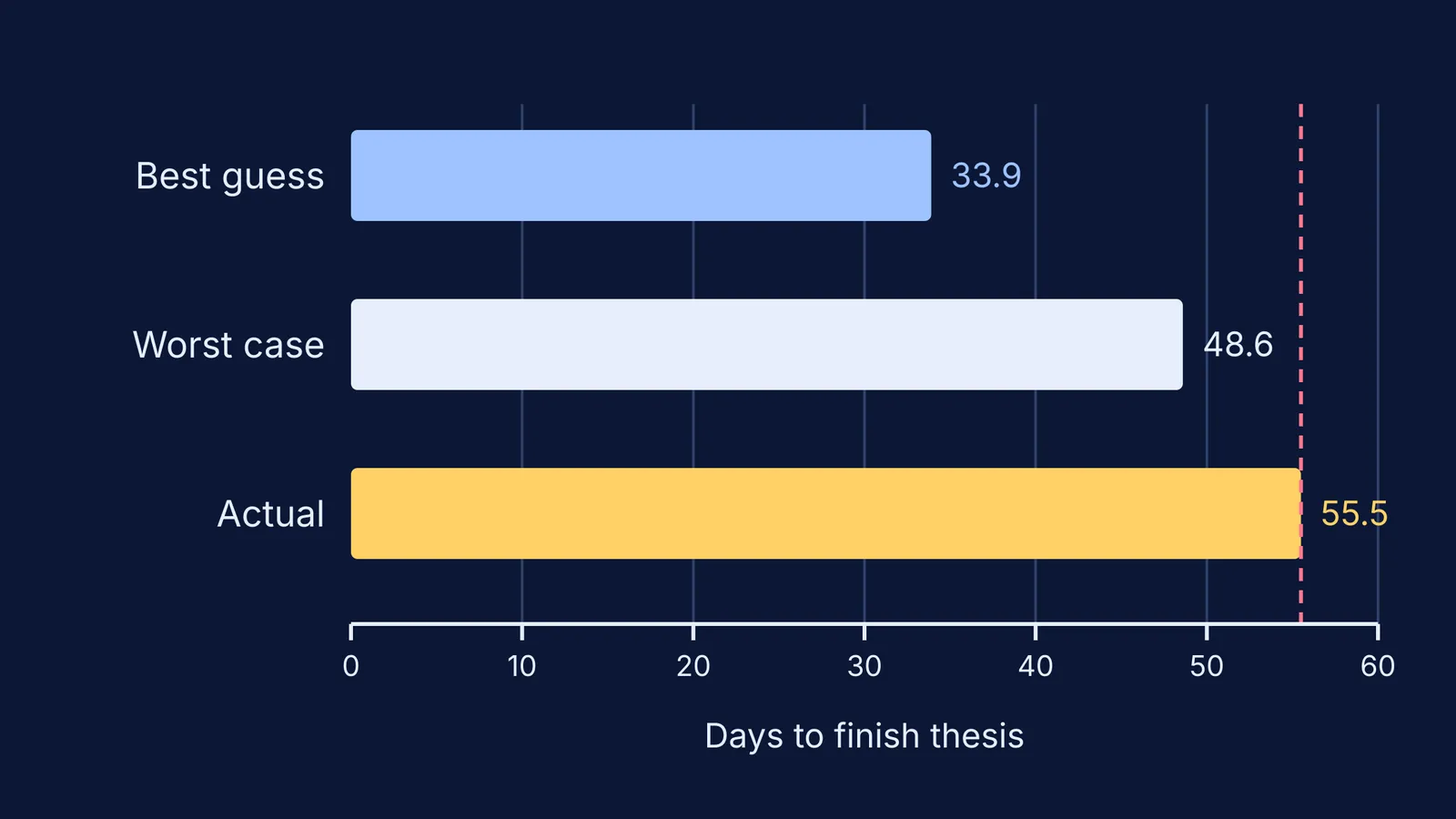
Assume it will take longer than you think. In a 1994 study of the "planning fallacy", Roger Buehler, Dale Griffin and Michael Ross asked psychology students in their final semester when they would finish their honours theses. Those who finished had predicted 33.9 days on average and took 55.5. Only 29.7% finished by their best guess, and even their average worst-case estimate, 48.6 days, was too short.
So plan backwards from the deadline. Here is a worked plan for a paper released at 10 am Friday and due at 10 am Sunday:
Friday, first hour: read every question, the word limits, the submission format and the rules on sources, discussion and AI tools. Write down anything unclear.
Friday, next two hours: outline each answer as a claim, two or three pieces of evidence, and the source for each.
Friday afternoon: draft the question worth the most marks while you are fresh.
Friday night: stop and sleep. An all-nighter on day one costs you day two.
Saturday morning: draft the remaining answers.
Saturday afternoon: a citation pass. Every quote, figure, diagram and borrowed idea gets a reference in your course's style.
Saturday evening: reread each answer against the exact wording of the question.
Saturday night: submit and check the upload opens. Sunday morning is your buffer for a dead laptop or slow portal.
How do you cite sources in a take-home paper?
India's University Grants Commission defines plagiarism as "the practice of taking someone else's work or idea and passing them as one's own" in its 2018 academic integrity regulations. They ask every institution to publish its own plagiarism policy on its website, and their formal similarity checks target theses and research papers, not assignments or answer scripts. So for a take-home paper, your college's policy and your instructor's instructions are the rules that apply.
A quick test while you write:
Copied the words? Put them in quotation marks and cite.
Took an idea, data, figure or method, even in your own words? Cite.
Would most people on the course know it without looking it up? Usually no citation needed.
Not sure? Cite. Over-citing costs little; the reverse can cost you the course.
For how similarity checks and penalties work in practice, read our piece on plagiarism in college assignments.
What does working independently mean on a take-home exam?
It usually means not discussing the questions with classmates, seniors or online forums until everyone has submitted, even just to "check an answer". Rules on AI tools differ by course. If they are not written in the paper or the course outline, ask before you start:
"Dear Professor (name), for the take-home exam in (course), may I use (lecture notes, library databases, an AI tool to check grammar)? If AI tools are allowed, how should I declare their use? Thank you, (your name and roll number)."
Keep the reply. If AI help is allowed, our guide to citing AI in a project shows how to declare it.
Fix shaky methods in the weeks before. If you keep picking the wrong approach on a type of problem, the Fermi Problem Library has worked problems with a step-by-step solver that explains the reasoning rather than printing an answer. During the exam, use only what your course allows.
What should you check before you submit?
Each answer does what the question asks, including words like "compare" or "evaluate".
Word limits and file format match the instructions.
Every source in the text is in the reference list, and the reverse.
Your name, roll number and any required honesty declaration are on the file.
If deadline stress is affecting your sleep or mood for more than a few days, talk to your college counsellor or call the free Tele MANAS helpline on 14416.