

On this page
What do oceanographers actually study?
Oceanography is the scientific study of the ocean's physical, chemical, biological, and geological processes, alongside interactions between the sea, atmosphere, and seafloor. According to the NOAA National Ocean Service, the discipline divides into four interconnected branches:
Physical oceanography examines fluid dynamics, surface currents, tides, waves, and thermohaline circulation. Physical oceanographers track how seawater transports heat, regulating monsoons and planetary climate. For ideas easier to see than read, the Fermi Simulation Lab provides interactive simulations exploring fluid motion and density gradients. This field builds on foundational work on planetary currents, including Wallace Broecker and the great ocean conveyor belt.
Chemical oceanography analyzes seawater composition, geochemical cycles, and the marine carbonate buffer. Marine chemists study how seawater absorbs anthropogenic carbon emissions, tracking acidification and nutrient dynamics.
Biological oceanography investigates marine life from photosynthetic phytoplankton that drive marine primary production to ecosystems surrounding deep hydrothermal vents.
Geological oceanography maps seafloor bathymetry, tectonic spreading ridges, and sediment cores recording climate history, rooted in breakthroughs like Marie Tharp's mapping of the ocean floor.
Despite the ocean driving climate and sustaining coastal economies, the UNESCO Global Ocean Science Report notes that an average of only 1.7% of national research budgets is allocated to ocean science worldwide. That same report shows expanding opportunities, with women comprising 39% of ocean science researchers globally.
Which science subjects lead into oceanography?
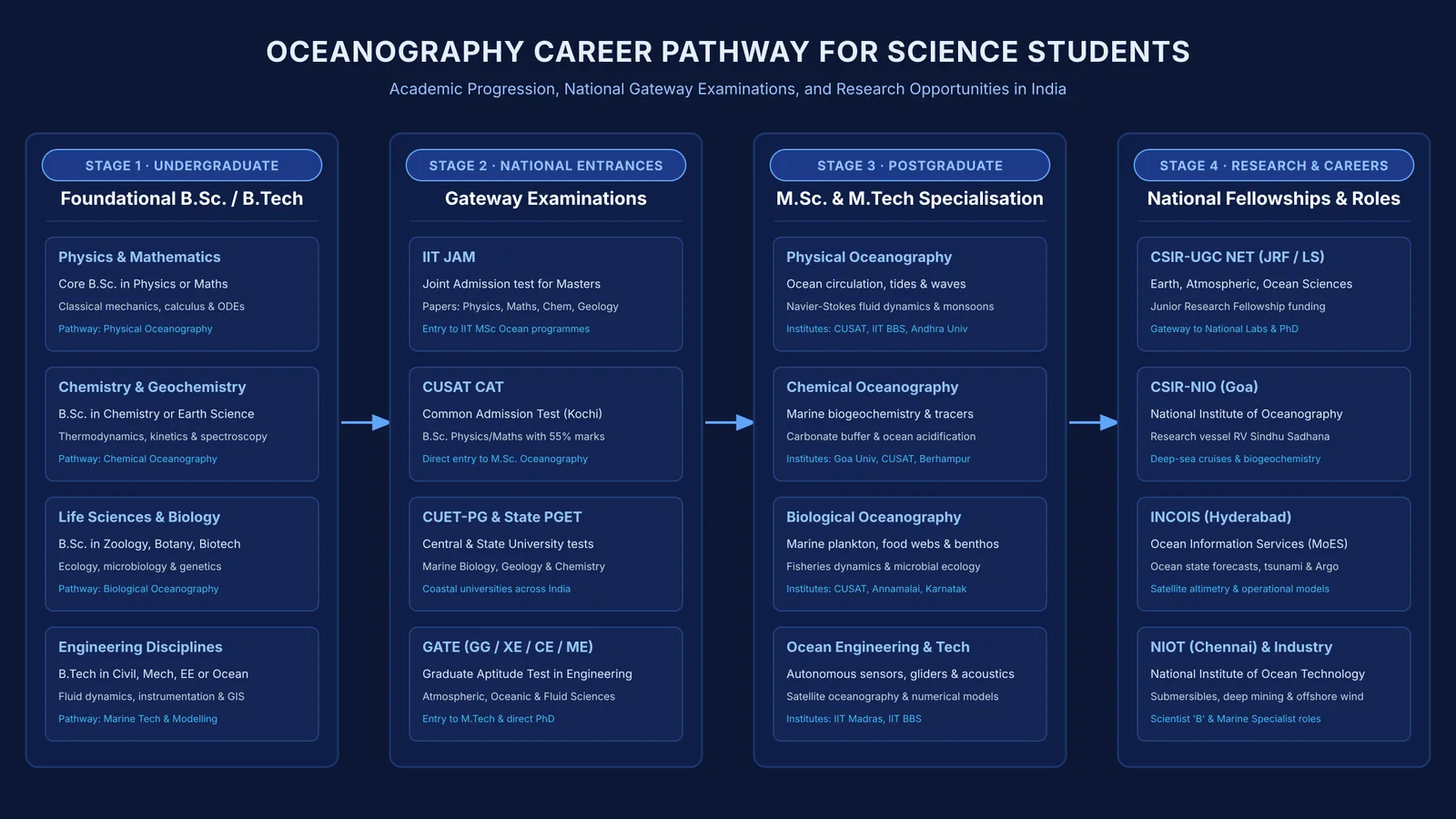
Oceanography is an interdisciplinary postgraduate science. High school and undergraduate students do not need a degree called oceanography; premier research institutes recruit students with solid grounding in foundational sciences.
If your strength is in physics and mathematics, physical oceanography and satellite meteorology offer direct routes applying Navier-Stokes equations, thermodynamics, and rotating fluid dynamics. When tackling pressure and flow concepts, our guide on avoiding common Bernoulli and fluid mechanics mistakes clarifies common pitfalls step by step.
Chemistry graduates move into marine biogeochemistry, while biology graduates study biological oceanography and marine food webs. For students bridging conceptual gaps across physics, chemistry, biology, or mathematics, the Fermi Concept Library offers lessons covering every core concept and its place in the map.
In India, master's programs provide structured entry into ocean sciences:
The Cochin University of Science and Technology (CUSAT) offers an M.Sc. in Oceanography requiring a B.Sc. in Physics or Mathematics with at least 55% aggregate marks.
The IIT Bhubaneswar School of Earth, Ocean and Climate Sciences admits science graduates through the Joint Admission test for Masters (JAM) into its M.Sc. in Atmosphere and Ocean Sciences.
Central and state universities also offer M.Sc. degrees in Marine Biology, Marine Geology, and Chemical Oceanography across coastal states.
What does oceanographic research and survey work look like?
Marine science links ocean-going expeditions with computational laboratory modeling. Researchers deploy autonomous sensor arrays, acoustic current profilers, and satellite radiometers to track the water column.
A central shipboard tool is the CTD rosette—an instrument array measuring conductivity, temperature, and depth surrounded by Niskin bottles collecting water samples. Oceanographers also monitor planetary circulation using robotic Argo floats, which descend to 1,000 metres, drift for nine days, sink to 2,000 metres, and record temperature and salinity profiles as they ascend.
In India, research cruises operate on dedicated vessels. The 80-metre research vessel *RV Sindhu Sadhana*, operated by the CSIR-National Institute of Oceanography (NIO), serves as a floating laboratory. During the Bay of Bengal Boundary Layer Experiment published in the Bulletin of the American Meteorological Society, researchers aboard the *Sindhu Sadhana* deployed gliders, CTDs, and drifters to map salinity barrier layers that modulate the South Asian monsoon.
How can Indian science students prepare for oceanography?
Entering oceanography requires building quantitative and computational rigor. Here is a practical roadmap for undergraduate science students:
Build a solid quantitative base: Emphasize calculus, differential equations, and mechanics. When tackling difficult fluid problems, the Fermi Problem Library provides worked problems with a step-by-step solver explaining the reasoning rather than just printing an answer.
Learn scientific programming early: Oceanography relies on data analysis. Learn Python, MATLAB, or R to process satellite datasets and Argo profiles, alongside geographic information systems (GIS).
Target national qualifying examinations: Prepare for postgraduate entrance tests like IIT JAM. For doctoral research and scientist posts at national laboratories, sit for the Joint CSIR-UGC NET in Earth, Atmospheric, Ocean and Planetary Sciences, guided by the CSIR-HRDG syllabus.
Apply for summer research internships: Seek fellowships at premier marine laboratories, including CSIR-NIO in Goa, the Indian National Centre for Ocean Information Services (INCOIS) in Hyderabad, and the National Institute of Ocean Technology (NIOT) in Chennai.
The ocean regulates Earth's climate and sustains the subcontinent. For science students, studying oceanography turns foundational physics, chemistry, and biology into active planetary stewardship.


