On this page
Many students prepare for NEET-UG only to realise midway through Class 11 or 12 that they would rather study engineering. Whether it is a newfound interest in coding, a desire to avoid the intense competition of medical entrance exams, or a fascination with how things are built, the shift is common. If you are a Physics, Chemistry and Biology (PCB) student wondering if you can still pursue a B.Tech, the answer is yes. Recent policy changes have opened up new paths to engineering, even if you dropped Mathematics in Class 11.
Can a PCB student do engineering in India?
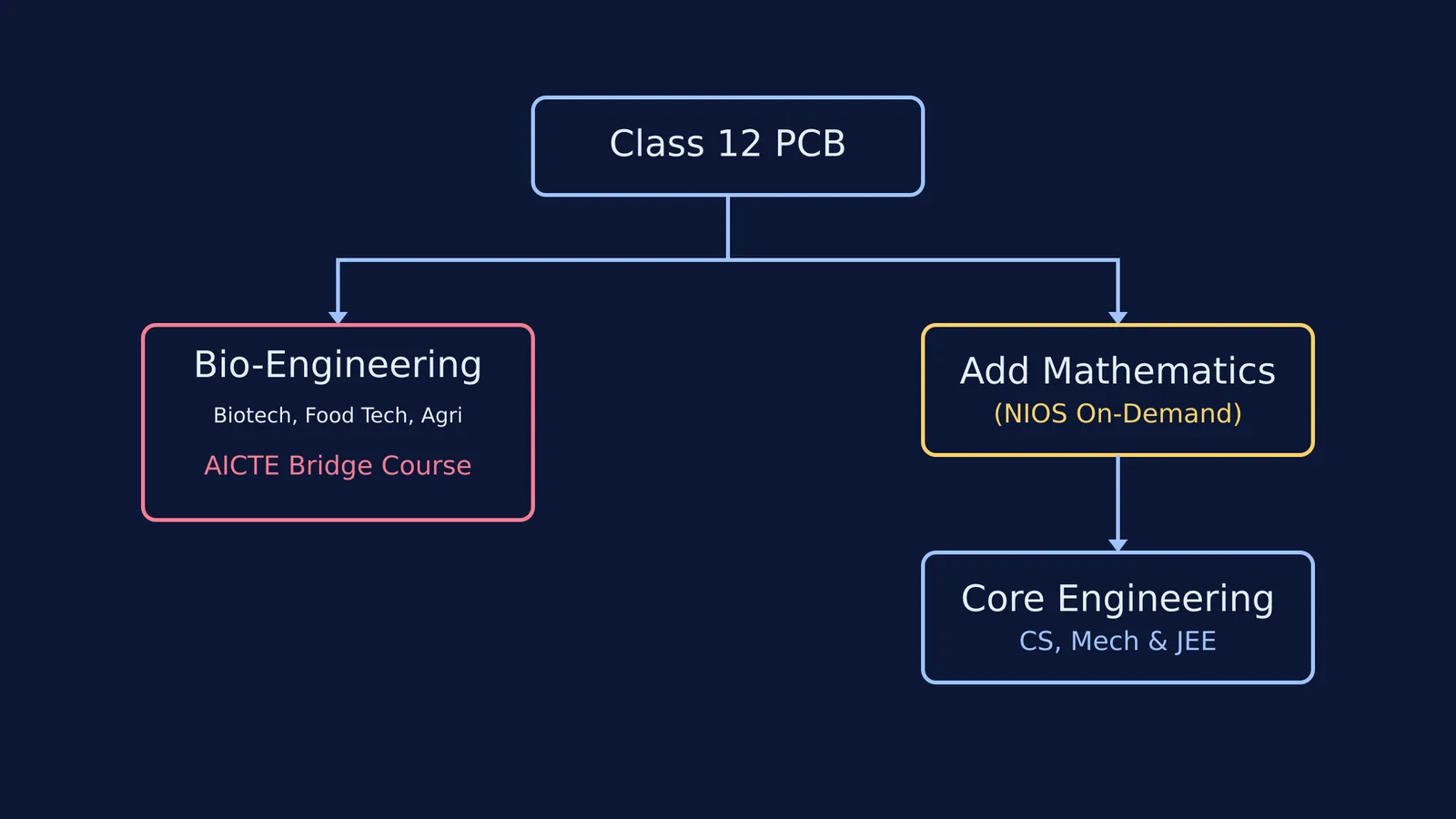
According to the AICTE Approval Process Handbook (2024-27), students who studied PCB in Class 12 are eligible for specific engineering branches without having studied Mathematics. The branches open to PCB students usually have a strong biological component. They include:
Biotechnology
Biomedical Engineering
Food Technology
Agriculture Engineering
If you enrol in one of these branches, the university will require you to complete a mandatory mathematics bridge course in your first year. This course covers the calculus, trigonometry and algebra you missed in Class 11 and 12, bringing your mathematical foundation up to the level required for engineering subjects. Without this foundational maths, subjects like fluid mechanics in biomedical engineering or process engineering in food technology would be impossible to grasp.
Catching up on two years of mathematics during your first semester of engineering is challenging. You will need to balance it with your regular college subjects. If you find studying calculus on your own difficult while catching up, Fermi's AI tutor can work out what you already know, build a plan for the session, and teach you step by step, writing out the mathematical reasoning just like a teacher at a board.
How to add Mathematics in Class 12?
If you want to study core engineering branches like Computer Science, Electronics or Mechanical Engineering, you will need Mathematics on your Class 12 marksheet. You can add it using the National Institute of Open Schooling (NIOS).
NIOS offers an On-Demand Examination (ODE) that allows you to sit for the Class 12 Mathematics exam and receive your results within 45 to 60 days. This provides a fast route for PCB students to qualify as PCM students for college admissions. However, if you are targeting JoSAA counselling for NITs and IITs, there is a catch. JoSAA often asks for a single consolidated marksheet showing all five subjects. Submitting your regular board's PCB marksheet alongside a separate NIOS Mathematics marksheet may lead to document rejection during counselling.
To avoid this, many students use the NIOS Transfer of Credit (TOC) facility. You can transfer the marks of up to two subjects (like Physics and Chemistry) from your original board to NIOS. You then appear for three remaining subjects (including Mathematics) through NIOS to get one unified marksheet. This method requires preparation, but it makes starting JEE prep in Class 12: a realistic monthly plan viable for students making a late switch.
What are the routes for PCMB students?
If you took Physics, Chemistry, Mathematics and Biology (PCMB) in Class 11, the switch is straightforward. You are already eligible for all engineering branches and entrance exams, including JEE Main, JEE Advanced, BITSAT and state-level CETs.
Since your syllabus was split across four heavy subjects, you might find gaps in your mathematics or physics problem-solving speed compared to PCM-only students. Medical preparation focuses heavily on biology and speed-solving pattern-based physics questions, whereas JEE demands deep, multi-step problem solving in mathematics and physics. You can use the Fermi Concept Library to catch up on specific chapters you missed while focusing on biology, ensuring you understand the core principles before tackling harder JEE problems.
How should you plan your switch to engineering?
When switching from medicine to engineering, a structured approach saves time and keeps your options clear:
Choose your branch: If you want biotechnology, agriculture or what is the environmental engineering branch?, you can apply directly to private universities using your PCB marks. Look at the specific course syllabus to ensure it matches your interests.
Check the bridge course: Confirm that the university offers the AICTE-mandated mathematics bridge course in the first year. Ask the admissions office how the course is structured and whether its marks affect your final CGPA.
Decide on core branches: If you want Computer Science or Mechanical Engineering, register for the NIOS On-Demand Examination to add Mathematics to your Class 12 qualification. Begin studying the Class 11 and 12 mathematics syllabus immediately.
Plan for JEE: If your goal is an NIT or IIT, apply for fresh admission in NIOS using the Transfer of Credit (TOC) facility to get a single marksheet with five subjects. Ensure you complete this process well before the JEE Main registration window opens.
Switching streams is a big decision, but it does not mean your time spent studying biology is wasted. Modern engineering increasingly intersects with biology, whether through bioinformatics, medical devices, or agricultural technology. Whether you choose biotechnology directly or decide to take the NIOS route to computer science, your PCB background offers a valid path to an engineering degree.