On this page
If you are searching for how to pick questions in NEET Section B, know this first: Section B no longer exists. The skill it taught, reading ahead and starting with the questions you are surest of, still matters. You now use it to decide the order you answer in.
Does NEET still have Section B in 2026?
No. When NTA announced the NEET-UG 2025 pattern, it said the provision for optional questions, introduced temporarily during the COVID-19 pandemic, would no longer be available, as Medical Dialogues reported.
The NEET-UG 2026 Information Bulletin says the paper "will consist of 180 compulsory questions which must be attempted by the candidates in 180 minutes": 45 in Physics, 45 in Chemistry and 90 in Biology.
Under the old format, each of the four subjects (Physics, Chemistry, Botany and Zoology) had a Section A of 35 questions and a Section B of 15, of which you could attempt any 10, and the exam lasted 3 hours 20 minutes (Medical Dialogues, NEET 2024 pattern). Older mock papers and guides still use that format, so check the year before you practise from one.
Always read the current bulletin on neet.nta.nic.in before your exam.
How should you choose questions in NEET now?
The 2026 bulletin gives 180 questions in 180 minutes, so you have one minute per question on average. Some biology questions take seconds; some physics numericals take several minutes. The aim is to stop slow questions eating the time you need for fast ones.
Do it in three passes:
First pass: sure questions. Read each question once. If you know the answer, or can work it out in about a minute, answer it and fill the OMR bubble. If not, note its number and move on.
Second pass: marked questions. Go back to the questions you noted. Some may feel easier now that you have warmed up and banked the sure marks.
Third pass: the hardest few. Work on these only once everything else is done. Try to rule out options rather than solve from scratch.
Here is how it could look for a student who is strong in biology. They do a first pass of Biology in about 70 minutes, then Chemistry in about 40 and Physics in about 40. That leaves about 30 minutes for the second and third passes. Your own order should come from your mock tests, not from a topper's video.
Should you guess on a NEET question you are unsure of?
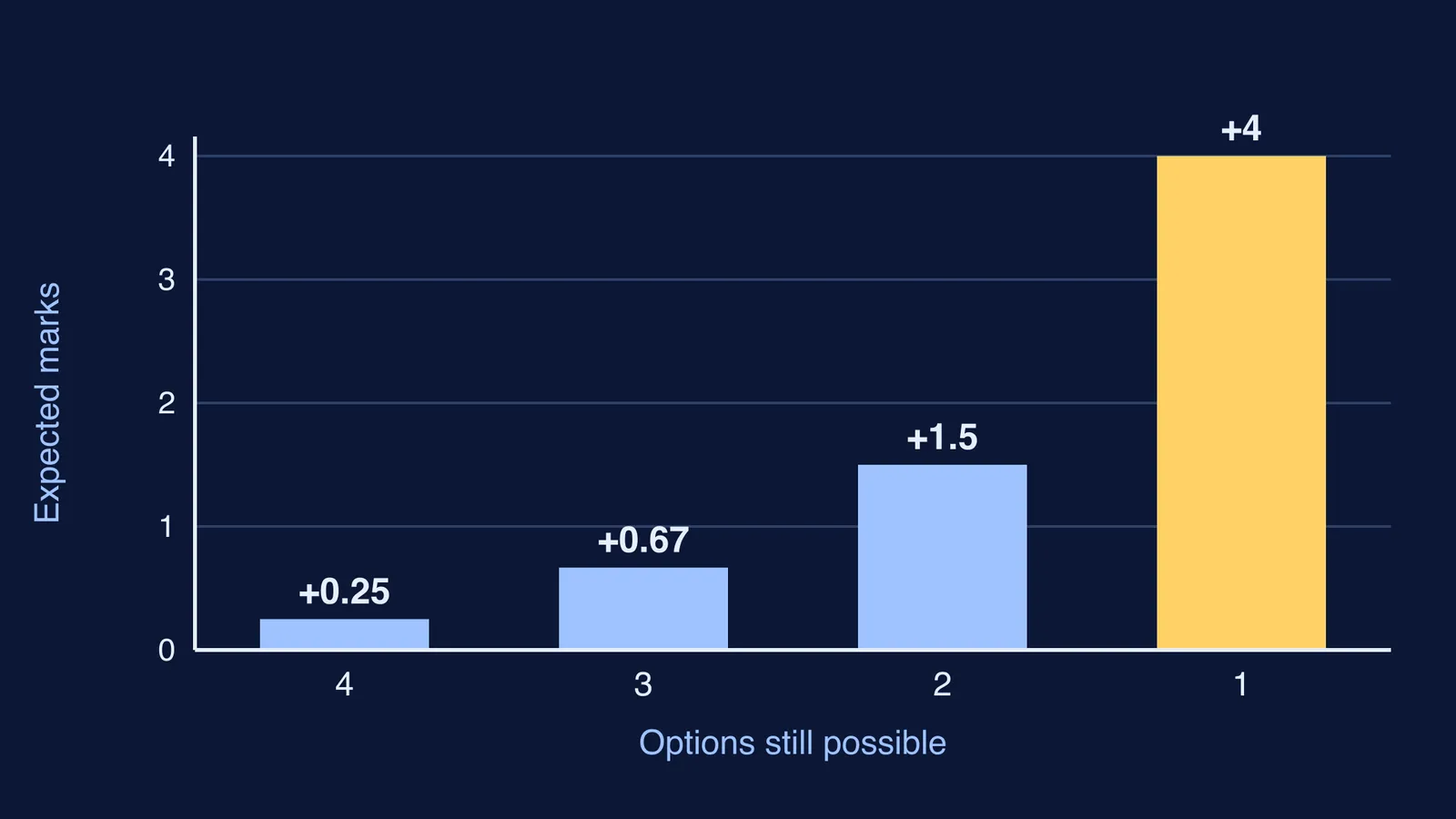
The bulletin's marking scheme is +4 for a correct answer, −1 for a wrong one and 0 for a question left blank (NTA, NEET-UG 2026 Information Bulletin). From that scheme you can work out what an answer is worth on average, depending on how many options you have ruled out:
No options ruled out (1 in 4 chance): on average +0.25 marks, but a quarter of these guesses earn 4 and the rest lose 1.
One option ruled out (1 in 3 chance): on average about +0.67 marks.
Two options ruled out (1 in 2 chance): on average +1.5 marks.
A blind guess barely pays and adds risk. Once you can honestly rule out two options, answering is clearly worth it.
Should you change an answer when you go back?
In a 2007 study in BMC Medical Education, Daniel Bauer, Veronika Kopp and Martin Fischer followed 79 third-year medical students in Munich through a multiple-choice exam. Their answer changes went from wrong to right far more often than from right to wrong: on average, 48.2% of a student's changes went from wrong to right, 21.6% from right to wrong and 30.2% from one wrong answer to another. The authors conclude that students should be told about the benefits of changing an answer once when in reasonable doubt. We would read reasonable doubt as a specific reason, such as a misread "not" or a units error, rather than a vague feeling.
How do you practise this before exam day?
Do your mock tests in the real exam format, with the clock running and an OMR sheet. Our guide on practising in the exam format for JEE and NEET explains why. After each mock, sort every question you noted into one of three groups:
Concept gap: you did not know the idea. Revise it from NCERT, or look it up in the Fermi Concept Library, which covers every concept in physics, chemistry and biology.
Wrong method: you knew the topic but your approach went wrong. Work through similar questions in the Fermi Problem Library, which has a step-by-step solver that explains the reasoning.
Time trap: you could solve it, just not quickly. Note the type so you skip it sooner next time.
Parents can help by keeping exam week calm; see our guide to NEET exam day rules for parents.
Exam nerves are common. If worry is affecting your sleep or eating, talk to someone you trust, or call Tele MANAS, the Health Ministry's free, round-the-clock helpline, on 14416.
If this is a repeat attempt, read our piece on handling last-attempt pressure at NEET. Then plan your next mock around the three passes.