

On this page
Biology is half of NEET-UG. The NTA information bulletin for NEET (UG)-2026 lists 90 biology questions (botany and zoology) out of 180, worth 360 of 720 marks, all multiple choice with four options and one correct answer. The same page gives 180 minutes for the paper, so about one minute per question. That makes biology a daily-habit subject: small, steady, every day.
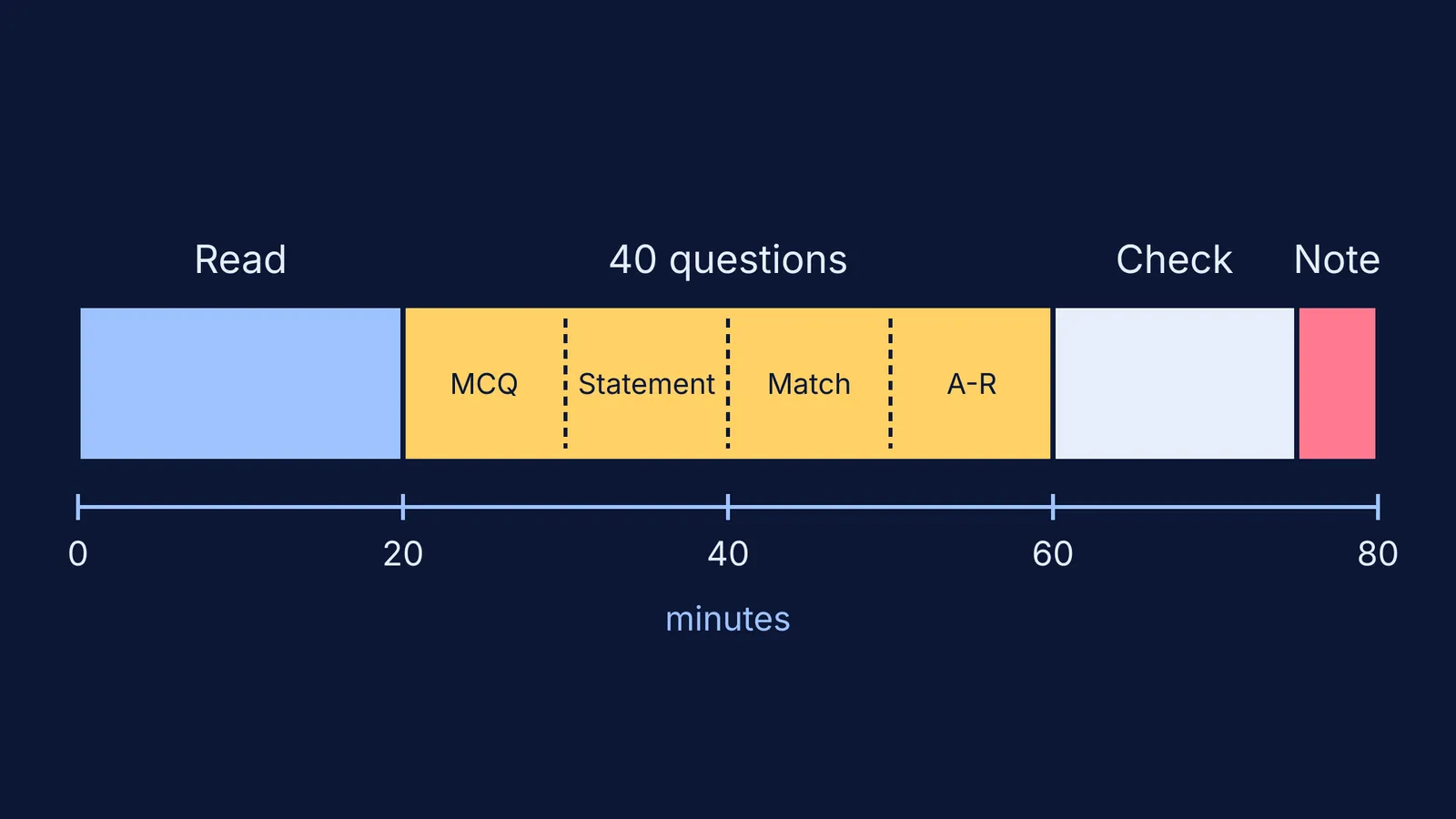
Here is a routine of about 80 minutes that you can run six days a week.
Why practise questions instead of rereading NCERT?
Rereading feels productive, but it is a weak way to remember. A review of ten study techniques by Dunlosky and colleagues (2013) rated practice testing and distributed (spaced) practice as “high utility” and rereading and highlighting as “low utility”.
In Roediger and Karpicke's 2006 experiments, students who took recall tests on a prose passage remembered more of it two days and one week later than students who reread it, even though rereading made students feel more confident. On a test after just 5 minutes, rereading won. That is the trap: rereading wins today and loses by the exam.
So NCERT stays the source, but the questions do the learning.
How to practise NEET biology questions daily: the 80-minute plan
Read one NCERT section (20 minutes). One numbered section, not a chapter. Read it once, slowly, with diagrams and tables. Close the book.
Answer 40 questions on it (40 minutes). One minute each, the pace the bulletin implies. Mix four formats, 10 of each (below). No book, no answers yet.
Check and read the explanations (15 minutes). Mark each one right or wrong. For every wrong answer, find the exact NCERT line that settles it.
Write the error note (5 minutes). Stop at five minutes. The note is a log, not new notes.
On the seventh day, do no new section. Redo only the questions you got wrong that week, mixed together.
For step 1, our guide to annotating NCERT margins shows what to mark as you read.
Which question formats should the 40 include?
All four can be written as four-option questions with one correct answer, the format the bulletin sets, and each tests a different kind of knowing:
Direct MCQ (10): one fact or definition. Tests recall.
Statement-based (10): “Which of the statements are correct?” Tests whether you know every line, not just the main idea.
Match the columns (10): pairs of terms, examples or functions. Tests whether you can tell close neighbours apart.
Assertion-reason (10): a claim plus a “because”. Tests whether you know why, not just what.
Mixing types and topics is called interleaving. Dunlosky and colleagues rated it “moderate utility”: promising, though the evidence for it was still limited. Once you have done a few sections, swap 10 of the 40 for older sections. Our interleaved practice plan shows how to build that mix.
What goes in a five-minute error note?
Janet Metcalfe's 2017 review “Learning from Errors” reports that, in experiments, making errors followed by corrective feedback helps learning. Errors made with high confidence are corrected more readily than low-confidence ones, and corrective feedback, including analysis of the reasoning that led to the mistake, is crucial. So the note records confidence and cause, not just the right answer.
One line per wrong answer, in this shape:
Q number and format (for example, 14, statement)
Confidence before checking: sure, half-sure or guess
Cause: didn't know the fact, mixed up two terms, misread “not” or “incorrect”, or knew it but ran out of time
The fix in eight words or fewer, with the NCERT page
What does one day's error note look like?
Say today's section is Mendel's monohybrid cross in Class 12, Principles of Inheritance and Variation. You score 31 out of 40. Your note shows six “mixed up two terms” errors, four of them confusing genotype with phenotype in match-the-column questions, and two “sure but wrong” assertion-reason answers.
That tells you exactly what to do tomorrow: start with the two sure-but-wrong items, because those are the beliefs to fix. Then redo the match-the-column set before the new section. Your score is not the lesson. The pattern is.
When the same concept keeps appearing in your error log, the gap is understanding, not memory. The Fermi Concept Library has a lesson for every concept in biology, so you can rebuild one idea before trying the questions again.
How do you know the routine is working?
Look at the weekly redo, not the daily score, which swings with each section's difficulty. On day seven, count how many of the week's wrong answers you now get right, and which cause shows up most. If “misread” leads, slow down on negatives. If “didn't know” leads, read more slowly in step 1.
Every few weeks, a full mock shows whether the routine carries over to exam conditions. Our guide to NEET mock analysis for biology errors shows how to read those results, so the mock and your daily log point at the same weak spots.
Start tonight with one section and 40 questions.


